Ayutthaya’s Historic City, inscribed since 1991, was the second capital of the Kingdom of Siam and one of the largest cities in the world in the seventeenth century — a city of one million people with hundreds of temples — before the Burmese army destroyed it in 1767. Sukhothai, Siam’s first capital, is 300 kilometres north; Bangkok, the capital built to replace Ayutthaya, is 80 kilometres south.
Historic City of Ayutthaya: The Sacked Siamese Capital City centre
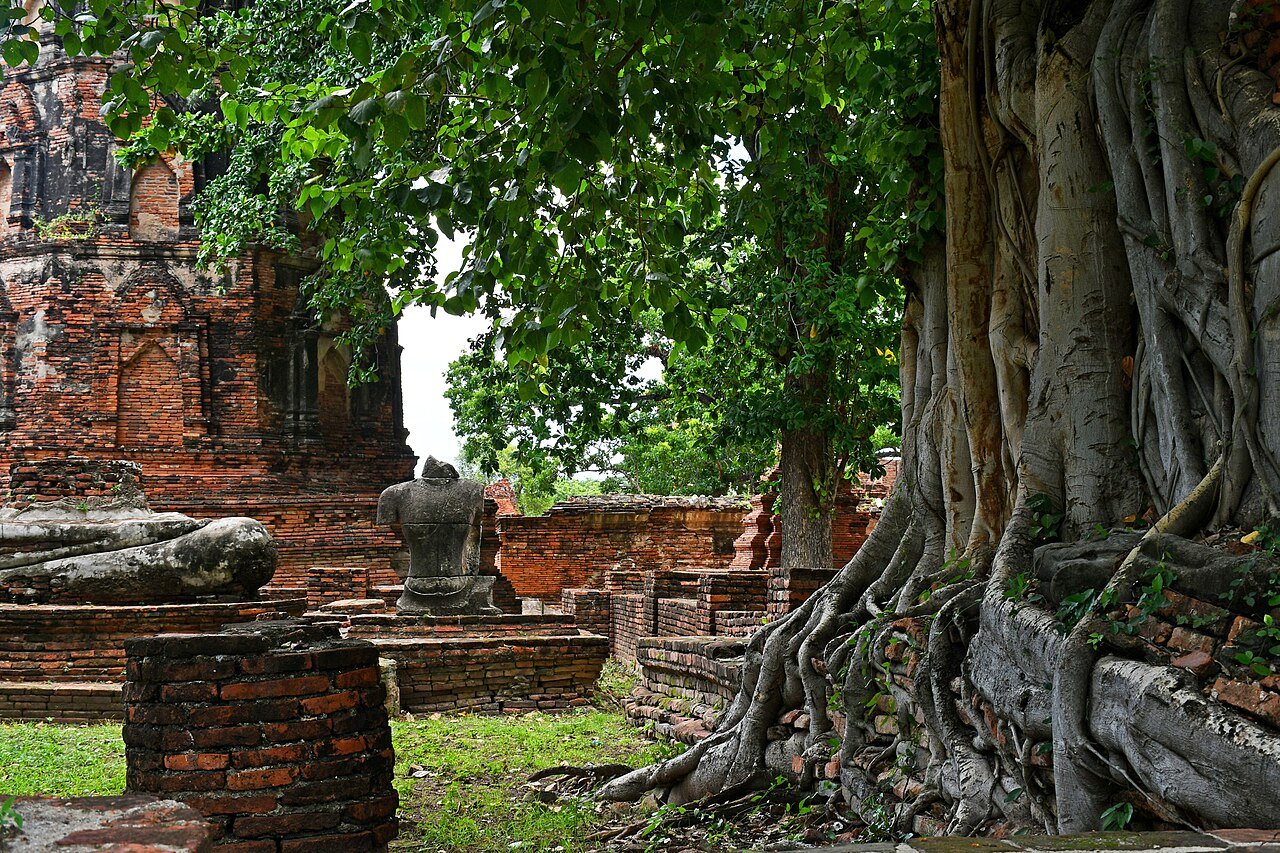
The Historic City of Ayutthaya, inscribed in 1991 under criterion (iii), was the capital of the Kingdom of Siam from 1350 to 1767 CE — 417 years — during which it became the principal city of mainland Southeast Asia and a major trading port visited by merchants from China, Japan, Persia, India, Portugal, Holland, France, and England. At its height in the seventeenth century, Ayutthaya had a population estimated at one million and contained more than 400 temples; the royal palace occupied the central island formed by three rivers (the Lopburi, Pridi, and Chao Phraya), ringed by a wall 12 kilometres long. In 1767, the Burmese army of King Hsinbyushin sacked the city, melted down the gold from the Buddhas, burned all wooden buildings, and enslaved most of the population; the Siamese court relocated to Thonburi and then to Bangkok. What remains — Wat Phra Sri Sanphet (the royal chapel, whose three chedis held the ashes of three Ayutthaya kings), Wat Mahathat (where a Buddha head is famously enclosed in the roots of a banyan tree), and Wat Ratchaburana (with its intact crypt containing Ayutthaya-era artifacts) — are brick ruins of a scale that conveys the city’s original grandeur.
Historic Town of Sukhothai: The First Siamese Capital 🚌 ~5 hrs north by bus
Historic Town of Sukhothai and Associated Historic Towns, inscribed in 1991 under criteria (i), (iii), and (iv), is the first capital of the Kingdom of Sukhothai (1238–1438 CE) — the founding city of Thai civilisation, where the Thai script was invented in 1283 CE by King Ramkhamhaeng. The inscribed historic park contains 193 monuments within 70 square kilometres — wats (temples), royal palaces, and reservoirs whose engineering adapted to the seasonal flooding of the Yom River plain. Wat Mahathat, the royal temple at the centre of the historic city, contains a famous walking Buddha (in the Sukhothai style, the most graceful form of Thai Buddhist sculpture) set in a pranang chamber of lotus-bud chedis. Sri Satchanalai, a companion town 60 kilometres north, is inscribed in the same property and is less visited — its hilltop temples and intact city walls give a better sense of the Sukhothai urban form.
Bangkok: Wat Phra Kaew and the Grand Palace 🚂 ~1.5 hrs south by train
While Bangkok has no UNESCO inscription (a proposed inscription for the Rattanakosin historic district remains under consideration), its Temple of the Emerald Buddha (Wat Phra Kaew) within the Grand Palace complex is the most sacred site in Thailand — a fourteenth-century jade figure of the Buddha in a golden throne room, dressed in three seasonal costumes changed by the King at the solstices and equinox. The Grand Palace (begun 1782 by King Rama I after the founding of Bangkok) is an ongoing architectural project of the Chakri dynasty, still the official royal ceremonial centre. Wat Pho, the temple of the Reclining Buddha (46 metres long, 15 metres high, in gold mosaic) adjacent to the palace, is Thailand’s oldest royal temple and contains the first traditional medicine school in Thailand — massage therapy is still taught and practiced there. The Wat Arun (Temple of Dawn) across the Chao Phraya, its central prang encrusted in Chinese porcelain fragments, completes the riverside monument circuit.
Phimai and the Khmer Temples of the Khorat Plateau 🚗 ~3 hrs northeast
Phimai Historical Park in Nakhon Ratchasima province preserves the most important Khmer temple complex in Thailand — a sandstone sanctuary built between the eleventh and twelfth centuries CE as the terminus of the Royal Road from Angkor, connected by a straight ceremonial avenue of laterite blocks running 225 kilometres to Angkor Thom. Phimai Prasat, with its central prang, galleries, and gopuras in white sandstone, was originally oriented toward Angkor rather than toward the east (unlike most Khmer temples), affirming its status as a provincial capital of the Angkor Empire. The National Museum at Phimai holds one of the finest collections of Khmer sculpture in Thailand, including the portrait statue of Jayavarman VII that is the companion piece to the Angkor Thom Bayon faces.
Practical information
Ayutthaya is 80 kilometres north of Bangkok and reached by frequent trains from Bangkok Hua Lamphong or Bang Sue (1.5 hrs) or by expressway bus (2 hrs). The historical park is best explored by bicycle (rentable at the Ayutthaya train station) or by tuk-tuk; the main temple ruins are spread over 3 kilometres. Sukhothai is served by overnight bus from Bangkok (7 hrs) or by connections from Phitsanulok airport (30 mins from Sukhothai). The best time to visit is November–March; the Loi Krathong festival (full moon in November) at Sukhothai, where the Historic Park’s ruins are lit by candlelight and floating lanterns, is the most beautiful heritage event in Thailand.
Frequently Asked Questions
Is Ayutthaya a UNESCO World Heritage Site?
Yes. The Historic City of Ayutthaya was inscribed in 1991 under criterion (iii). The inscription covers the ruins of the former Siamese capital on the island formed by three rivers — the historic park containing more than 40 sites of royal temples, palaces, and urban infrastructure from the 417-year period of Ayutthayan rule.
Why was Ayutthaya destroyed?
The Burmese army under King Hsinbyushin of the Konbaung dynasty sacked and burned Ayutthaya in April 1767, after a 14-month siege. The destruction was the conclusion of long-running conflict between the two kingdoms over control of mainland Southeast Asia’s trade routes; the Burmese melted down the city’s Buddha images for gold, burned the wooden structures, and forced an estimated 30,000 Siamese into slavery in Burma. The Siamese state reorganised under King Taksin at Thonburi and subsequently under King Rama I at Bangkok.
Can you do Ayutthaya as a day trip from Bangkok?
Yes. Trains from Bangkok Hua Lamphong or Bang Sue depart regularly from 6 a.m.; the journey takes 1.5 hours. With 6–7 hours on site (by bicycle or tuk-tuk covering the main temple groups), you can see Wat Phra Sri Sanphet, Wat Mahathat, Wat Ratchaburana, and Wat Chaiwatthanaram before the last train back to Bangkok in the evening. A full day is recommended; an overnight stay allows the sunset light at Wat Chaiwatthanaram.
Sources
- S1 — Baker, Chris, and Pasuk Phongpaichit. A History of Ayutthaya: Siam in the Early Modern World. Cambridge University Press, 2017. ISBN 978-1-107-19076-4.
- S2 — Wyatt, David K. Thailand: A Short History. Yale University Press, 2003. ISBN 978-0-300-08440-5.
Spotted an error? Write to editorial@culturalheritageonline.com and we correct it the same day.