Bruges is the best-preserved medieval commercial city in northern Europe — a trading capital whose canals, Belfry, and cloth halls document the peak of Flemish textile wealth in the fourteenth and fifteenth centuries. The Grand-Place of Brussels, the Flemish Béguinages, and the Plantin-Moretus printing house in Antwerp extend a Belgian heritage itinerary that covers medieval commerce, religious life, and the birth of European print culture.
Historic Centre of Bruges: The Venice of the North City centre
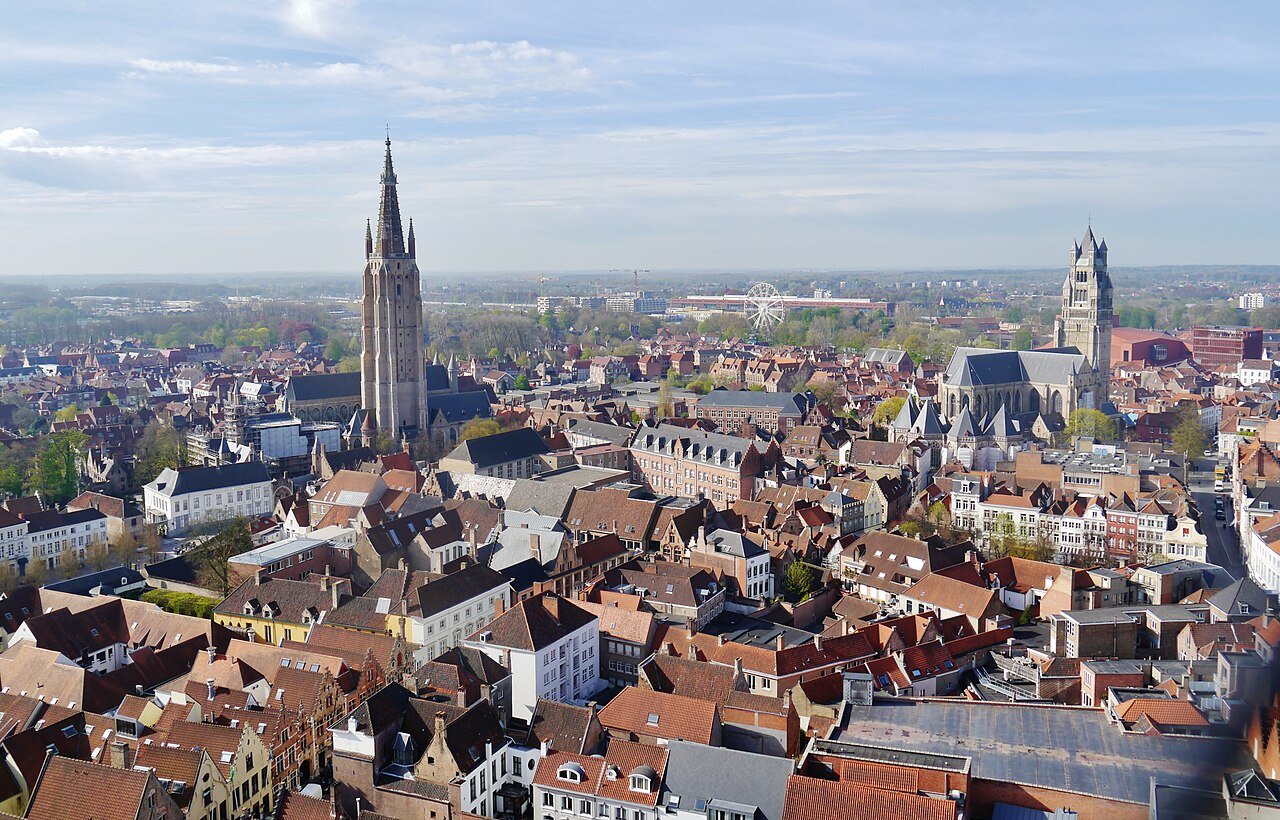
The Historic Centre of Bruges, inscribed in 2000 under criteria (ii), (iv), and (vi), is the best-preserved medieval city in northern Europe — a trading capital that controlled northern Europe’s access to Mediterranean luxury goods in the thirteenth and fourteenth centuries and whose Gothic civic architecture is intact to an extent unmatched outside the German Baltic Hanseatic towns. The Belfry (began 1240, upper octagon 1482, 83 metres) towers above the Markt — the main square where Flemish weavers and English wool merchants traded in cloth that clothed the courts of Europe; the carillon of 47 bells plays a continuous programme audible from the canal banks below. The Church of Our Lady (built 1220–1520) contains Michelangelo’s Madonna and Child (c. 1501–1503) — a marble statue bought by a Bruges merchant in Italy and the only work by Michelangelo to leave Italy during his lifetime. The canal network — the Dijver, Groenerei, and Minnewater — is navigable by open boat and gives the city its characteristic water-level perspective on the rear facades of medieval guild houses and warehouses.
Grand-Place, Brussels: The Most Beautiful Square in Europe 🚅 ~1 hr east by IC train
The Grand-Place, Brussels, inscribed in 1998 under criteria (ii) and (iv), is enclosed by the Gothic Town Hall (begun 1402) and a continuous ring of guild houses rebuilt in 1695–1700 after the French bombardment of 1695, when Louis XIV’s army fired 4,000 cannonballs and 1,500 fire bombs onto the city in 36 hours, burning the entire historic centre except the stone Town Hall. The rebuilding is one of the most remarkable acts of collective urban reconstruction in European history: each guild — the bakers, the butchers, the tailors, the archers — rebuilt their house in a Baroque idiom with gilded facades and figurative sculpture, creating a degree of unity from voluntarism rather than imposed planning. Victor Hugo, writing in 1852, called the Grand-Place “the most beautiful square in the world.” It is now used for the biennial Flower Carpet (August, even years), when 700,000 begonias cover the 1,800-square-metre square in a floral composition.
Flemish Béguinages: Women’s Autonomous Religious Communities Bruges + Ghent + Antwerp
Flemish Béguinages, inscribed in 1998 under criteria (ii), (iii), and (iv), protect thirteen surviving béguinage complexes across Flanders — walled communities of small houses around a church and garden, built from the thirteenth century onward for béguines: laywomen who chose to live in community, pray together, and work (as nurses, lacemakers, and teachers) without taking monastic vows and while retaining the right to leave and marry. The Bruges béguinage (Wijngaard) still functions as a community of Benedictine nuns within the thirteenth-century layout; its white-plastered houses, cobbled courtyard, and garden of narcissus and forget-me-not are the most intact survivor of the béguinage tradition. The Ghent Sint-Elisabeth béguinage is the largest, with 160 brick houses arranged on a street system that mimics a small city.
Antwerp: Plantin-Moretus Museum and Major Mining Sites 🚅 ~1 hr by IC train
The Plantin-Moretus House-Workshops-Museum Complex in Antwerp, inscribed in 2005 under criteria (ii), (iii), and (iv) and (vi), is the workshop and family house of Christophe Plantin, the sixteenth century’s most important printer — the only printing works in the world to survive with its original presses, type foundry, library, and business archives from the sixteenth and seventeenth centuries intact. Plantin operated up to 16 presses simultaneously; his Polyglot Bible (1568–1572), printed in five parallel columns in Hebrew, Aramaic, Greek, Latin, and the Vulgate, was the most technically ambitious printing project of the century. The workshop is now a museum that preserves the entire printing operation as a working archaeological site: the wooden hand-presses of the sixteenth century still function and are demonstrated for visitors.
Practical information
Bruges is 15 minutes from Ghent and 1 hour from Brussels by IC train (frequent departures). The historic centre is served by a canal boat network (open April–October) and is fully walkable from the railway station in 15 minutes. Brussels Midi station connects to London (2 hrs by Eurostar), Paris (1.5 hrs by Thalys), and Amsterdam (2 hrs by Thalys). The Belfry requires advance booking for timed entry (366 steps, 83 metres). The Bruges Triennial (contemporary art installations in the historic centre) runs in alternate years; the Christmas market on the Markt (November–January) is among the most atmospheric in Belgium. The best low-season visit is January–February when the canals are clear of tourist boats and the city is closest to its working self.
Frequently Asked Questions
Is Bruges a UNESCO World Heritage Site?
Yes. The Historic Centre of Bruges was inscribed in 2000 under criteria (ii), (iv), and (vi). The inscription covers the medieval city within the ring canal — approximately 430 hectares — with its canals, Belfry, guild houses, Flemish Primitive art collections, and the béguinage.
What are the Flemish Primitives and where can you see them in Bruges?
The Flemish Primitives are the fifteenth-century panel painters of Bruges and Ghent who defined the first northern European school of oil painting — Jan van Eyck, Hans Memling, Roger van der Weyden, Hugo van der Goes. The Groeningemuseum in Bruges holds Van Eyck’s Madonna of Canon van der Paele (1436) and Memling’s Moreel Triptych; the Sint-Janshospitaal Museum holds six Memling altarpieces in the original chapel for which they were painted.
How long do you need in Bruges?
Two full days for a comprehensive visit: Day 1 — Markt and Belfry, the canal boat circuit, the Church of Our Lady, Sint-Janshospitaal (Memling), evening on the Rozenhoedkaai. Day 2 — Groeningemuseum, the béguinage, the Minnewater park, and the brewery tour. Day 3 can be a day trip to Ghent (Altarpiece of the Mystic Lamb at Sint-Baafskathedraal, must be pre-booked).
Sources
- S1 — Blockmans, Wim. Metropolis: The Golden Age of the Medieval City of Bruges. Mercatorfonds, 2002. ISBN 978-90-6153-520-1.
- S2 — Huizinga, Johan. The Autumn of the Middle Ages. University of Chicago Press, 1996. ISBN 978-0-226-35992-2.
Spotted an error? Write to editorial@culturalheritageonline.com and we correct it the same day.