Reykjavik is the world’s northernmost capital, and its nearest UNESCO World Heritage Site lies 45 kilometres east — Þingvellir National Park, where Iceland’s parliament first convened in 930 CE and where the North American and Eurasian tectonic plates visibly diverge. A second site, the volcanic island of Surtsey, lies 30 kilometres offshore.
Þingvellir National Park: The Birthplace of Parliament 🚗 45 mins from Reykjavik
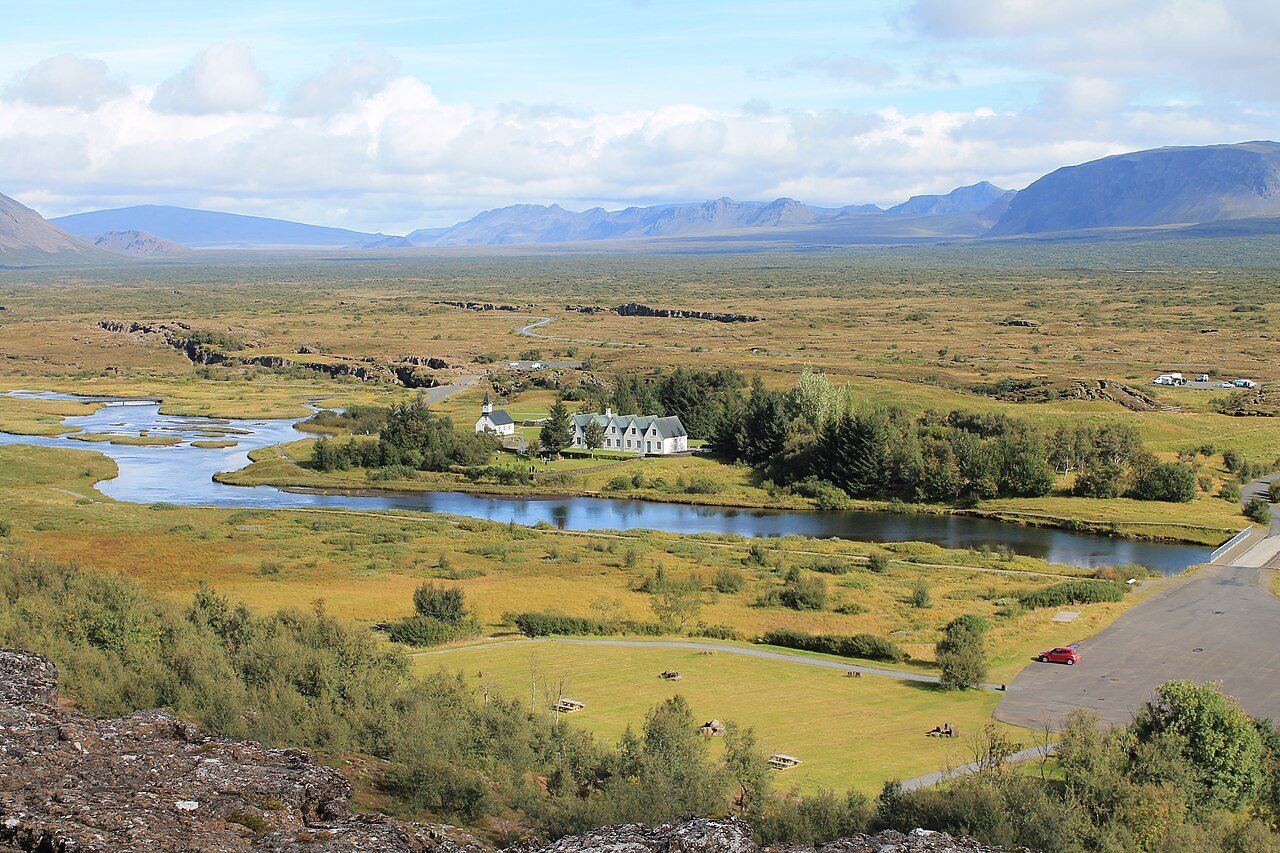
Þingvellir National Park, inscribed in 2004 under criteria (iii) and (vi), occupies the rift valley where the North American and Eurasian tectonic plates are separating at roughly two centimetres per year. The geological setting is visible: basalt cliffs drop sharply to the valley floor, where fissures — some filled with extraordinarily clear glacial meltwater — cut through lava fields. The Althing, Iceland’s parliament, first assembled here in 930 CE, making it one of the world’s oldest parliamentary institutions. The Lögberg (Law Rock), where the Lawspeaker recited the legal code from memory, and the Almannagjá gorge, where disputes were settled, give the site a political history that is inextricable from its geology. The park also surrounds Lake Þingvallavatn, Iceland’s largest natural lake, which is fed by slow-filtered lava groundwater and supports four endemic species of Arctic char.
Surtsey: A New Island Born in 1963 🚢 ~3 hrs by boat from Vestmannaeyjar
Surtsey, inscribed in 2008 under criteria (ix) and (x), is a volcanic island that emerged from the sea in November 1963 during a four-year eruption and has been closed to all but scientific researchers since its formation. Its value is precisely that restriction: Surtsey provides an uncontaminated record of how plant and animal life colonises a new land surface — wind-dispersed seeds, sea-carried plant matter, seabird colonies, invertebrates, and eventually vascular plants have established themselves in a documented succession undisturbed by human activity. Access requires permission from the Icelandic Institute of Natural History; researchers are the only regular visitors. From Reykjavik, the Westman Islands (Vestmannaeyjar) are accessible by ferry from Landeyjahöfn (45 minutes) or by a 30-minute flight, with Surtsey visible on clear days from the Westman Islands high ground.
The Golden Circle: Þingvellir, Geysir, Gullfoss 🚗 45 mins–2 hrs from Reykjavik
The Golden Circle route connects Þingvellir to Geysir (the geothermal area that gave all geysers their English name — the geyser Strokkur erupts every 5–10 minutes) and Gullfoss, the two-tiered waterfall that was the subject of one of Iceland’s earliest conservation campaigns in the 1920s. Neither Geysir nor Gullfoss is individually UNESCO-listed, but they form the natural and geological complement to Þingvellir’s cultural inscription, and the circuit is the most efficient introduction to Iceland’s landscape for travellers arriving in Reykjavik with limited time. The full circuit from Reykjavik takes about eight hours at a comfortable pace.
Reykjavik’s Own Heritage Layer City centre
The city itself is not inscribed, but it holds layers of significance: the settlement mound at Aðalstræti, where the remains of a Viking longhouse dating to the late ninth century were excavated beneath an eighteenth-century city street, is housed in a dedicated underground museum. The National Museum of Iceland documents the Settlement Age through the medieval period with material that contextualises the political history of Þingvellir. Hallgrímskirkja, the modernist concrete church whose tower has orientated the city’s skyline since 1986, was designed by state architect Guðjón Samúelsson to evoke Iceland’s basalt columns — a direct architectural reference to the geology visible at Þingvellir and along the coast.
Practical information
Keflavík International Airport (KEF) lies 50 kilometres southwest of Reykjavik, with connections to North America and Europe. Þingvellir is accessible by car (Route 36, paved) year-round, though winter driving requires caution. Admission to the national park is free; parking fees apply. Surtsey visits require prior arrangement with the Icelandic Institute of Natural History and are granted only for scientific purposes. The summer solstice period (June–July) offers 24-hour daylight and maximum visitor capacity; spring (April–May) and early autumn (September) give good weather with fewer crowds and the possibility of northern lights in the evenings.
Frequently Asked Questions
How many UNESCO World Heritage Sites does Iceland have?
Iceland has two inscribed UNESCO World Heritage Sites: Þingvellir National Park (2004) and Surtsey island (2008).
Can you visit Þingvellir as a day trip from Reykjavik?
Yes, easily. Þingvellir is 45 minutes by car from Reykjavik on paved road. Combined with Geysir and Gullfoss on the Golden Circle, the return trip takes a full day and is one of Iceland’s classic heritage and landscape circuits.
Is it possible for tourists to visit Surtsey?
No. Surtsey is closed to general visitors to preserve its value as an uncontaminated study site for ecological colonisation. Access is restricted to researchers with permits from the Icelandic Institute of Natural History.
Sources
- S1 — Byock, Jesse L. Viking Age Iceland. Penguin Books, 2001. ISBN 978-0-14-029115-5.
- S2 — Karlsson, Gunnar. The History of Iceland. University of Minnesota Press, 2000. ISBN 978-0-8166-3589-4.
Spotted an error? Write to editorial@culturalheritageonline.com and we correct it the same day.