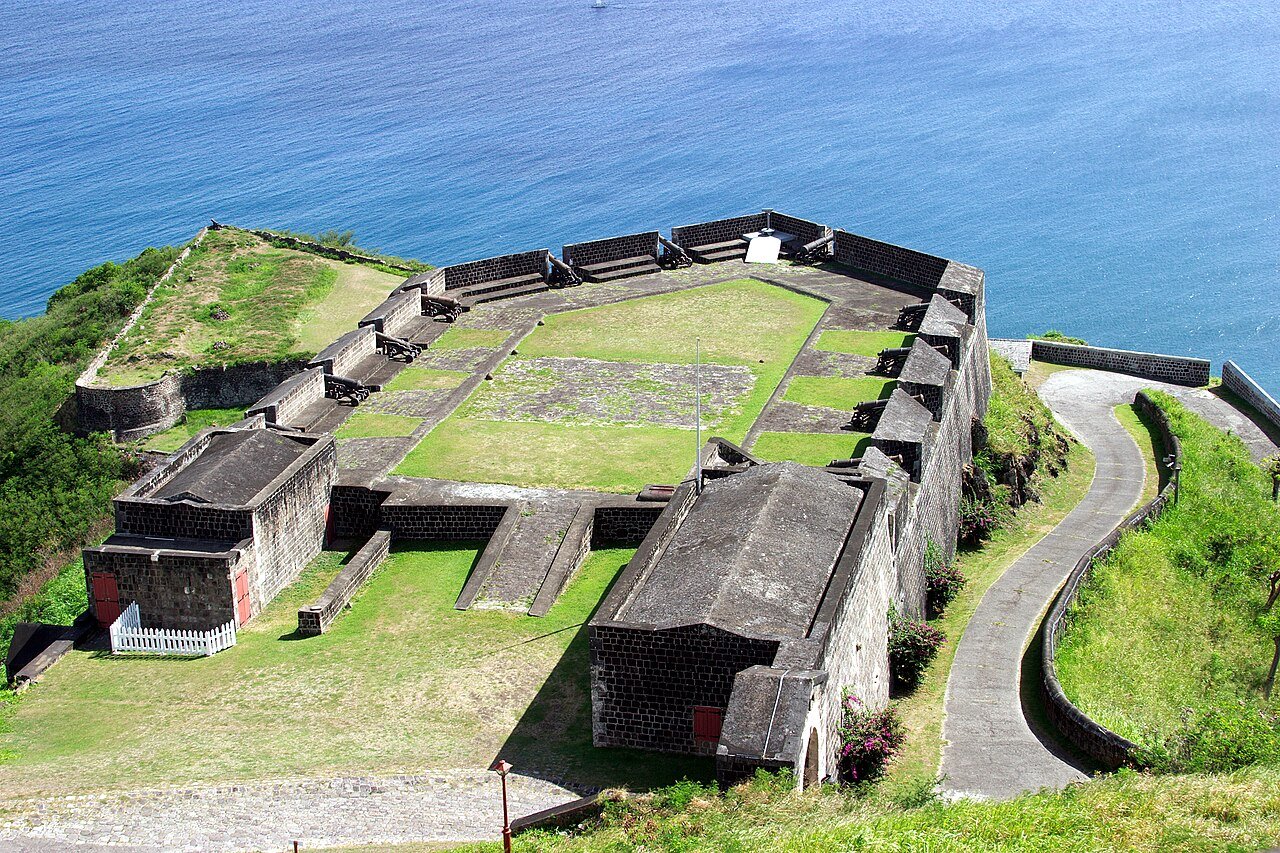
Saint Kitts and Nevis has one UNESCO World Heritage Site: Brimstone Hill Fortress National Park — the largest and best-preserved British colonial fortification in the Eastern Caribbean, built between 1690 and 1790 on a volcanic hill above the Caribbean Sea, approximately 13 km northwest of the capital Basseterre. From Cultural Heritage Online.
Brimstone Hill Fortress National Park 13 km northwest of Basseterre — 20 min by road
Brimstone Hill Fortress is an extraordinary achievement of British colonial military engineering — a complex of fortifications built between approximately 1690 and 1790 on and around a 240-metre volcanic plug, using blocks of volcanic andesite cut from the hill itself. The fortress complex includes the Citadel (the main defensive work on the summit), the Infantry Officers’ Quarters, the Prince of Wales Bastion, the artillery emplacements, and the surrounding defensive works on the lower slopes. The entire site was constructed essentially by enslaved African labour under the direction of British Royal Engineers over a period of a century.
Brimstone Hill was taken by French forces in 1782 after a month-long siege — one of the few successful assaults on the fortress in its history — and returned to Britain under the Treaty of Paris (1783). It was used as an active military installation until 1853, when the garrison was withdrawn as a cost-cutting measure. The fortress then decayed until a restoration programme begun in the 1960s brought it to its current state. UNESCO inscribed the site in 1999 as an outstanding example of European military colonial architecture in the Caribbean, comparable to Vauban’s fortifications in Europe. The Citadel on the summit gives panoramic views that, in clear conditions, extend to five neighbouring islands: Nevis, Sint Eustatius, Saba, St Barthélemy, and St Maarten.
Basseterre and the Colonial Town Heritage
Basseterre, the capital of St Kitts, retains a significant collection of eighteenth and nineteenth-century colonial buildings around Independence Square (formerly Pall Mall Square) — the original central square of the British colonial town. The square is ringed by Georgian buildings including the Berkeley Memorial clock tower, law courts, and churches. The town was seriously damaged by fire in 1867 and rebuilt; the surviving fabric dates primarily from the late Victorian period. The National Museum of St Kitts is housed in the Old Treasury Building (1894) near the waterfront.
Getting there from Basseterre: Brimstone Hill Fortress is 13 km northwest of Basseterre by road (approximately 20 minutes by taxi or rental car; the main road around the northern coast passes the fortress). Public buses also run along this route. Allow: 2–3 hours for a thorough exploration of the fortress. Best for: Colonial military architecture; Caribbean plantation history; panoramic views.
Frequently Asked Questions
How many UNESCO World Heritage Sites does St Kitts and Nevis have?
One: Brimstone Hill Fortress National Park, inscribed as a cultural site in 1999. It is the only inscribed UNESCO site in the country and one of only three UNESCO World Heritage Sites in the Eastern Caribbean (the others being Morne Trois Pitons National Park in Dominica and the Pitons Management Area in Saint Lucia).
Why is Brimstone Hill considered the “Gibraltar of the West Indies”?
The nickname “Gibraltar of the West Indies” refers to Brimstone Hill’s combination of a naturally strong defensive position (a volcanic plug rising 240 metres above the surrounding lowlands), its massive masonry fortifications, and its historical record of successfully resisting most attempts to take it by storm. Like Gibraltar, it commands a strategically important position — in Brimstone Hill’s case, it overlooks the Narrows, the channel separating St Kitts from Nevis, and gives its defenders visibility across a wide arc of the Caribbean Sea, allowing the early detection of approaching fleets.
How was Brimstone Hill built, and who built it?
Brimstone Hill Fortress was built over approximately a century (circa 1690–1790) by enslaved African workers under the direction of British Royal Engineers. The construction required the quarrying and dressing of large blocks of the local volcanic andesite from the hill itself, their transportation up the steep slopes, and their assembly into the massive walls and bastions of the fortress. The British government’s investment in the fortress reflected the extraordinary value of St Kitts (then one of the most productive sugar islands in the British Empire) and the strategic importance of controlling the Narrows. The fact that a significant proportion of the construction work was done by enslaved people — who also provided the labour that made the sugar economy viable — is part of the broader colonial heritage that the site represents.
What is the sugar heritage of St Kitts?
St Kitts was one of the most economically important islands in the British Caribbean sugar economy from the seventeenth to the nineteenth century. The island was dotted with approximately 70 sugar estates at the peak of the plantation era; the ruins of these estates — sugar mills, boiling houses, greathouses, slave quarters — are distributed across the island and represent a significant heritage layer beneath the modern landscape. The last sugar harvest in St Kitts took place in 2005, when the government closed the state sugar corporation after centuries of continuous production. The old narrow-gauge sugar railway that encircled the island is now operated as a tourist attraction, known as the St Kitts Scenic Railway.