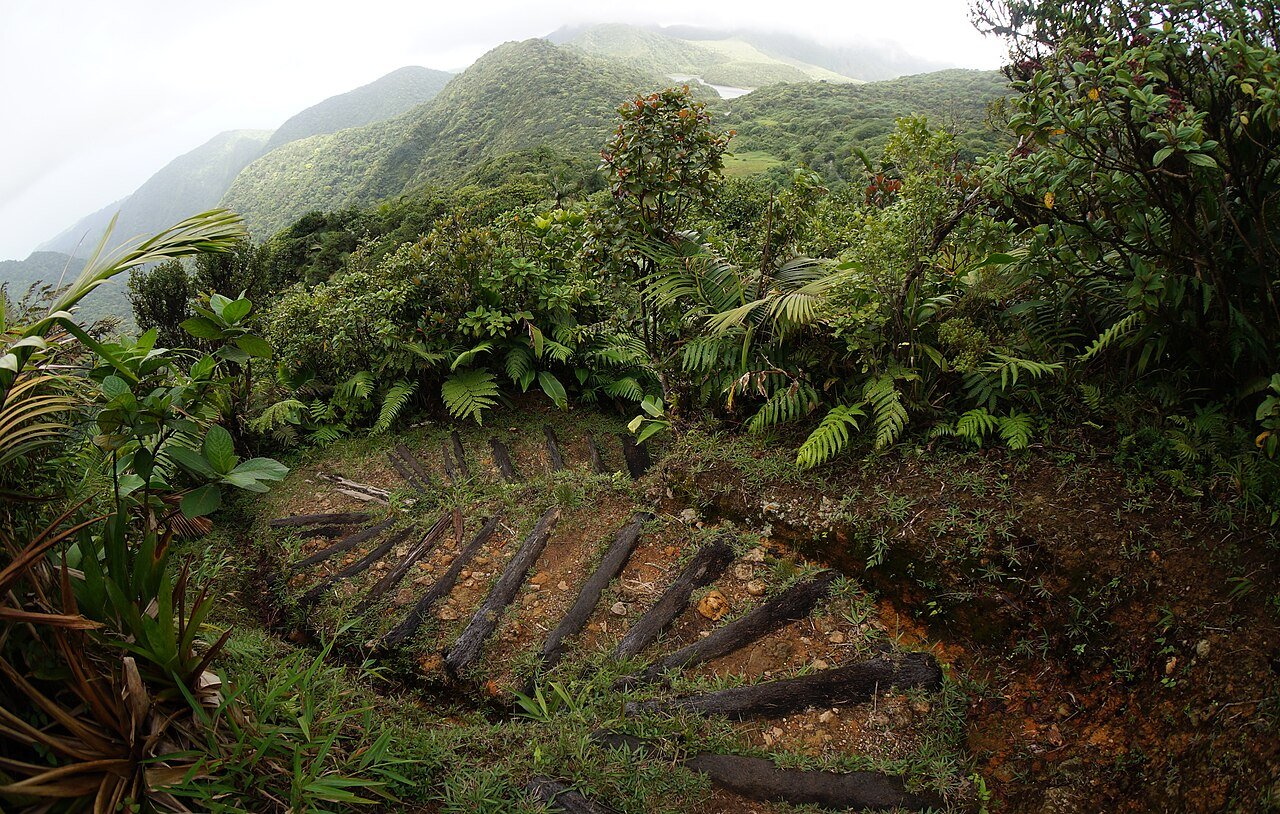
Dominica has one UNESCO World Heritage Site: the Morne Trois Pitons National Park, a 6,857-hectare volcanic park in the island’s interior that contains the Boiling Lake (the second largest thermally active lake in the world), Trafalgar Falls, Valley of Desolation, and extraordinary tropical rainforest. The park is inscribed as a natural heritage site for its outstanding geology and biodiversity, and is accessible on foot from Roseau. From Cultural Heritage Online.
Morne Trois Pitons National Park 8 km east of Roseau — 30 min by road and then on foot
Morne Trois Pitons National Park was Dominica’s first national park (gazetted 1975) and became the first UNESCO World Heritage natural site in the Eastern Caribbean when it was inscribed in 1997. The park is centred on the volcanic massif of Morne Trois Pitons (1,387 m), the second-highest peak in Dominica, and encompasses a geologically extraordinary landscape of fumaroles, boiling springs, hot mud pools, sulphur vents, and two thermally active lakes — the Boiling Lake and the Freshwater Lake.
The Boiling Lake, reached by a 6–8 hour return hike from Laudat village (8 km from Roseau), is the second largest thermally active lake in the world. It sits in a flooded fumarole and the water temperature at the centre is unmeasured but significantly above 90°C; the water is in constant agitation, giving the appearance of boiling. The lake reached its current state in the 1870s and has occasionally drained and refilled, most recently in 2004. The Valley of Desolation, traversed on the approach to the Boiling Lake, is a volcanic landscape of grey mud and sulphur deposits where nothing grows — a striking contrast to the lush rainforest that begins immediately at its margins.
The park’s rainforest supports the Sisserou parrot (Amazona imperialis), Dominica’s national bird and the island’s most threatened endemic species, with an estimated wild population of fewer than 250–350 individuals. The Sisserou is the largest of the Amazon parrots and exists nowhere else in the world.
Trafalgar Falls
Trafalgar Falls, approximately 8 km east of Roseau in the Roseau Valley, are a pair of adjacent waterfalls (Father and Mother Falls) dropping from a volcanic cliff into a pool fed by both cold rainwater from above and warm thermal springs from beneath. The resulting hot-spring pool at the base is accessible to bathers and is one of the most popular heritage and nature experiences in Dominica. The Wotten Waven village nearby has several small hot-spring bathing facilities. Trafalgar Falls are within the national park boundary and accessible by a 15-minute walk from the road.
Getting there from Roseau: The park entrance and Trafalgar Falls are approximately 8 km east of Roseau (30 min by road). The Boiling Lake hike departs from Laudat village, approximately 12 km from Roseau; the hike is 6–8 hours return and requires a local guide (mandatory). The park trail network can be explored independently for shorter hikes. Allow: Half day for Trafalgar Falls; full day for Boiling Lake. Best for: Volcanic landscape; tropical rainforest ecology; thermally active geology; Sisserou parrot.
Frequently Asked Questions
How many UNESCO World Heritage Sites does Dominica have?
One: Morne Trois Pitons National Park, inscribed as a natural site in 1997. It was the first UNESCO natural World Heritage Site in the Eastern Caribbean. Dominica has no cultural UNESCO sites.
What is the Boiling Lake and why is it in a state of constant agitation?
The Boiling Lake is a flooded fumarole — a volcanic vent from which gases and steam escape through the surface of a water-filled depression. The water in the lake is superheated from below by volcanic activity associated with the magma chamber beneath Dominica’s volcano, and the temperature in the center of the lake is believed to exceed 90°C. The constant input of heat causes vigorous convection currents that make the water appear to boil. The lake sits within the Valley of Desolation, a hydrothermally altered landscape where sulphuric acid emanating from fumaroles has destroyed the native vegetation over a significant area.
What is the Sisserou parrot and why is it endangered?
The Sisserou parrot (Amazona imperialis) is an Amazon parrot endemic to the upper montane forests of Dominica, existing nowhere else in the world. It is the largest of the Amazon parrot species and Dominica’s national bird. The wild population is estimated at between 250 and 350 individuals. It is threatened by habitat loss (particularly the destruction of the montane rainforest that it depends on for nesting and feeding), hunting, capture for the pet trade in the past, and — increasingly — direct mortality from hurricanes. Hurricane Maria (2017) was estimated to have killed approximately 30% of the Sisserou population when it swept across Dominica in September 2017 with wind speeds of 260 km/h. A related species, the Jaco parrot (Amazona arausiaca), is also endemic to Dominica and has a somewhat larger population.
Is Dominica the same as the Dominican Republic?
No. Dominica (officially the Commonwealth of Dominica) and the Dominican Republic are two entirely different countries, separated by approximately 1,100 km of the Caribbean Sea. Dominica is a small volcanic island in the Eastern Caribbean, a former British colony with a population of approximately 72,000 people; its official language is English and its capital is Roseau. The Dominican Republic occupies the eastern two-thirds of the island of Hispaniola (which it shares with Haiti), has a population of approximately 11 million, was a Spanish colony, and its capital is Santo Domingo. The confusion arises because both names derive from the same Latin root (Dominicus, relating to Sunday, as Dominica was traditionally named after the day it was sighted).