The Marshall Islands has one UNESCO World Heritage Site: Bikini Atoll Nuclear Test Site, 850 km northwest of the capital Majuro, where the United States conducted 23 nuclear weapons tests between 1946 and 1958 — including the first hydrogen bomb test and the contamination of an inhabited atoll whose population has not returned. From Cultural Heritage Online.
Bikini Atoll Nuclear Test Site 850 km northwest — domestic flight from Majuro
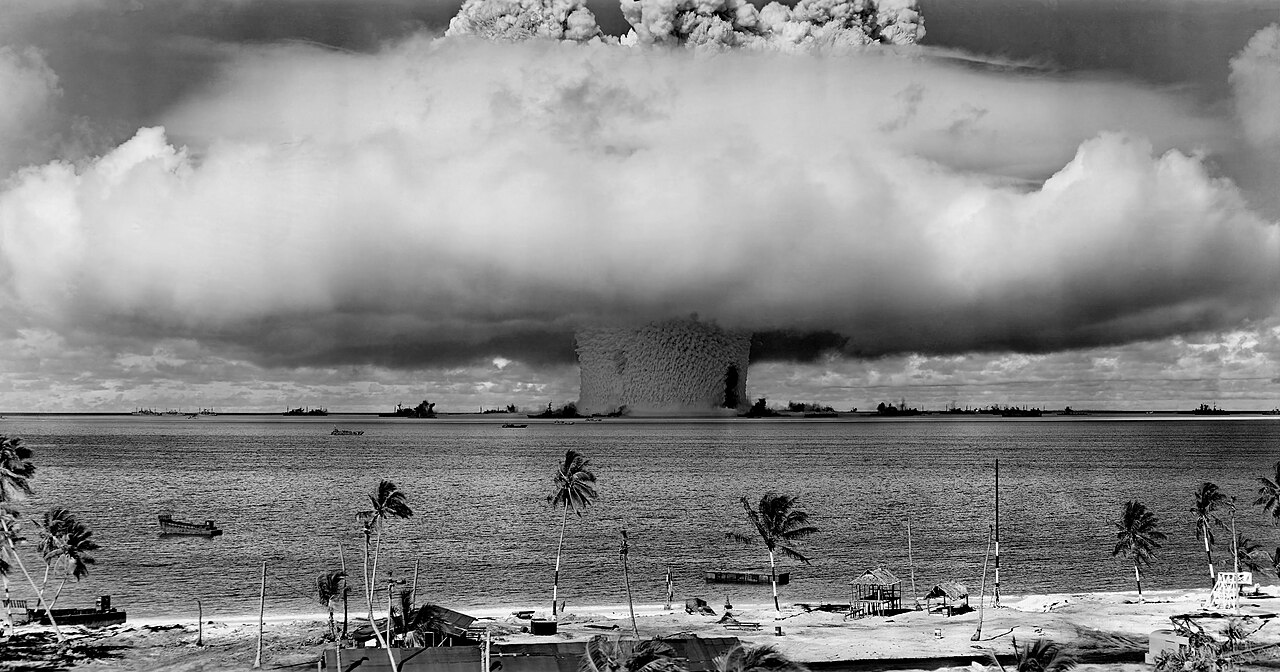
Bikini Atoll, a ring of 23 coral islands enclosing a lagoon approximately 50 km wide in the northwestern Marshall Islands, was the site of 23 nuclear weapons tests conducted by the United States between 1946 and 1958. The 167 indigenous Bikinians were relocated to Rongerik Atoll in 1946 — told by Commodore Ben Wyatt that their displacement would be “for the good of mankind” — before the first test, Operation Crossroads, detonated an atomic bomb in the lagoon on 25 July 1946. The underwater “Baker” detonation contaminated the lagoon and 80 warships placed there as targets with levels of radioactivity that the US Navy’s monitoring equipment could not fully measure.
The most consequential test was Castle Bravo on 1 March 1954: the first US hydrogen bomb test, which produced a yield of 15 megatons — roughly 1,000 times the Hiroshima bomb — dramatically exceeding the 6-megaton prediction. The fallout cloud spread across the Marshall Islands and contaminated the crew of the Japanese fishing vessel Lucky Dragon 5, 160 km from the blast. Castle Bravo contaminated Rongelap and Utirik atolls, whose populations were not evacuated for three days; the subsequent health effects on Rongelap people — thyroid cancers, birth defects, miscarriages — became one of the most documented cases of nuclear exposure harm in history.
Bikini Atoll was inscribed as a UNESCO World Heritage Site in 2010 “as a symbol of the dawn of the nuclear age” and for its outstanding universal value as a site that bears witness to the global consequences of nuclear weapons testing. The lagoon contains the wrecks of 20 ships sunk in the 1946 tests, including the USS Saratoga aircraft carrier and the Japanese battleship Nagato. These wrecks are accessible to technical divers and are among the most historically significant dive sites in the world. The Bikinians remain off the atoll; their descendants live primarily on Kili Island and Majuro.
Getting there: Domestic flights from Majuro to Bikini Atoll are possible but irregular; advance coordination required. Liveaboard dive charters from Majuro are the primary means of access for visitors. Allow: Multi-day trip (dive charters typically 7–10 days). Best for: Technical divers; nuclear history researchers; heritage specialists.
Frequently Asked Questions
How many UNESCO World Heritage Sites does the Marshall Islands have?
One: Bikini Atoll Nuclear Test Site, inscribed in 2010. The site is located in the northwestern Marshall Islands, approximately 850 km from the capital Majuro. It was inscribed as outstanding universal value relating to the dawn of the nuclear age and the humanitarian consequences of nuclear weapons testing.
Can tourists visit Bikini Atoll?
Yes, with significant logistical planning. The atoll is accessible by domestic charter flight from Majuro, and liveaboard dive charters regularly visit the lagoon wrecks. The wreck of the USS Saratoga aircraft carrier and the Japanese battleship Nagato are among the most visited dive sites. The atoll remains uninhabited; no accommodation exists on the islands. Radiation levels in the soil are still above safe limits for permanent habitation, though day visits are generally considered safe.
What ships were sunk at Bikini Atoll in the 1946 tests?
The 1946 Operation Crossroads tests used approximately 80 surplus warships as target vessels placed in Bikini lagoon. Vessels deliberately sunk include the USS Saratoga (aircraft carrier), the USS Arkansas (battleship), the HIJMS Nagato (Japanese battleship that survived the attack on Pearl Harbor and was surrendered in Tokyo Bay), the USS Apogon and USS Pilotfish (submarines), and numerous smaller vessels. The wrecks now constitute one of the world’s most significant underwater heritage sites.
What was Castle Bravo and why is it important?
Castle Bravo was the first US hydrogen bomb test, detonated at Bikini Atoll on 1 March 1954. It produced a yield of 15 megatons — far exceeding the predicted 6 megatons — making it the largest US nuclear test ever conducted. The fallout cloud contaminated the crew of a Japanese fishing vessel 160 km away and caused significant health damage to the populations of Rongelap and Utirik atolls, who were not evacuated for three days. Castle Bravo intensified global concern about nuclear testing and contributed to the 1963 Partial Nuclear Test Ban Treaty.
Sources
- S1 — Niedenthal, Jack. For the Good of Mankind: A History of the People of Bikini. Micronitor, 2001. ISBN 978-982-9050-02-1.
- S2 — Kirch, Patrick Vinton. On the Road of the Winds. University of California Press, 2000. ISBN 978-0-520-22347-9.
Spotted an error? Write to editorial@culturalheritageonline.com and we correct it the same day.