
Slovenia concentrates three UNESCO World Heritage Sites within 80 kilometres of Ljubljana, ranging from a prehistoric wetland on the city’s southern edge to one of the most spectacular underground canyons on Earth. Each site is reachable as a day trip, and together they span seven millennia of human and geological time. Editorial content by Cultural Heritage Online.
Prehistoric Pile Dwellings — Ljubljana Marshes 5 km south · 20 min by bike
The Ljubljansko Barje — the Ljubljana Marshes — is the most immediately accessible UNESCO World Heritage Site anywhere near a European capital. The flat wetland stretching south of the city was, between roughly 4500 and 1000 BC, a dense archipelago of pile-dwelling villages built on wooden platforms over shallow water and bog. The site is one of 111 prehistoric pile-dwelling settlements inscribed as a trans-boundary serial property across six Alpine countries in 2011, and the Slovenian entries at Ig and the Barje are among the most archaeologically productive in the network.
Excavations here have recovered the oldest wooden wheel with axle ever found — dated to around 3200 BC — along with textile fragments, dugout canoes, and refuse deposits that give unusually detailed evidence of early Bronze Age diet and trade. The settlements themselves are no longer visible above the surface, but the landscape reads clearly as layered time: water channels, raised bog, and protected meadow over a submerged Neolithic world. The cycle path from Ljubljana passes observation points where interpretive panels locate the buried settlement zones.
Getting there: Cycle path from Ljubljana city centre, approximately 45 minutes; or drive south on the Ig road (20 min). The Barje Nature Park visitor centre near Črna vas has orientation materials. Allow: 2–3 hours including cycling time. Best for: Cyclists, prehistory enthusiasts, and visitors who want a UNESCO site without leaving the city’s immediate hinterland.
Škocjan Caves 80 km southwest · 1.5 hr by road or train to Divača

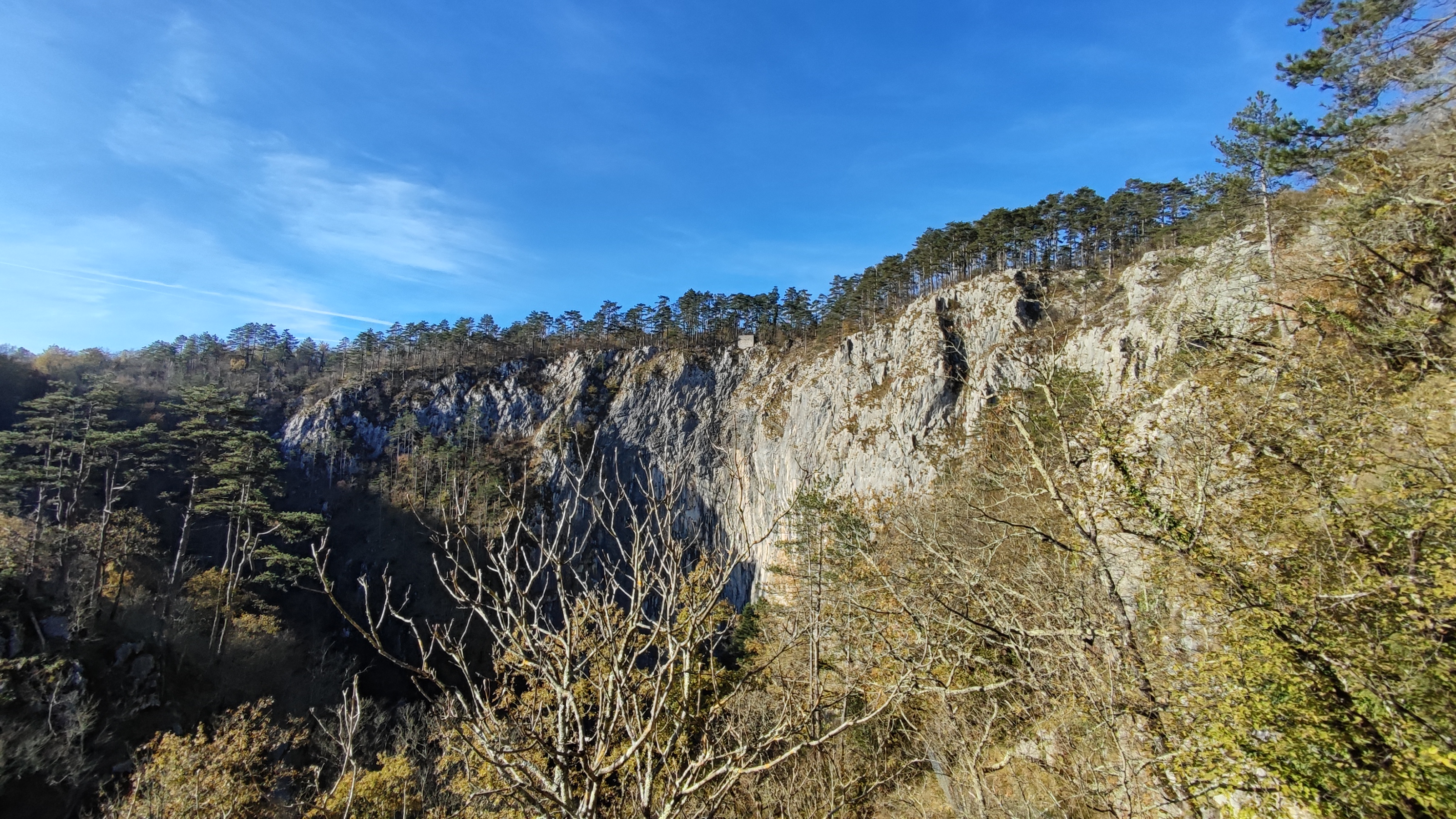
The Reka River rises in the hills above Trieste, crosses into the Slovenian Karst, and then vanishes underground. At Škocjan, it has spent millions of years carving what geologists classify as one of the largest underground canyons in the world: a gorge 150 metres deep and three kilometres long, entirely inside the mountain. The system was inscribed as a UNESCO World Heritage Site in 1986, the same year the nomination was submitted — an unusual speed of recognition that reflects both the site’s scientific importance and the completeness of its karst features.
The guided tour follows the river through two distinct cave systems. The Silent Cave, the section closest to the entrance, is dominated by the scale and concentration of its formations: columns, stalactites, and stalagmites developed over geological time in chambers of cathedral scale. The Murmuring Cave, further in, shifts the register entirely — the path follows a ledge above the active river, which drops over a 45-metre waterfall before disappearing deeper into the system. At this point visitors are effectively standing inside a functioning karst drainage event, watching a surface river become a subterranean one.
Škocjan was considered alongside Postojna Cave as Slovenia’s premier cave site, but was inscribed for different reasons: not the density of formations (Postojna is more spectacular in that regard) but the integrity of a complete karst hydrological system — the collapsed dolines, the active river, the canyon, the subterranean lake, the resurgence spring — all present and functioning within a single protected area.
Getting there: Train from Ljubljana to Divača (1 hr 20 min), then local shuttle or 4 km walk/taxi to the cave entrance. By car: 80 km via the A1 motorway, approximately 1 hr 10 min. Guided tours run daily; booking ahead is recommended in summer. Allow: Half day including travel; a full day if combining with the Karst landscape above ground. Best for: Anyone with an interest in geology, karst landscapes, or simply the experience of walking through an active underground river system.
Heritage of Mercury — Idrija 60 km west · 1 hr by road

Idrija sits in a narrow valley in the hills west of Ljubljana, and its entire reason for existing is mercury. The mine was discovered in 1490, when a local woodcutter found liquid mercury pooling at the bottom of a wooden tub. Within a decade the Habsburgs had claimed the deposit and begun extracting one of the most strategically valuable substances in early modern Europe — mercury was essential for silver refining using the amalgamation process, which underpinned the entire New World silver economy. Idrija became the second-largest mercury mine in the world, after Almadén in Spain, and the two sites were jointly inscribed as a trans-boundary UNESCO World Heritage Site in 2012.
The mine operated for 517 years, closing in 2007 when international treaties banned mercury production. What remains is a remarkably intact industrial town: the mine shafts (the deepest reaches 383 metres), the 18th-century Gewerkenegg Castle converted to a mining museum, the miners’ theatre built in 1769 — one of the oldest in Central Europe — and the surrounding landscape shaped entirely by centuries of extraction, smelting, and the social infrastructure a mine of that scale required. The heritage landscape extends to the Rake, an ingenious 17th-century water-management system that channelled mountain streams to power the mine machinery.
Getting there: By car from Ljubljana: 60 km via Logatec, approximately 1 hour. No direct train; buses run from Ljubljana to Idrija (1.5 hr). The Municipal Museum of Idrija manages the heritage sites and offers underground mine tours; book in advance. Allow: Full day. Best for: Industrial heritage, early modern history, and visitors interested in the economic history of pre-industrial Europe.
Frequently Asked Questions
How many UNESCO World Heritage Sites are near Ljubljana?
Three UNESCO World Heritage Sites are accessible as day trips from Ljubljana: the Prehistoric Pile Dwellings around the Alps (2011), which includes the Ljubljana Marshes just 5 km from the city centre; Škocjan Caves (1986), 80 km southwest; and the Heritage of Mercury — Almadén and Idrija (2012), 60 km west in the town of Idrija.
How do I get to the Ljubljana Marshes UNESCO site from the city centre?
The Ljubljana Marshes (Ljubljansko Barje) are reachable by bicycle from the city centre in under an hour via a flat cycle path heading south. By car, the Ig road takes roughly 20 minutes. The Barje Nature Park visitor centre near Črna vas provides orientation; interpretive panels at key points along the cycle route mark the location of buried pile-dwelling settlements. No admission fee is required to visit the landscape.
Can I visit Škocjan Caves and Idrija in the same day trip?
In theory possible but not recommended: Škocjan lies 80 km southwest and Idrija 60 km west of Ljubljana, in different directions. Each site warrants at least half a day — Škocjan for the guided cave tour and the surrounding karst landscape, Idrija for the mine tour and the town’s heritage buildings. A comfortable itinerary spreads these across two separate days, which also allows more time underground at each site.
Why was Idrija inscribed alongside Almadén in Spain rather than as a standalone site?
UNESCO’s serial and trans-boundary inscriptions are used when Outstanding Universal Value is most fully expressed by a group of related sites rather than a single location. Idrija and Almadén together represent the two largest mercury producers in history and document, between them, the full cycle of the global mercury trade from the late 15th century to the present-day international ban. Each site has properties the other lacks — Almadén’s Roman-era galleries, Idrija’s 18th-century miners’ theatre and water-management infrastructure — and the joint inscription makes explicit that mercury’s historical significance was planetary in scale, not local.



.jpg)
.jpg)