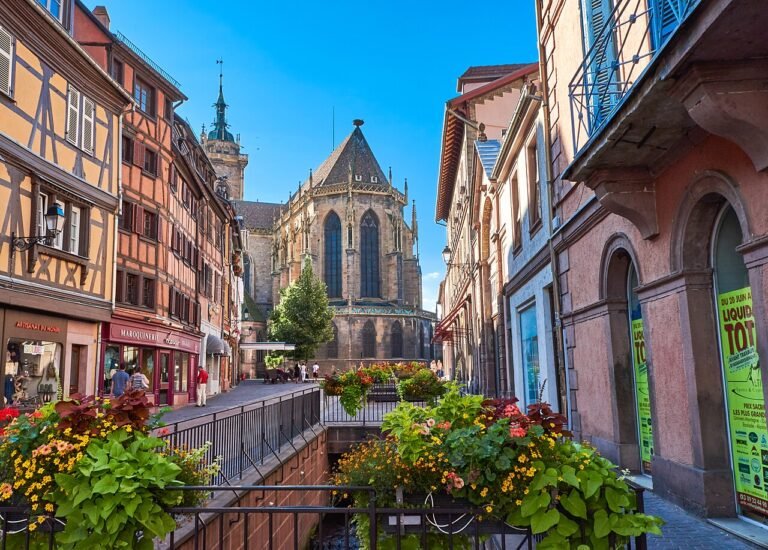
Within two hours of Brussels by train or car, six UNESCO World Heritage Sites span medieval market squares, living canal engineering, a walled beguinage, one of Europe’s greatest printing dynasties, and a prehistoric mine field that rewrote the archaeology of northwestern Europe. From Cultural Heritage Online.
La Grand-Place, Brussels City centre — Metro lines 1 & 5 to Gare Centrale
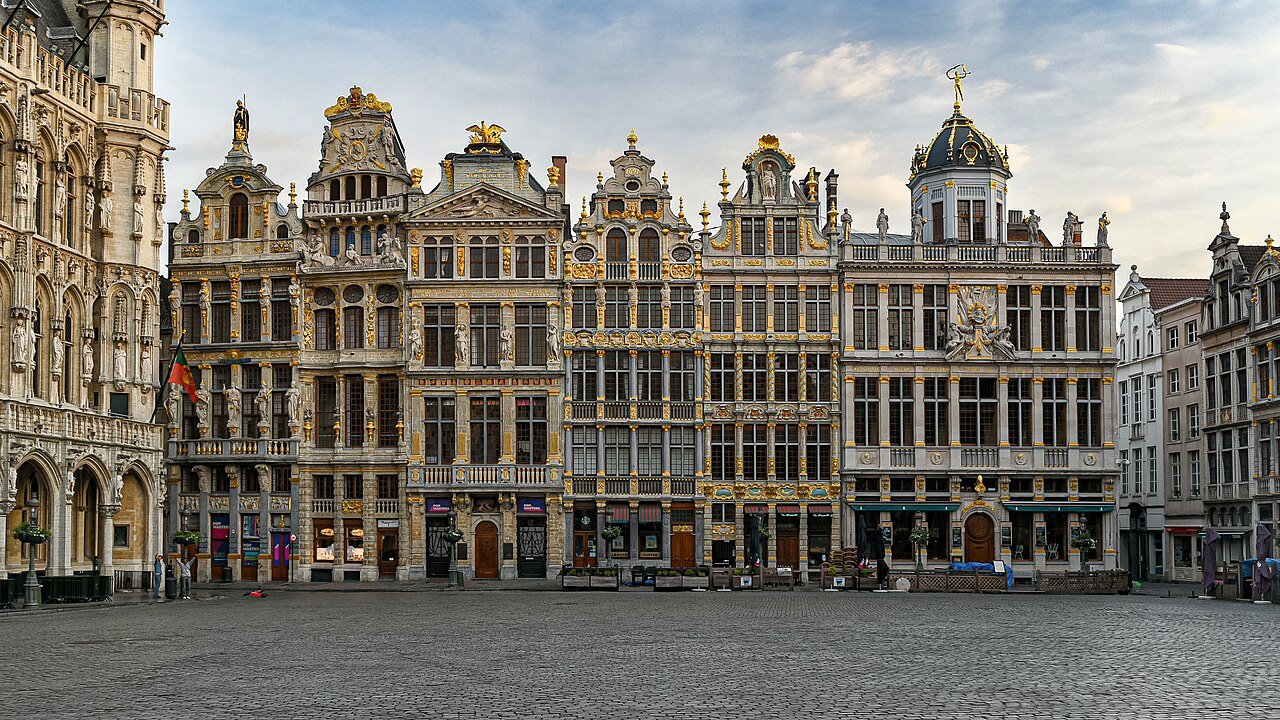
Inscribed in 1998, the Grand-Place is the historic centre of Brussels and one of the best-preserved medieval market squares in Europe. The space measures 68 by 110 metres and is completely enclosed by the Flamboyant Gothic Town Hall, built in stages between 1401 and 1455 to a design partly attributed to architect Jan van Ruysbroek, and by two dozen Baroque guildhalls reconstructed with remarkable speed after French artillery razed the square in August 1695. The guildhalls carry names such as Le Roy d’Espagne, Le Cygne, and L’Arbre d’Or; their richly sculptured façades, with rusticated pilasters, balustrades, and lavishly carved gables, press in on every side so tightly that the square seems to breathe only upward, funnelling attention to the 96-metre tower capped by a gilded statue of Saint Michael. Every two years in August the cobblestones disappear under nearly a million begonias arranged in a 1,800-square-metre floral carpet.
Getting there: Metro lines 1 and 5 to Gare Centrale, then a five-minute walk; the square is in the city centre. Allow: 1–2 hours. Best for: An immersive first encounter with Brussels’ Baroque heritage without leaving the city — the grandest architecture here is free to see at any hour.
The Four Hydraulic Lifts on the Canal du Centre ~1 hr by train to La Louvière, then local bus
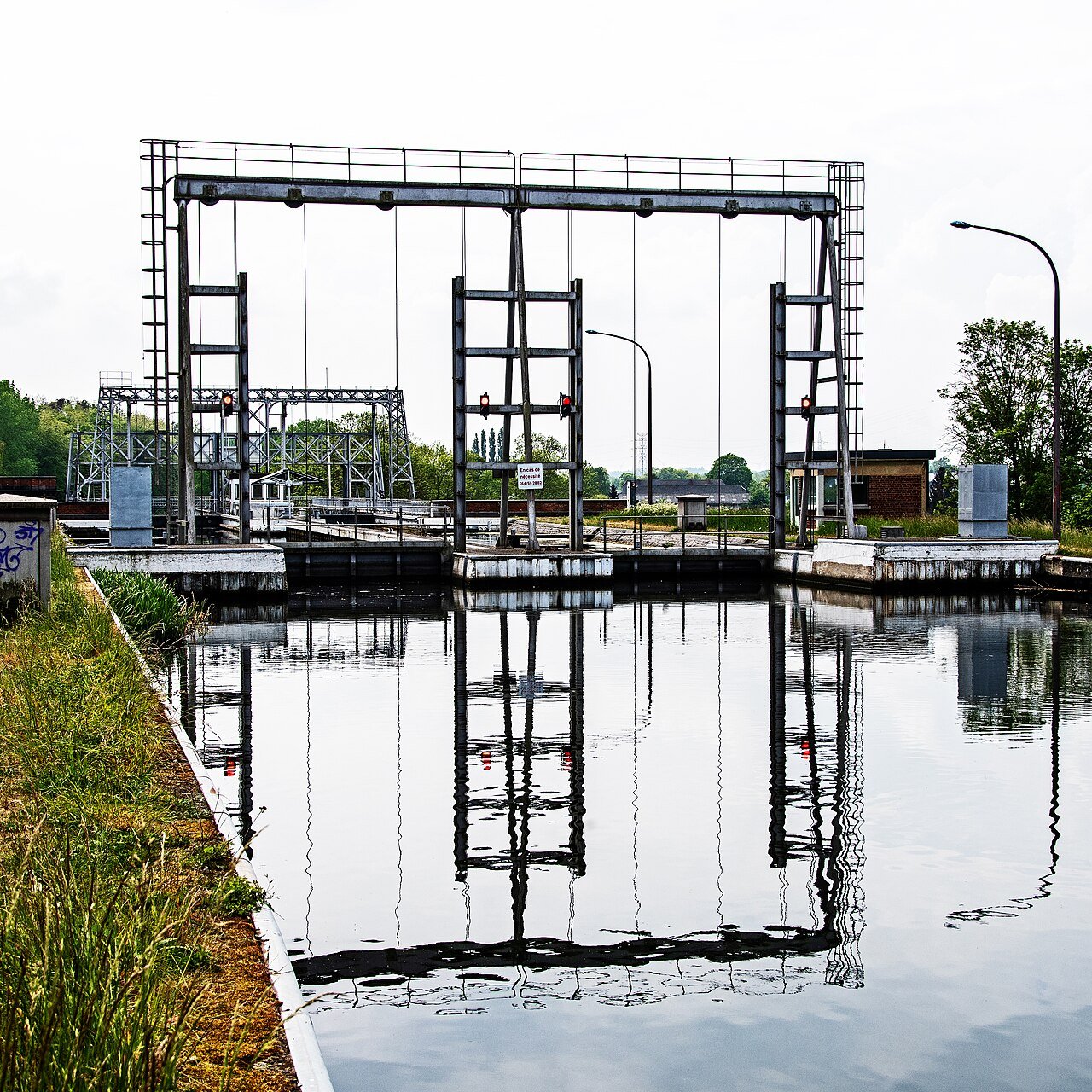
Inscribed in 1998, the four hydraulic boat lifts strung along a seven-kilometre stretch of the Canal du Centre near La Louvière represent the high-water mark of Victorian civil engineering. British engineer Edwin Clark conceived the system; lift No. 1 at Houdeng-Goegnies opened in 1888 and lifts two, three, and four followed in 1917. Each operates on a counterbalance principle: two water-filled caissons, each supported on an iron column, rise and descend simultaneously, one’s weight cancelling the other’s so that very little energy is needed to move a fully laden barge. Lift No. 1 raises vessels 15.40 metres; the remaining three raise them 16.93 metres each — together overcoming a total elevation difference of 66.2 metres between the Meuse and Scheldt basins. Of the eight hydraulic boat lifts ever built in the late nineteenth and early twentieth centuries, these four remain the only ones still operating in their original form. Standing beside a rising caisson, you hear only a low mechanical sigh and the trickle of water.
Getting there: Train from Brussels-Midi to La Louvière-Centre (approximately 1 hour), then local bus toward Thieu or Houdeng-Goegnies; check TEC bus schedules in advance. Allow: 2–3 hours. Best for: Watching living industrial heritage in motion — the lifts still carry pleasure craft and occasional barges through the Hainaut countryside.
Historic Centre of Brugge ~1 hr by IC from Brussels-Midi
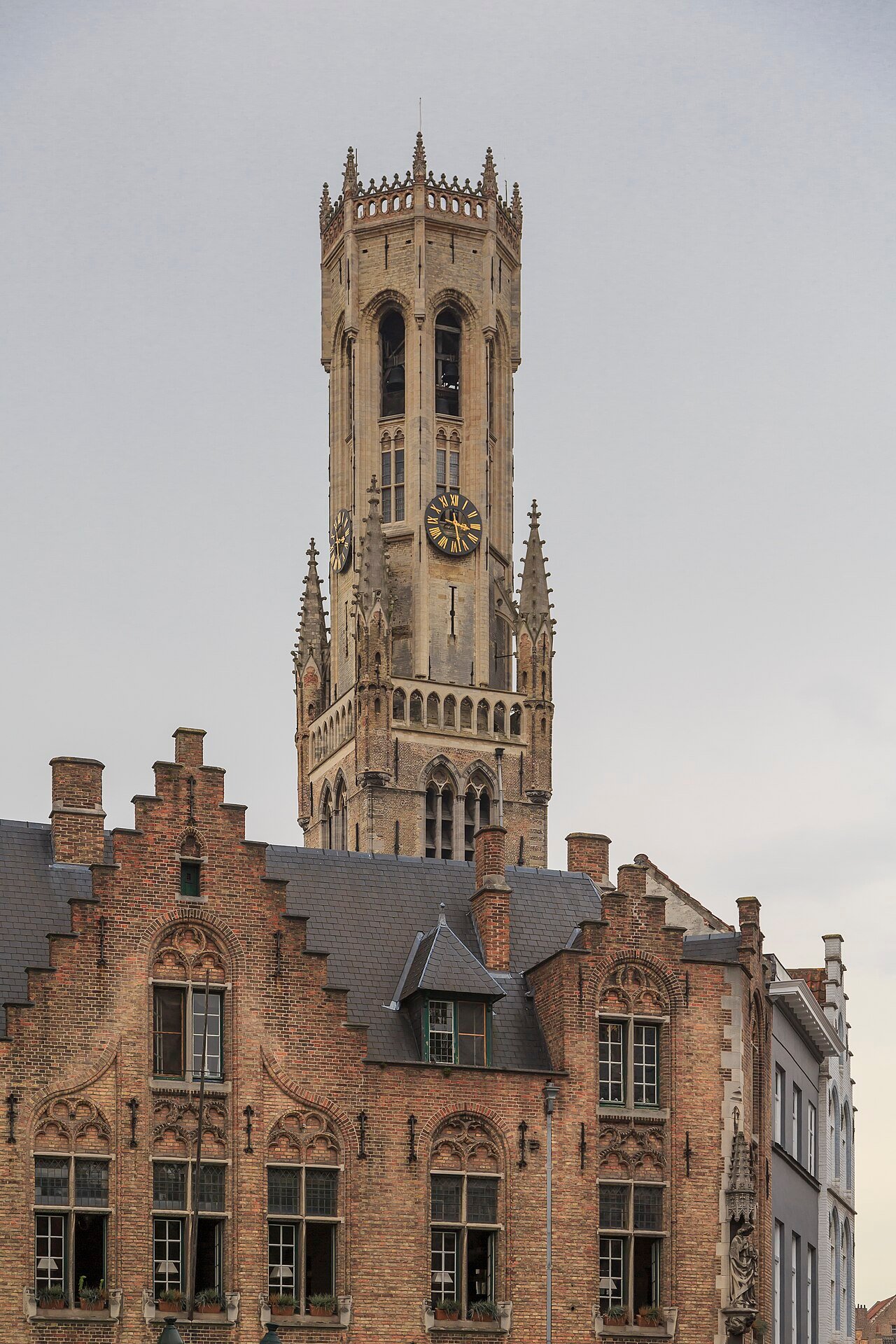
Inscribed in 2000, the historic centre of Bruges covers 410 hectares of medieval urban fabric that survived the twentieth century largely intact. The city rose to prominence as one of northern Europe’s leading trading hubs between the twelfth and fifteenth centuries, its wealth built on the cloth trade and its position at the meeting of Flemish and North Sea commerce. Decline followed when the Zwin channel silted up after 1500, and the halt in development that impoverishment brought inadvertently preserved the medieval street pattern, the Gothic churches, and the canal network. The 13th-century Belfry, whose municipal carillon comprises 47 bells, dominates the Markt; the Church of Our Lady nearby raises a brick spire to 115.6 metres, still the world’s second-highest brick structure. Climbing the Belfry’s 366 steps rewards visitors with a panorama across terracotta rooflines that stretches to the flat polders on every horizon.
Getting there: Intercity train from Brussels-Midi to Bruges (approximately 1 hour), then a 15-minute walk from the station to the Markt. Allow: 4–5 hours. Best for: A full day trip combining canal walks, world-class medieval art at the Groeningemuseum, and some of Belgium’s finest chocolate.
Plantin-Moretus Museum, Antwerp ~35 min by IC from Brussels-Centraal
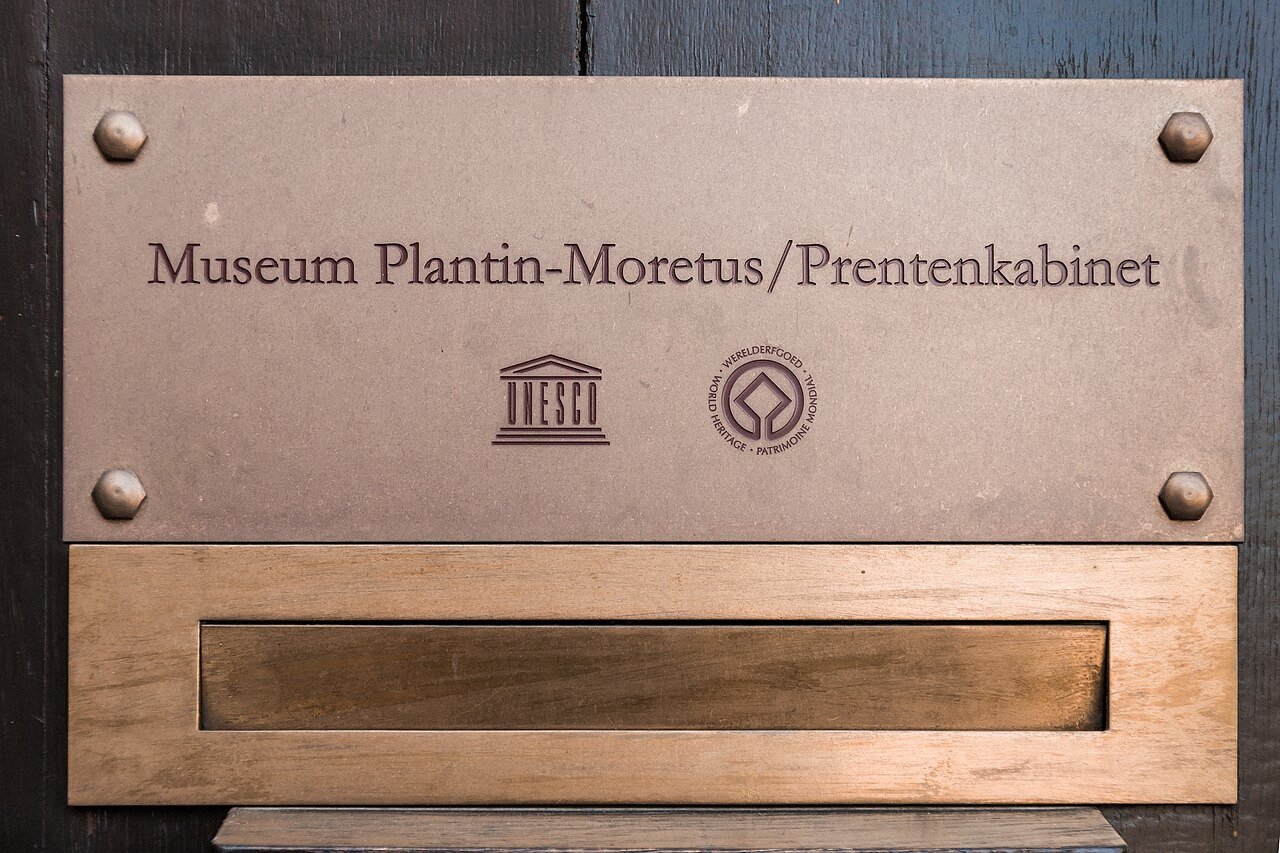
Inscribed in 2005, the Plantin-Moretus Museum is unique on the World Heritage List as the only museum to receive the designation. It occupies the residence and working printing house of Christophe Plantin, who established his press in Antwerp in the sixteenth century and built it into the largest printing enterprise in the Western world. Plantin’s most ambitious project, the Biblia Regia (or Plantin Polyglot Bible), was produced here between 1568 and 1572 across eight volumes in five parallel languages: Latin, Greek, Hebrew, Aramaic, and Syriac. After Plantin’s death the business passed to his son-in-law Jan Moretus; the Moretus family kept it operating and — crucially — preserved the full archive, including the two oldest surviving printing presses in existence, complete sets of type, punches, and matrices. In 1876 Edward Moretus sold the entire complex to the city of Antwerp. The building itself, arranged around a Renaissance courtyard, retains original furnishings, Peter Paul Rubens paintings, and the distinctive smell of old paper and iron type that permeates every room.
Getting there: Intercity train from Brussels-Centraal to Antwerp-Centraal (approximately 35 minutes), then tram or a 20-minute walk to the Vrijdagmarkt. Allow: 2–3 hours. Best for: Encountering the tangible machinery of the Information Age’s first industrial-scale operation — a rare site where you see the press, the type, and the books all in their original setting.
Flemish Beguinages — Grand Beguinage of Leuven ~25 min by IC from Brussels-Centraal to Leuven
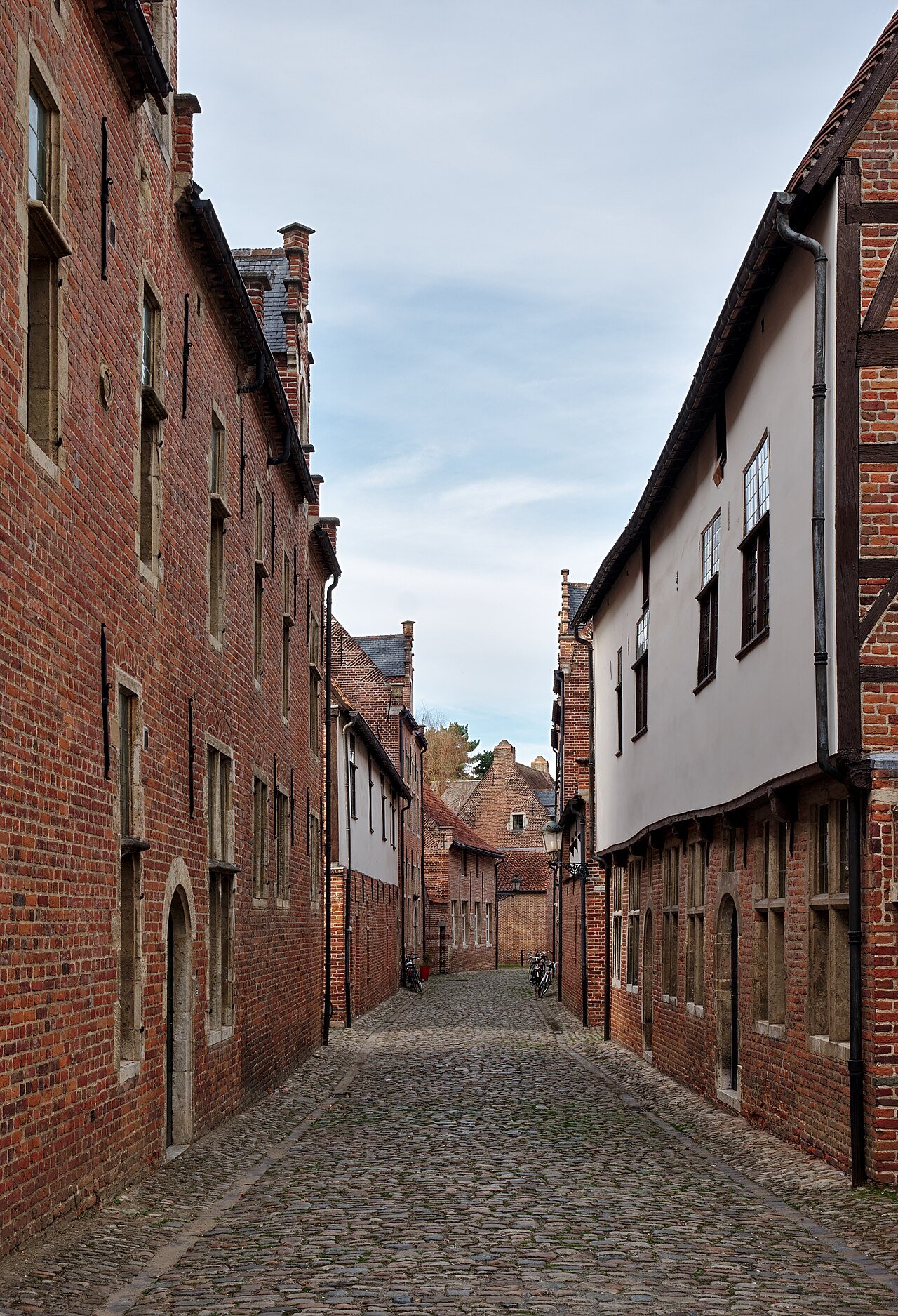
Inscribed in 1998 as part of the Flemish Beguinages group designation, the Grand Beguinage of Leuven is one of the largest surviving beguinages in the Low Countries, covering 4.2 hectares on a looped island formed by two arms of the River Dyle. Beguines were laywomen who chose a semi-religious communal life without taking permanent vows; the earliest written documentation of this community dates to 1232, and local historians have argued for a founding as early as 1205. The nearly 100 houses and apartment buildings visible today were built primarily between 1630 and 1670, their red-brick façades and crow-stepped gables forming an atmosphere of continuous domestic quietude that the surrounding city cannot penetrate. At its peak around 1650–1670 the community housed 360 residents. Restored between 1964 and 1989 by the Catholic University of Leuven following the principles of the Venice Charter, the enclave now serves as academic housing. The last beguine died in 1988. Three small bridges connect the island to the street grid; step across any one of them and the urban noise drops away almost immediately.
Getting there: Intercity train from Brussels-Centraal to Leuven (approximately 25 minutes), then a 20-minute walk south from the station. Allow: 1–2 hours. Best for: A meditative counterpoint to Brussels — a self-contained medieval neighbourhood that functions quietly as a living campus.
Neolithic Flint Mines at Spiennes ~1 hr by train to Mons, then taxi
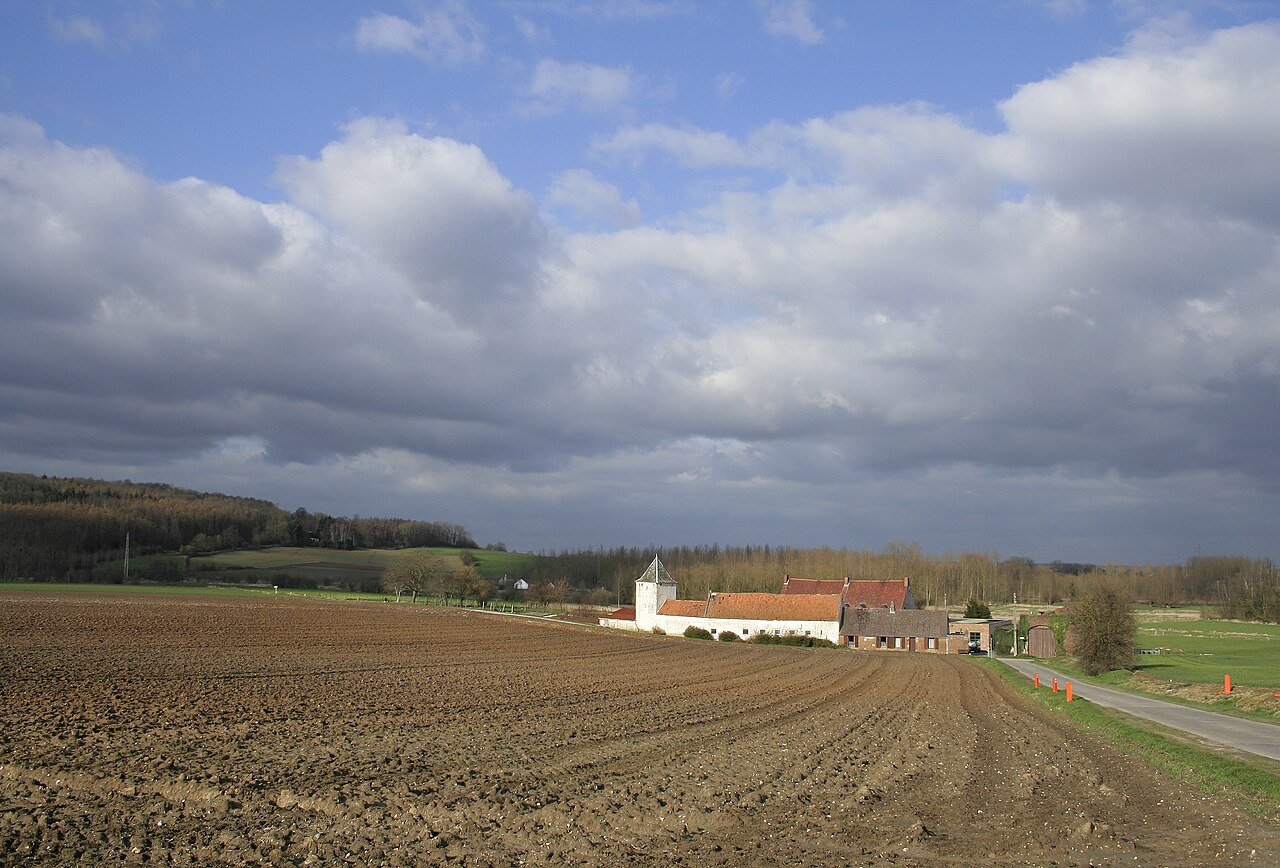
Inscribed in 2000, the Neolithic flint mines at Spiennes, a village on the southern edge of Mons, constitute the largest and earliest concentration of ancient mining pits known anywhere in Europe. Mining here began around 4,000 BCE and continued for several millennia; the high-quality flint extracted from chalk beds deep beneath the surface was knapped into axes and blades that travelled across a wide trading network reaching far beyond the Hainaut region. The site covers more than 100 hectares, though the most intensive ancient activity is concentrated in a smaller zone. Miners sank vertical shafts through overlying clay and soft chalk to reach the prized flint seams, then cut horizontal galleries outward from the shaft base — a sophisticated underground technique that implies considerable knowledge of geology and structural stability for its era. The Site et Musée des Mines de Silex de Spiennes, opened in a former railway building, presents excavated tools, reconstructed shaft sections, and interpreted stratigraphy that makes the deep, silent chalk workings legible to a general audience.
Getting there: Train from Brussels-Midi to Mons (approximately 1 hour), then taxi to Spiennes (about 5 km); the museum and site entrance are on Chemin du Thiriau. Allow: 2 hours. Best for: A genuinely rare experience — walking the surface of one of prehistoric Europe’s great industrial landscapes, with interpretive infrastructure that contextualises what is underfoot.
Frequently Asked Questions
How many UNESCO World Heritage Sites are near Brussels?
Six UNESCO World Heritage Sites lie within approximately two hours of Brussels by public transport or car. They include La Grand-Place in the city centre itself, the Historic Centre of Brugge, the Plantin-Moretus Museum in Antwerp, the Grand Beguinage of Leuven, the Four Hydraulic Lifts on the Canal du Centre, and the Neolithic Flint Mines at Spiennes near Mons.
What is the closest UNESCO World Heritage Site to Brussels?
La Grand-Place is the closest, sitting at the heart of Brussels and reachable by Metro lines 1 and 5 to Gare Centrale in minutes. The Grand Beguinage of Leuven is the closest site requiring a train journey, at roughly 25 minutes from Brussels-Centraal by Intercity service.
Can you visit multiple UNESCO sites near Brussels in a single day?
Two sites in one day is feasible with careful planning. Leuven pairs well with a morning in Brussels at the Grand-Place, since the train journey is only 25 minutes. Combining Bruges with Ghent or Antwerp in a single day is achievable but demanding; most visitors find one destination per day allows proper exploration without rushing.
Do you need to book tickets in advance for the Plantin-Moretus Museum or the Spiennes mines?
The Plantin-Moretus Museum in Antwerp accepts walk-in visitors, though booking online in advance is advisable during peak summer months to guarantee entry. The Site et Musée des Mines de Silex at Spiennes has more limited opening hours and guided underground tours that require prior reservation; check the museum’s official website before travelling.
Sources used in this article
- UNESCO World Heritage Centre — World Heritage List.
- Wikipedia — Grand-Place, Brussels.
- Wikipedia — Four lifts on the Canal du Centre.
- Wikipedia — Plantin-Moretus Museum.
- CHO — Interactive heritage map.