Climate change is now one of the most consequential threats to humanity’s shared cultural and natural legacy. While armed conflict dominates UNESCO’s List of World Heritage in Danger — 53 sites currently inscribed, with 22 in the Arab States region alone — the slow, structural pressure of a warming planet poses a different kind of danger: one that no ceasefire can resolve. Coral bleaching, glacial retreat, accelerating sea level rise, and intensifying storms are reshaping the conditions under which some of the world’s most celebrated landscapes and seascapes exist. From Cultural Heritage Online.
Climate change as a heritage threat
The 1972 World Heritage Convention was designed for a world in which threats were discrete — a dam project, a development encroachment, a conflict. Climate change breaks that model. Its effects are diffuse, cumulative, and borderless. A reef system damaged by warming waters, a glacier retreating at speed, a low-lying island site regularly inundated by storm surges: none of these fits neatly into the Convention’s original language of “outstanding universal value” under threat from a locatable cause.
UNESCO has acknowledged this gap. Its Climate and World Heritage programme, launched in the early 2000s and expanded through successive World Heritage Committee sessions, has produced a series of reports documenting how rising global temperatures intersect with site integrity. The IPCC’s Sixth Assessment Report (2021–2022) explicitly identified World Heritage sites — particularly coral reefs and glacial areas — as among the ecosystems most acutely sensitive to temperature overshoots above 1.5°C. The policy challenge is that the danger list was designed as a mobilisation tool, not a climate registry, and no climate-damaged site has yet been formally inscribed on the list solely because of climate stress.
Coral reefs: the most visible victims
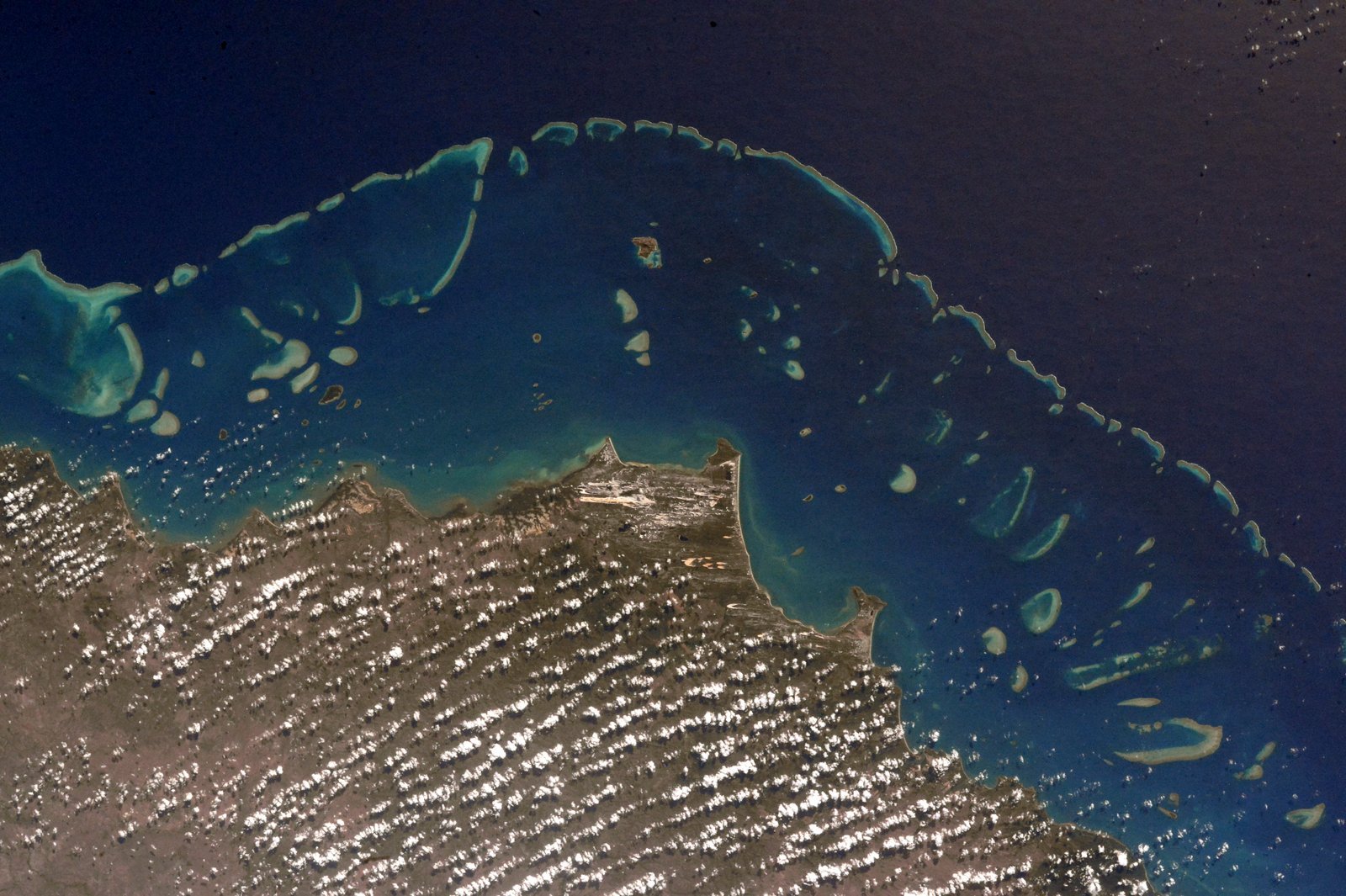
The Great Barrier Reef, inscribed as a World Heritage Site in 1981, remains the most internationally recognised test case. Australia’s reef system — the largest coral reef ecosystem on Earth, stretching over 2,300 kilometres — has experienced multiple mass bleaching events since 1998, with the 2016, 2017, 2020, and 2022 events being particularly severe. The World Heritage Committee has placed the site on its “enhanced monitoring” watch mechanism on more than one occasion, and a formal recommendation to inscribe it on the danger list was narrowly deferred following diplomatic pressure from Australia. The reef is not currently on the danger list, but its condition remains a point of sustained international scrutiny.
The Belize Barrier Reef Reserve System offers a more hopeful data point. Inscribed on the danger list in 2009 after concerns about coastal development and offshore oil concessions, it was removed in 2018 — the most widely cited recovery case in World Heritage history — after the Belizean government imposed a moratorium on offshore oil drilling and banned mangrove removal. The intervention was policy-driven rather than climate-driven, but it demonstrated that inscription on the danger list can generate the political pressure needed to produce decisive government action.
Low-lying sites and sea level rise
Several World Heritage Sites occupy island or atoll environments that are acutely vulnerable to sea level rise and intensifying cyclonic activity. Bikini Atoll, in the Marshall Islands, was inscribed in 2010 for its significance as the site of United States nuclear weapons tests conducted between 1946 and 1958. It remains largely uninhabited as a result of radiation contamination — but the broader Marshall Islands context places it within one of the world’s most climate-threatened sovereign territories. East Rennell, in the Solomon Islands, is the southernmost island in the Melanesian chain and the largest raised coral atoll in the world. Inscribed in 1998, it has faced pressure from logging, invasive species, and increasingly frequent cyclones that disrupt the freshwater Lake Tegano ecosystem at its core.
Cultural sites in coastal urban environments face analogous pressures. Venice and its Lagoon — not on the danger list as of June 2026 following Italy’s commitments on the MOSE flood barrier system — represents a recurring debate about how rising Adriatic water levels interact with the stone fabric of a medieval city. The pattern is global: heritage managers in Alexandria, Cartagena, and across the Pacific Islands are already adapting conservation plans to account for storm surge frequencies that were not anticipated when those sites were inscribed.
Glaciers, permafrost, and frozen heritage
The Swiss Alps Jungfrau-Aletsch area, inscribed in 2001, contains the largest glacier in the Alps. The Aletsch Glacier has retreated by more than three kilometres since systematic measurement began in the mid-nineteenth century, and projections under high-emissions scenarios suggest a loss of up to 90 percent of its volume by 2100. The site’s Outstanding Universal Value rests partly on geomorphological processes — on the active sculpting of landscape by ice — and that value is contingent on the glacier continuing to exist in a recognisable form.
Permafrost degradation introduces a separate category of risk. In Arctic and sub-Arctic heritage contexts, both natural sites and indigenous cultural landscapes are affected by ground instability as permafrost thaws. Wooden structures, burial sites, and submerged archaeological deposits held in perpetual cold are increasingly exposed to decay as temperatures rise. This category of loss is largely invisible in public discourse about climate and heritage, but it concerns archaeologists working across Alaska, Siberia, and northern Scandinavia.
What the international community is doing
UNESCO’s Policy Document on Climate Change and World Heritage, adopted by the World Heritage Committee in 2006 and updated subsequently, asks States Parties to integrate climate risk assessments into conservation management plans. In practice, compliance is uneven. Site managers in small island developing states frequently lack the technical and financial capacity to conduct baseline vulnerability assessments, let alone implement adaptive measures. The Green Climate Fund and UNESCO’s World Heritage Fund have provided targeted support to some sites, but the scale of funding remains disproportionate to the scale of the risk.
The most consequential lever remains global emissions reduction — a domain outside UNESCO’s remit but central to whether any heritage site in a climate-sensitive environment retains the conditions that justified its inscription. Until global average temperature rise is stabilised, conservation management at individual sites is, at best, a holding action. These sites sit alongside thousands of others on CHO’s interactive heritage map, with GPS coordinates and sourced editorial history. See our complete guide to UNESCO Sites in Danger and our explainer on UNESCO criteria.
Frequently Asked Questions
Are any UNESCO World Heritage Sites at risk from climate change?
Yes. UNESCO’s own research identifies coral reef systems, glacial areas, low-lying island sites, and coastal cultural landscapes as particularly vulnerable to climate-driven pressures including ocean warming, glacial retreat, sea level rise, and intensifying storm events. The Great Barrier Reef (Australia) and Jungfrau-Aletsch (Switzerland) are among the most frequently cited examples in scientific and policy literature.
Has any UNESCO site been lost to climate change?
No World Heritage Site has been formally delisted because of climate damage, and no site has yet been inscribed on the danger list solely on climate grounds. However, significant and measurable degradation has occurred at multiple sites — particularly coral reefs subject to repeated mass bleaching — and scientists warn that some sites may lose the attributes that qualified them for inscription within this century if emissions trajectories are not altered.
Why has the Great Barrier Reef not been placed on UNESCO’s danger list?
The World Heritage Committee has considered formal danger listing for the Great Barrier Reef on multiple occasions. Each time, Australia has committed to new conservation measures and the decision has been deferred. As of June 2026, the reef remains under enhanced monitoring but is not on the danger list. The episode illustrates the political sensitivities involved in applying the danger list mechanism to climate-threatened sites in wealthy member states.
What does UNESCO’s Climate and World Heritage programme actually do?
The programme supports research into site vulnerability, develops policy guidance for States Parties, and advocates for climate action within international negotiations. UNESCO asks countries managing World Heritage Sites to integrate climate risk into conservation management plans. It also facilitates access to climate adaptation funding for site managers, though available resources remain limited relative to the number of sites facing demonstrable climate risk.
Sources used in this article
- UNESCO — UNESCO World Heritage — Climate Change.
- UNESCO — List of World Heritage in Danger.
- CHO magazine — What is a World Heritage Site?
- CHO — Interactive map of heritage sites.