
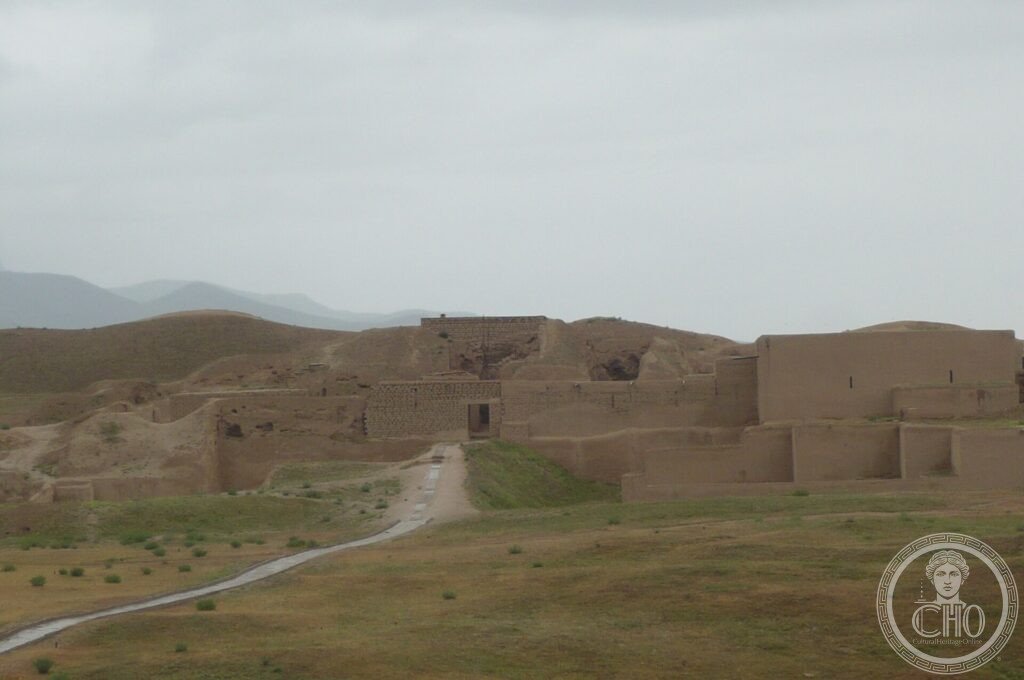
Ai piedi dei monti Kopet Dag, in Turkmenistan, sorgono le rovine in terra cruda di Nisa, una delle prime capitali dei Parti: l’impero arsacide che per quasi cinque secoli contese a Roma il dominio dell’Oriente. Mura, sale e tesori sepolti raccontano una civiltà che fondeva tradizioni persiane, greche e delle steppe.
At a glance
The Parthian Fortresses of Nisa, near Ashgabat in Turkmenistan, are the earthen remains of one of the first capitals of the Parthian Empire, the Arsacid dynasty that ruled much of the Near East for nearly five centuries and was Rome’s great rival in the East. Built of mud brick at the foot of the Kopet Dag mountains, the two fortified sites — Old and New Nisa — preserve palaces, temples, treasuries and fortifications, and have yielded works of art blending Persian, Greek and Central Asian traditions. They were inscribed by UNESCO in 2007.
Key facts
- UNESCO: World Heritage since 2007 (Parthian Fortresses of Nisa)
- Parthian capital: an early seat of the Arsacid empire
- Rome’s rival: the Parthians long contested the East with Rome
- Earthen architecture: mud-brick palaces, temples and walls
- Two sites: Old Nisa and New Nisa
- Cultural fusion: art mixing Persian, Greek and steppe styles
History
The Parthians, a people from the steppes, rose in the 3rd century BC to build an empire stretching across Iran and Mesopotamia, ruling for almost five hundred years and repeatedly checking the power of Rome. Nisa, at the foot of the Kopet Dag, was an early royal centre, with a fortified upper town of palaces and temples (Old Nisa) and a lower walled town (New Nisa).
Excavations have revealed the mud-brick architecture and treasures of Nisa, including carved ivory drinking horns (rhyta), sculptures and documents that show how Parthian culture blended Iranian, Hellenistic and nomadic elements. After the empire fell the site decayed into mounds of earth, rediscovered and studied in modern times and inscribed by UNESCO in 2007.
What you see
The site consists of two great walled enclosures of eroded mud brick on the plain below the mountains: at Old Nisa, the excavated foundations of the round hall, the square hall, temples and treasury within the ramparts; at New Nisa, the lines of the lower town’s defences. The finds, including the famous ivory rhyta, are displayed in museums in Ashgabat.
The earthen ramparts and mounds, set against the Kopet Dag, evoke a great empire now almost forgotten.
Practical information
- Site: the two enclosures are open; finds are in Ashgabat museums
- Time needed: 1–2 hours
- Note: just outside Ashgabat; combine with the city museums
- Setting: at the foot of the Kopet Dag mountains
Getting there
The Parthian Fortresses of Nisa are about 18 km west of Ashgabat, the capital of Turkmenistan, reached by road. GPS: 37.96° N, 58.20° E.
Nearby
- Ashgabat — the Turkmen capital and its museums
- Kopet Dag — the mountains along the Iran border
- Anau — an ancient site east of Ashgabat
Sources
- UNESCO World Heritage Centre — “Parthian Fortresses of Nisa” (ref. 1242)
- Government of Turkmenistan — official body
- Encyclopaedia Britannica — Parthia; Nisa
Find it on the map
See this place and what’s around it →📷 Become a Cultural Heritage Online photographer
Share your photos of places: they stay published under your name as the author. The more they're seen, the more you get noticed — and soon a contest will reward the most appreciated photos.
Log in or sign up free to add a photo