
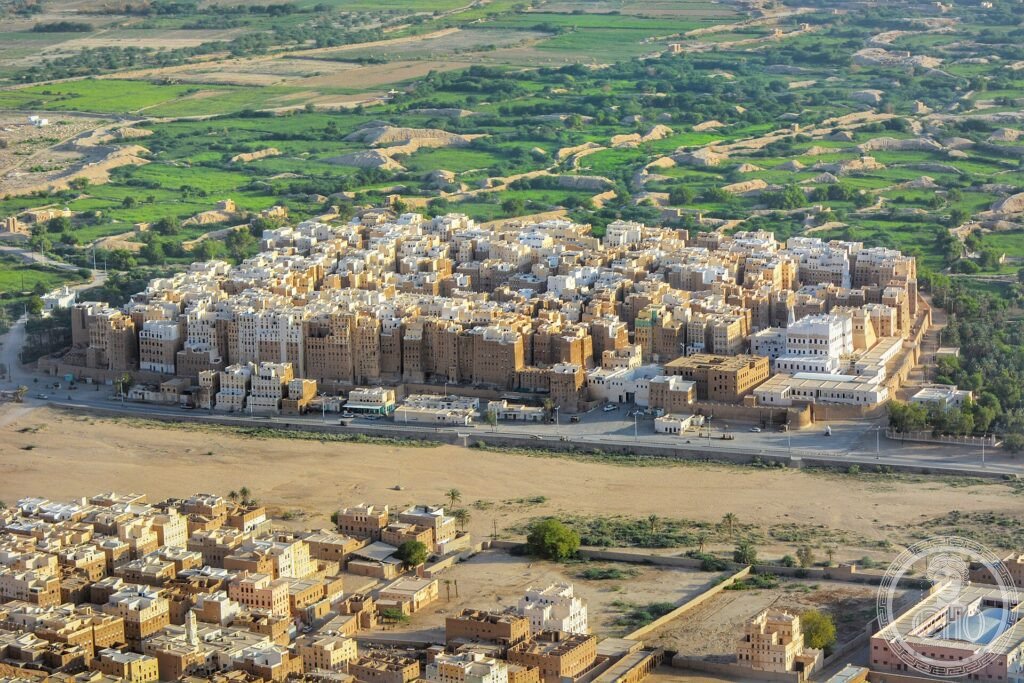
In a desert valley of Yemen stands a city that looks modern but is centuries old: Shibam, where mudbrick tower-houses up to eight storeys tall crowd inside its walls. Called the “Manhattan of the Desert”, it is the world’s oldest example of vertical urban planning.
At a glance
Shibam, in the Hadhramaut valley of Yemen, is one of the most striking towns on Earth: a walled city of mudbrick tower-houses, some rising eight storeys, packed tightly together on a grid of narrow lanes. Built mostly in the 16th century on older foundations, it is the oldest example of urban planning based on vertical construction, earning it the nickname “the Manhattan of the desert”. This dramatic feat of earthen architecture was inscribed by UNESCO in 1982.
Key facts
- UNESCO: World Heritage since 1982 (Old Walled City of Shibam)
- Tower-houses: mudbrick buildings of five to eight storeys
- “Manhattan of the desert”: the oldest vertical urban planning
- 16th century: mostly rebuilt then, on older foundations
- Walled: a compact grid town enclosed by a fortified wall
- Hadhramaut: in a great desert valley of eastern Yemen
History
Shibam stands at a strategic point in the Wadi Hadhramaut, on the caravan routes that carried frankincense and other goods across southern Arabia. After a great flood in the 16th century, the town was largely rebuilt in its present form, the houses raised ever higher within the protective wall to make the most of the limited safe ground above the flood plain.
Built entirely of mud brick, with the lower walls thick and tapering upward, the houses are constantly maintained and re-plastered against sun and rain. Lived in for centuries, Shibam remains an inhabited town, a remarkable survival of traditional earthen high-rise architecture.
What you see
From the desert the city appears as a cluster of pale and ochre towers rising sheer behind its wall, the tallest mudbrick buildings of their kind, their upper storeys often whitewashed. Within, narrow shaded lanes thread between the houses, opening onto small squares and the mosque.
The contrast of the vertical town and the flat valley, best seen from the surrounding heights, is unforgettable.
Practical information
- Town: a living city; visited respectfully on foot
- Time needed: 1–2 hours
- Note: check current travel advice for Yemen before any visit
- Setting: in the Wadi Hadhramaut, eastern Yemen
Getting there
Shibam is in the Wadi Hadhramaut of eastern Yemen, near the towns of Seiyun and Tarim. Access depends on the security situation in the country. GPS: 15.927° N, 48.627° E.
Nearby
- Seiyun — the valley town with its great sultan’s palace
- Tarim — a town of mosques and libraries in the valley
- Wadi Hadhramaut — the desert valley and its palm groves
Sources
- UNESCO World Heritage Centre — “Old Walled City of Shibam” (ref. 192)
- General Organisation for the Preservation of Historic Cities in Yemen — official body
- Encyclopaedia Britannica — Shibam
Find it on the map
See this place and what’s around it →📷 Become a Cultural Heritage Online photographer
Share your photos of places: they stay published under your name as the author. The more they're seen, the more you get noticed — and soon a contest will reward the most appreciated photos.
Log in or sign up free to add a photo