
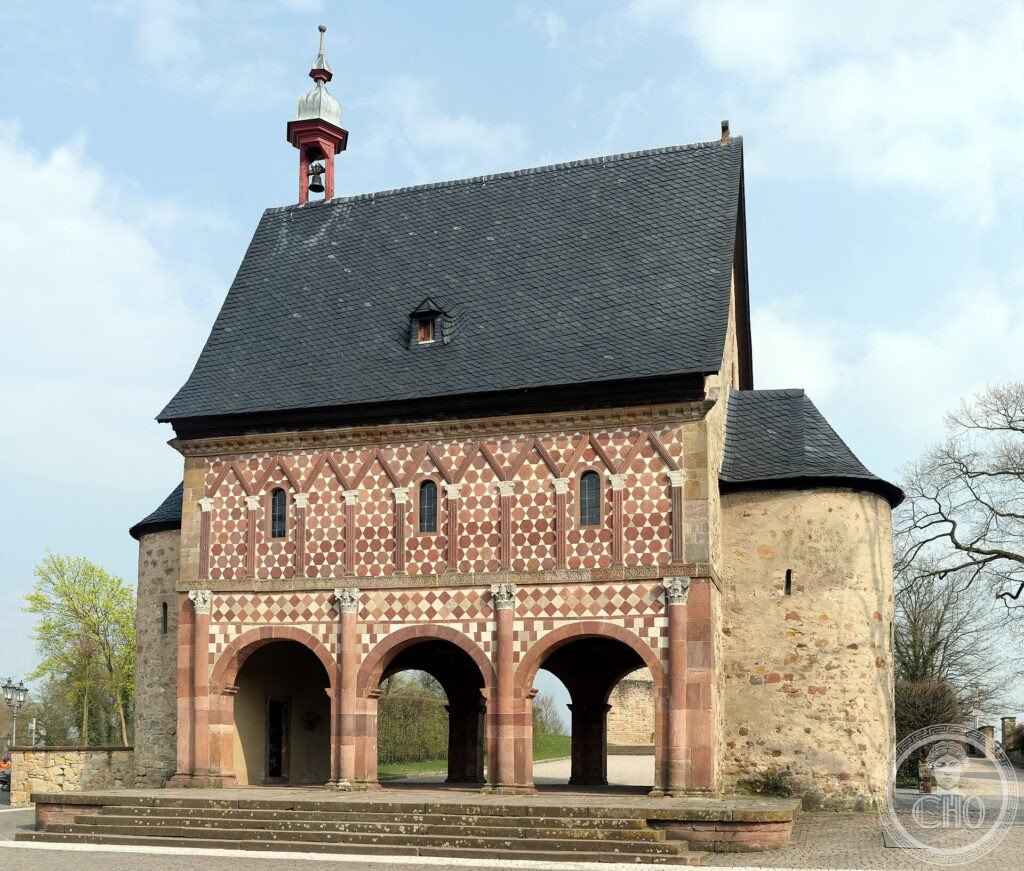
Little remains of the great imperial abbey of Lorsch, founded in 764; but what remains is precious: the Königshalle, a gatehouse hall in stone inlaid with red and white patterns, is one of the very few complete buildings to survive from the age of Charlemagne. A fragment of the Carolingian Renaissance, a bridge between Rome and the Middle Ages.
At a glance
Lorsch Abbey, founded in 764, was one of the most renowned monasteries of the Carolingian Empire, a centre of learning whose library and scriptorium shaped early medieval Europe. Of the great abbey little survives, but what does is exceptional: the Königshalle, or gatehouse, a small stone hall faced in red-and-white patterned masonry, is one of the very few complete buildings to come down from the age of Charlemagne. A jewel of the Carolingian Renaissance, the abbey remains were inscribed by UNESCO in 1991.
Key facts
- UNESCO: World Heritage since 1991 (Abbey and Altenmünster of Lorsch)
- Founded: 764, an imperial Benedictine abbey
- Carolingian Renaissance: a leading centre of learning and manuscripts
- Königshalle: the gatehouse, c. 800, a rare complete Carolingian building
- Patterned masonry: red-and-white stonework in geometric designs
- Lorsch Codex: its famous medieval chronicle and the Lorsch Pharmacopoeia
History
Founded in 764 and soon richly endowed, Lorsch became one of the cultural powerhouses of the Carolingian Empire, its monks copying and composing manuscripts — the Lorsch Codex and the Lorsch Pharmacopoeia among them — and its abbots counted among the great men of the realm. The abbey church held royal burials of the Carolingian line.
Over the centuries the abbey declined, was secularised at the Reformation, and its buildings were largely demolished or quarried. The Königshalle survived, its purpose still debated — gatehouse, hall or memorial — preserving in its decorated stone front a vivid sense of the art of Charlemagne’s age.
What you see
The Königshalle stands alone on the old abbey green: a small two-storey hall raised on three arches, its walls patterned in red and white stone like a Roman triumphal arch reimagined, with fluted pilasters above. Fragments of the abbey church and the foundations of the great monastery lie around it.
A nearby museum and the open-air remains help reconstruct the lost grandeur of the imperial abbey.
Practical information
- Site: the Königshalle and grounds are open; a museum charges entry
- Time needed: 1–1.5 hours with the museum
- Note: the interior of the Königshalle is visited on a tour
- Setting: in the small town of Lorsch in southern Hesse
Getting there
Lorsch is in southern Hesse, Germany, between Darmstadt and Mannheim, near the Bergstrasse. It is reached by road or train via Bensheim. GPS: 49.6539° N, 8.5694° E.
Nearby
- Heidelberg — the famous university city and castle, to the south
- Bergstrasse — the scenic orchard-and-wine route nearby
- Worms — a city of imperial cathedrals across the Rhine
Sources
- UNESCO World Heritage Centre — “Abbey and Altenmünster of Lorsch” (ref. 515)
- UNESCO Welterbe Kloster Lorsch — official site
- Encyclopaedia Britannica — Carolingian art; Lorsch
Find it on the map
See this place and what’s around it →📷 Become a Cultural Heritage Online photographer
Share your photos of places: they stay published under your name as the author. The more they're seen, the more you get noticed — and soon a contest will reward the most appreciated photos.
Log in or sign up free to add a photoIs this page about you?
This page is read by travellers and heritage enthusiasts who find it on Google. Tell us how you are connected to this place and we will take it from there.