

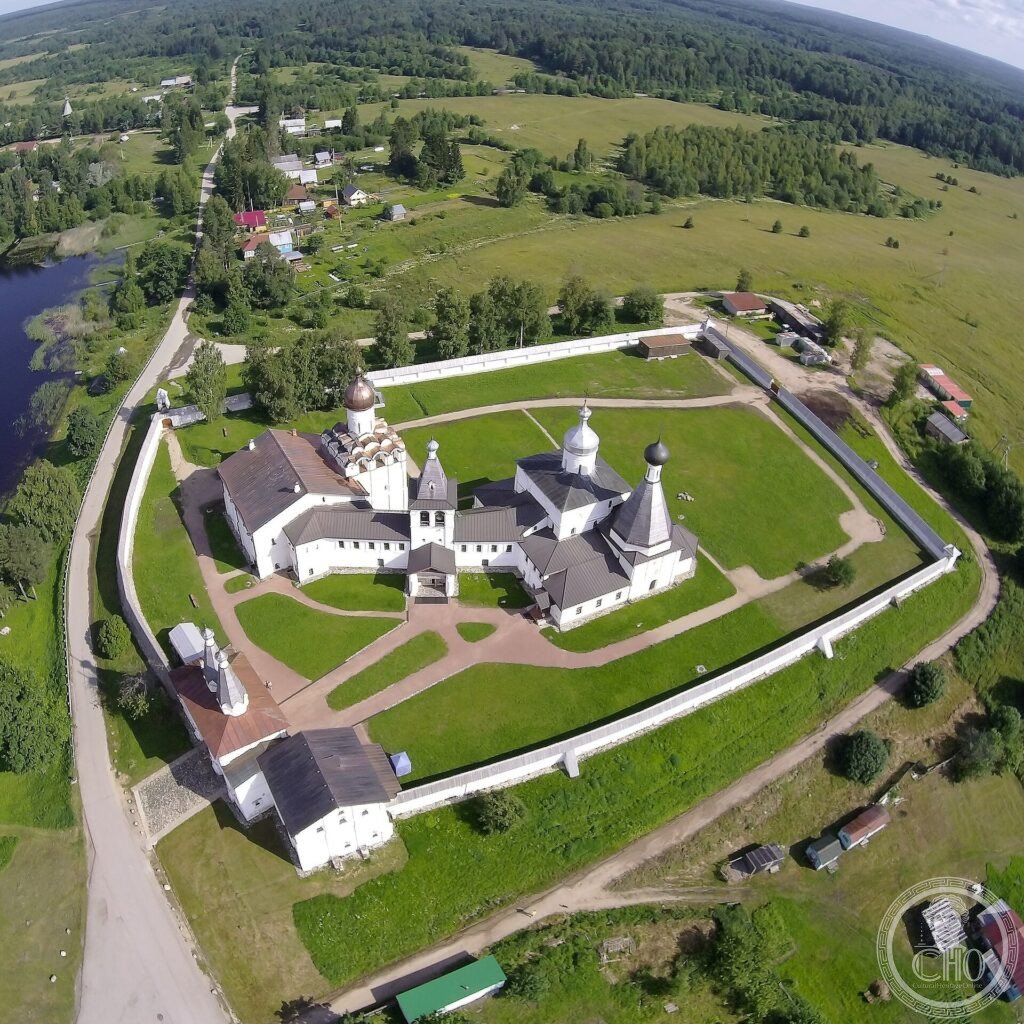
In a remote corner of northern Russia, among lakes and forests, Ferapontov Monastery holds a unique treasure: the only fully preserved fresco cycle by the great master Dionisy, painted in 1502. Soft colours and elegant figures mark the summit of Russian Renaissance painting.
At a glance
The Ferapontov Monastery, founded in 1398 in the remote lake country of northern Russia, is small but holds a treasure of world importance: the only fully preserved cycle of wall paintings by Dionisius, the greatest Russian painter of his age. Painted in 1502 in the Cathedral of the Nativity of the Virgin, the frescoes cover its walls in luminous, delicate colour. The well-preserved monastic ensemble, an exceptional example of its kind, was inscribed by UNESCO in 2000.
Key facts
- UNESCO: World Heritage since 2000 (Ensemble of the Ferapontov Monastery)
- Founded: 1398 by St Ferapont, in the northern lake country
- Dionisius frescoes (1502): the only complete surviving cycle by the master
- Cathedral of the Nativity: houses the painted cycle
- Intact ensemble: churches, refectory and bell-tower of the 15th–17th centuries
- Setting: between lakes in the Vologda region
History
The monastery was founded in 1398 by St Ferapont in the forests and lakes north of Moscow, part of a movement of monastic colonisation of the Russian north. It grew modestly but gained lasting fame when, in 1502, the painter Dionisius and his sons decorated its new Cathedral of the Nativity of the Virgin with a complete cycle of frescoes.
Dionisius, the leading icon and fresco painter of his generation, worked here in a refined, elongated style of soft colour. Because the monastery later declined and was little altered, the frescoes survived where almost all comparable cycles were lost, making Ferapontov a unique witness to Russian Renaissance painting.
What you see
The white monastery, behind its walls between two lakes, is modest in scale but harmonious. Inside the Cathedral of the Nativity, the walls glow with Dionisius’s frescoes: the Virgin and saints, processions and scenes in his unmistakable pale palette of blue, ochre and rose, the figures slender and serene.
The refectory, bell-tower and smaller churches complete an unusually intact northern monastic ensemble.
Practical information
- Cathedral: the frescoes are protected; entry is limited and weather-dependent (humidity)
- Time needed: a half day; combine with Kirillov nearby
- Note: a museum cares for the frescoes; photography may be restricted
- Access: remote; best reached by car
Getting there
Ferapontovo is in the Vologda region of northern Russia, near Kirillov, about 120 km north-west of Vologda. It is reached by road from Vologda or Cherepovets. GPS: 59.957° N, 38.567° E.
Nearby
- Kirillo-Belozersky Monastery — a vast fortified monastery nearby
- Vologda — a northern city of wooden houses and a stone kremlin
- The Russian North — lakes, forests and wooden churches
Sources
- UNESCO World Heritage Centre — “Ensemble of the Ferapontov Monastery” (ref. 982)
- Museum of Frescoes of Dionisius — official body
- Encyclopaedia Britannica — Dionisius (painter)
Find it on the map
See this place and what’s around it →📷 Become a Cultural Heritage Online photographer
Share your photos of places: they stay published under your name as the author. The more they're seen, the more you get noticed — and soon a contest will reward the most appreciated photos.
Log in or sign up free to add a photoIs this page about you?
This page is read by travellers and heritage enthusiasts who find it on Google. Tell us how you are connected to this place and we will take it from there.