
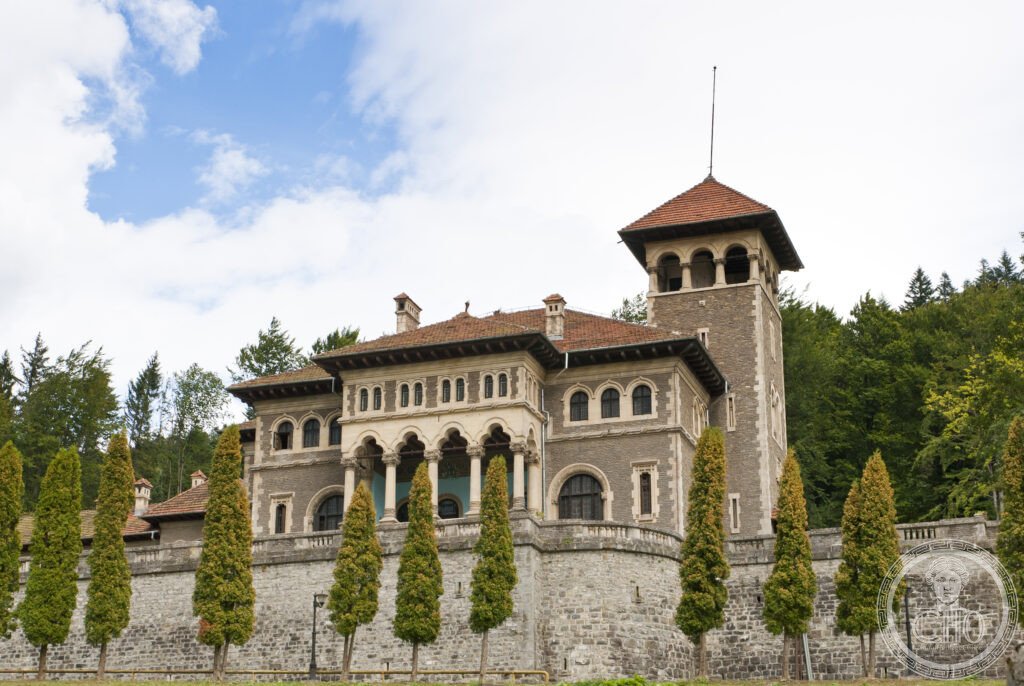
Built for Prince Gheorghe Grigore Cantacuzino, nicknamed “the Nabob”, the castle at Bușteni is one of the finest examples of the neo-Romanian style: stone arches, Brâncovenesc loggias and terraced gardens beneath the ridges of the Bucegi. Today it is also widely known as a location for international film sets.
At a glance
Cantacuzino Castle stands above the resort town of Bușteni in the Prahova Valley, below the dramatic cliffs of the Bucegi Mountains. Built in 1911 for Prince Gheorghe Grigore Cantacuzino — one of the wealthiest men in Romania, nicknamed “the Nabob” — it is a refined example of the Neo-Romanian (Brâncovenesc revival) style, which fused medieval Romanian, Byzantine and folk motifs into a national architecture. With its stone arcades, carved loggias, heraldic decoration and terraced gardens, it expresses the cultural confidence of the Romanian aristocracy on the eve of the First World War. It is now open to visitors and has gained wider fame as an international film location.
Key facts
- Built: 1911, by architect Grigore Cerchez
- For: Prince Gheorghe Grigore Cantacuzino, former Prime Minister of Romania
- Style: Neo-Romanian (Brâncovenesc revival), a national-romantic architecture
- Cantacuzino family: one of the oldest princely families of the Romanian and Byzantine world
- Gardens: terraced grounds, fountains and a grotto, with views of the Bucegi massif
- Today: museum, events venue and a noted filming location
History
The Cantacuzino family traced its origins to Byzantine nobility and produced rulers, statesmen and patrons across centuries of Romanian history. Prince Gheorghe Grigore Cantacuzino, twice Prime Minister and reputedly the richest man in the country, commissioned the castle at Bușteni in 1911 from the architect Grigore Cerchez, a leading exponent of the Neo-Romanian style. The building was conceived as a summer residence expressing both family prestige and a distinctly national architectural identity.
After the Second World War the estate was confiscated by the Communist state and put to various uses, including as a sanatorium. Restored after 1989 and returned to private heritage management, it reopened to the public and has since become a popular cultural destination, further publicised by its use as a film set.
What you see
The castle is built in grey stone with open arcades and loggias whose carved capitals and arches draw on the Brâncovenesc tradition of 17th- and 18th-century Wallachia. Heraldic motifs of the Cantacuzino family — including the double-headed eagle — appear throughout. The terraced gardens descend in levels, with fountains, a grotto and balustrades framing views toward the Bucegi cliffs and the Caraiman peak with its monumental cross. Inside, the rooms combine national-revival detailing with early 20th-century comfort.
Practical information
- Getting there: in Bușteni, on the Bucharest–Brașov rail and road line; a short walk from the centre
- Combine with: Peleș and Pelișor at Sinaia, about 10 km south
- Gardens: open to walk; the terraces are a highlight
- Time needed: 1–1.5 hours including the grounds
Getting there
Cantacuzino Castle is in Bușteni, in the Prahova Valley, on the main route between Bucharest and Brașov. Trains stop at Bușteni (about 2 hours from Bucharest); the castle is a short uphill walk from the town centre. GPS: 45.4090° N, 25.5360° E.
Nearby
- Peleș and Pelișor Castles — the royal residences at Sinaia, about 10 km south
- Bucegi Mountains — cable car from Bușteni to the plateau and rock formations
- Caraiman Cross — the monumental hero’s cross on the mountain above the town
Sources
- Cantacuzino Castle — official site (cantacuzinocastle.ro)
- Studies of the Neo-Romanian (Brâncovenesc revival) architectural style
- History of the Cantacuzino family — biographical and genealogical sources
- Institutul Național al Patrimoniului — Romanian heritage register
Find it on the map
See this place and what’s around it →📷 Become a Cultural Heritage Online photographer
Share your photos of places: they stay published under your name as the author. The more they're seen, the more you get noticed — and soon a contest will reward the most appreciated photos.
Log in or sign up free to add a photoIs this page about you?
This page is read by travellers and heritage enthusiasts who find it on Google. Tell us how you are connected to this place and we will take it from there.