
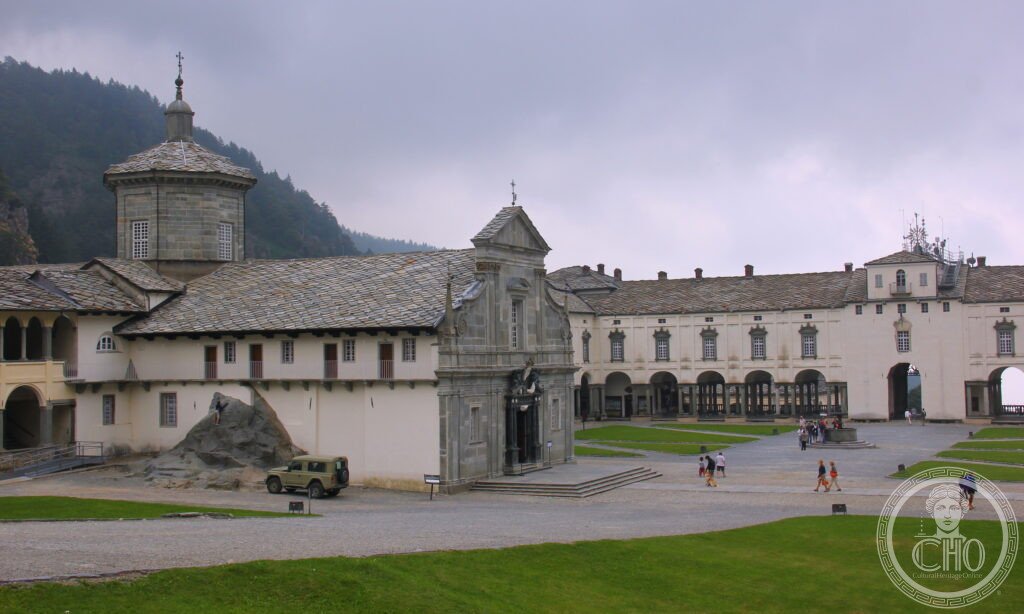
Above Biella, at 1200 metres, the sanctuary of Oropa gathers a venerated Black Madonna, a dome by Filippo Juvara and twenty chapels scattered through the surrounding woodland. It is the most important Marian shrine in Piedmont and part of the UNESCO-listed Sacri Monti of Piedmont and Lombardy.
At a glance
The Santuario di Oropa sits in the Valle d’Oropa above Biella, built around a square measuring 140 by 90 metres and enclosed on three sides by seventeenth and eighteenth-century porticoes known locally as the chiostri. Pilgrim cells once lined the upper floors of these arcades; the ground floor and courtyard still form the working heart of the sanctuary.
At its centre stands the Basilica Inferiore, begun in 1620 and completed a century later with a dome designed by Filippo Juvara. Behind it, reached through a portal at the rear of the later Basilica Superiore, the hillside opens onto the Sacro Monte, where twenty chapels are dispersed through the woodland rather than arranged along a single path, as at Varallo or Varese.
Key facts
- Founder tradition: attributed to St Eusebius of Vercelli, c.369 CE.
- Basilica Inferiore: built 1620–1720, with a dome by Filippo Juvara.
- Dome: circular plan, 20 metres in diameter, rising 35 metres to the lantern, with eight ribs and no windows in the pendentives so that light falls only from the lantern above.
- Basilica Superiore: built 1885–1960 to designs by Ignazio Galletti and Roberto Morozzo della Rocca, with a neo-Romanesque façade in grey Montorfano granite.
- Sacro Monte: twenty chapels spread across the hillside above the sanctuary.
- UNESCO status: inscribed in 2003 as part of the Sacri Monti of Piedmont and Lombardy, reference 1068.
History
According to Piedmontese devotional tradition, the sanctuary was founded by Eusebius, bishop of Vercelli and a leading opponent of Arianism in Italy, who is said to have placed a carved image of the Madonna in a cave on the Oropa hillside around 369 CE. Tradition also credits the carving itself to St Luke the Evangelist, an origin story shared by several hundred Black Madonnas across Europe. The earliest documentary trace of the shrine, however, is a parchment of 1300 held at the Archivio Capitolare di Vercelli, meaning the Eusebius attribution rests on medieval tradition rather than contemporary record, even if it remains widely accepted locally.
Oropa became the traditional coronation site of the House of Savoy: the ceremony of crowning the statue of the Black Madonna with a gold crown has been repeated roughly once a century, including in 1620, 1720, 1820, 1920 and 2020. The 1920 coronation was the most elaborate, with a crown made by the Viennese goldsmith Albert Köchert set with diamonds and emeralds donated by Piedmontese noble families; the crown remains in the sanctuary’s treasury. In 2003 the Sacro Monte di Oropa was inscribed on the UNESCO World Heritage List together with the other Sacri Monti of Piedmont and Lombardy, under reference 1068.
What you see
The oldest part of the complex is the Cappella Antica, a cave chapel whose natural rock walls and vaulted ceiling still enclose the original grotto. The carved wooden statue of the Madonna Nera, plated in a lead alloy that has darkened with age into the black finish that gives the image its name, stands in a glass case above the altar; pilgrims commonly reach out to touch the case.
In the Basilica Inferiore, entered from the south door, the Juvara dome draws the eye upward: eight ribs converge on a lantern high above the floor, and because Juvara chose not to pierce the pendentives with windows, the interior receives its light almost entirely from that single opening, producing a concentrated, vertical shaft of daylight at the centre of the space.
Behind the Basilica Superiore, a portal leads onto the Sacro Monte, where a looping trail links the twenty chapels scattered through the woods. The largest, the Cappella dell’Assunzione, dates from 1854 and contains terracotta figures by the Biella sculptor Giacomo Fantoni. From one of the higher chapels the view opens down the Valle d’Oropa towards Biella and, on clear days, across the Po plain beyond.
Practical information
- Access: the sanctuary can be reached by road from Biella or via the historic Biella–Oropa funicular, opened in 1884 and still in operation.
- Trail map: available from the sanctuary’s information office for those wishing to walk the full loop of the twenty chapels.
- Current details: opening times, transport timetables and any charges are best checked directly with the Santuario di Oropa before visiting.
Getting there
Oropa lies a short distance above Biella, reachable by road along the SS338 or by the funicular that has linked the town with the sanctuary since the nineteenth century. Regional trains connect Biella with Turin, and local buses also run up to the sanctuary.
Nearby
- Biella — the valley town below the sanctuary, with rail connections and the lower station of the historic funicular.
- Superga Basilica, Turin — the other principal religious commission of the architect Filippo Juvara, useful for comparing his work at Oropa.
Sources
- Archivio Capitolare di Vercelli
- UNESCO World Heritage List (reference 1068)
Find it on the map
See this place and what’s around it →📷 Become a Cultural Heritage Online photographer
Share your photos of places: they stay published under your name as the author. The more they're seen, the more you get noticed — and soon a contest will reward the most appreciated photos.
Log in or sign up free to add a photo