
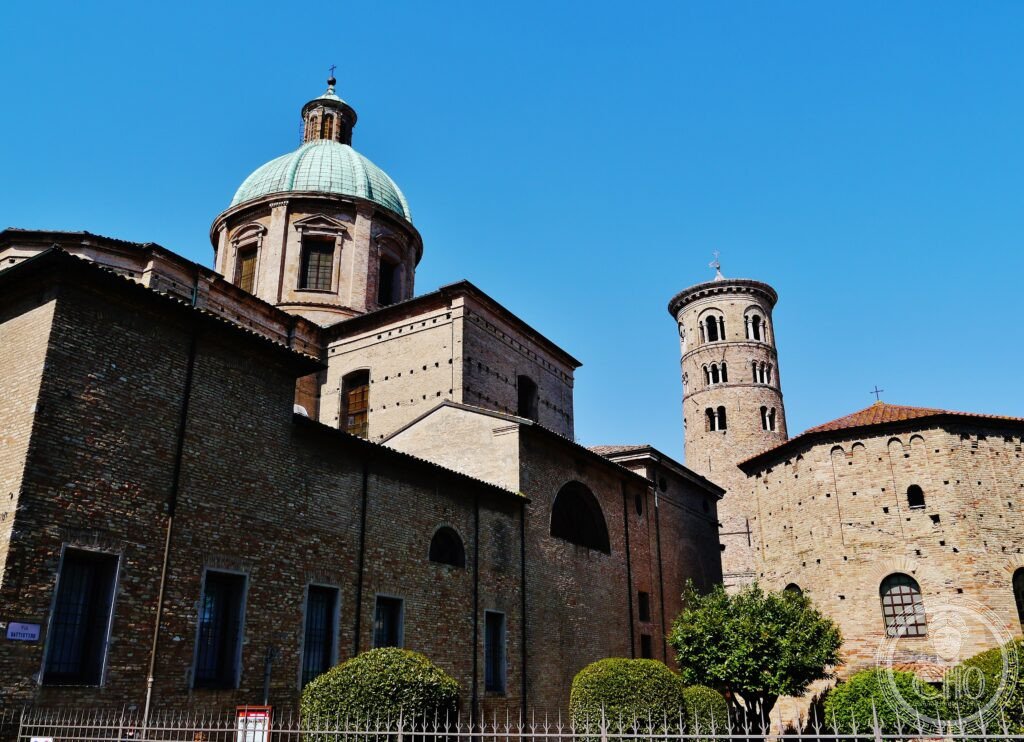
Ravenna holds the world’s largest surviving concentration of early Christian mosaics: eight buildings raised between 430 and 547 CE across three successive political worlds, the Western Roman Empire, the Ostrogothic kingdom and the Byzantine exarchate. No other city preserves mosaic work from all three traditions side by side.
At a glance
The UNESCO listing covers eight buildings scattered across Ravenna and, in one case, the nearby village of Classe. The Mausoleo di Galla Placidia, from around 430 CE, is the oldest of the group and holds a deep blue starfield ceiling over its central crossing. The Battistero Neoniano, from around 458 CE, has a dome mosaic of Christ’s baptism surrounded by prophets and apostles. The Basilica di Sant’Apollinare Nuovo, built under Theodoric in the early sixth century, carries two long processions of martyrs and virgins along its nave walls, altered after the Byzantine reconquest to remove Theodoric’s own portrait from the palace scene.
The Battistero degli Ariani, Theodoric’s own Arian baptistery, repeats the baptism theme in a cruder style, and, tellingly, omits the dove of the Holy Spirit. The Cappella Arcivescovile shows Christ dressed as a soldier rather than in liturgical robes. The Basilica di San Vitale, consecrated in 547 CE, holds the apse portraits of Justinian and Theodora and is generally treated as the centrepiece of the whole group. The Mausoleo di Teodorico, a two-storey decagonal tomb roofed with a single monolithic limestone slab, is included for its architecture rather than for any mosaic. The Basilica di Sant’Apollinare in Classe, a short distance south of the city, closes the group with an abstract Transfiguration mosaic in its apse.
Key facts
- Type: serial UNESCO inscription of eight early Christian and early medieval monuments
- Built: between about 430 and 547 CE, spanning the Western Roman, Ostrogothic and Byzantine periods
- Centrepiece: Basilica di San Vitale, with the apse mosaics of Emperor Justinian I and Empress Theodora
- Inscription in the mosaic: Bishop Maximianus of Ravenna is the only figure named directly in any of the panels
- Literary link: Dante Alighieri died in Ravenna in 1321 and is buried in the city
- UNESCO status: inscribed in 1996, reference 788
History
In 402 CE the Emperor Honorius moved the Western imperial court from Milan to Ravenna, a city protected on three sides by marshland and reachable by land only along a single causeway. The defence worked: Ravenna went untouched during the Visigothic sack of Rome in 410 and the Vandal sack in 455. Galla Placidia, daughter of Theodosius I and regent of the Western Empire from Ravenna between 423 and 437 CE, is commemorated by the mausoleum that bears her name, though she was in fact buried in Rome and the sarcophagus inside has always been empty.In 493 CE Theodoric the Great made Ravenna his capital after completing his conquest of Italy. An Arian Christian ruling a largely orthodox population, he nonetheless proved an effective administrator, and the buildings raised under him, including Sant’Apollinare Nuovo and the Battistero degli Ariani, show little overt sign of doctrinal difference beyond the omission of the dove in the baptistery dome. Byzantine forces under Belisarius took the city in 540 CE on behalf of Justinian I, establishing the Exarchate of Ravenna as the seat of Byzantine government in Italy. San Vitale was consecrated under Bishop Maximianus in 547, seven years into Byzantine rule.
Dante Alighieri died in Ravenna in September 1321, having completed the final cantos of the Paradiso there; the city has repeatedly refused Florentine requests for the return of his remains. His present tomb, built in the eighteenth century, still stands in the city. The eight monuments were together inscribed on the UNESCO World Heritage List in 1996 under reference 788.
What you see
In San Vitale the north apse panel shows Justinian standing at the centre, flanked by Bishop Maximianus, the only figure whose name is inscribed above his head, together with soldiers, clergy and attendants; the arrangement of overlapping feet marks out a hierarchy, with the emperor advancing and the rest following. The opposite panel shows Theodora with a jewelled crown, a chalice in her hands, and a retinue of court ladies; it is treated as the only surviving contemporary portrait of her. Comparison with coin portraits of Justinian, which show him bearded from the early 540s, is generally used to support the identification of the central figure in the mosaic.
At Sant’Apollinare Nuovo the two processions of martyrs and virgins run the length of the nave, and close inspection of the palace scene shows curtains and disembodied hands where Theodoric’s own image is thought to have once appeared. At Sant’Apollinare in Classe, some distance from the other sites, the apse mosaic reduces the Transfiguration to a gold cross set in a starfield, and a detached Romanesque bell tower stands apart from the early Christian church.
Practical information
- Combined access: several of the eight sites can be visited on a single combined ticket; the Basilica di San Vitale is generally ticketed separately or paired with the Mausoleo di Galla Placidia. Check the official Ravenna mosaics or municipal tourism site for current arrangements.
- Timing: opening hours vary by site and by season; confirm directly with each monument or the official visitor information channel before travelling.
- Sequence: the sites are spread across the city, with Sant’Apollinare in Classe some distance outside the centre, so a visit is best planned around a full morning or day.
Getting there
The Basilica di San Vitale stands on Via San Vitale in central Ravenna, within walking distance of the city’s other main mosaic sites. Sant’Apollinare in Classe lies outside the centre, in the village of Classe.
Nearby
- Mausoleo di Galla Placidia — within the same San Vitale complex, in the historic centre of Ravenna.
- Battistero Neoniano and Basilica di Sant’Apollinare Nuovo — both within Ravenna’s historic centre, part of the same UNESCO group.
- Basilica di Sant’Apollinare in Classe — about five kilometres south of Ravenna, in the village of Classe.
- Dante’s tomb — in the historic centre, on Via Dante Alighieri.
Sources
- UNESCO World Heritage List (reference 788, Early Christian Monuments of Ravenna)
Find it on the map
See this place and what’s around it →📷 Become a Cultural Heritage Online photographer
Share your photos of places: they stay published under your name as the author. The more they're seen, the more you get noticed — and soon a contest will reward the most appreciated photos.
Log in or sign up free to add a photoIs this page about you?
This page is read by travellers and heritage enthusiasts who find it on Google. Tell us how you are connected to this place and we will take it from there.