
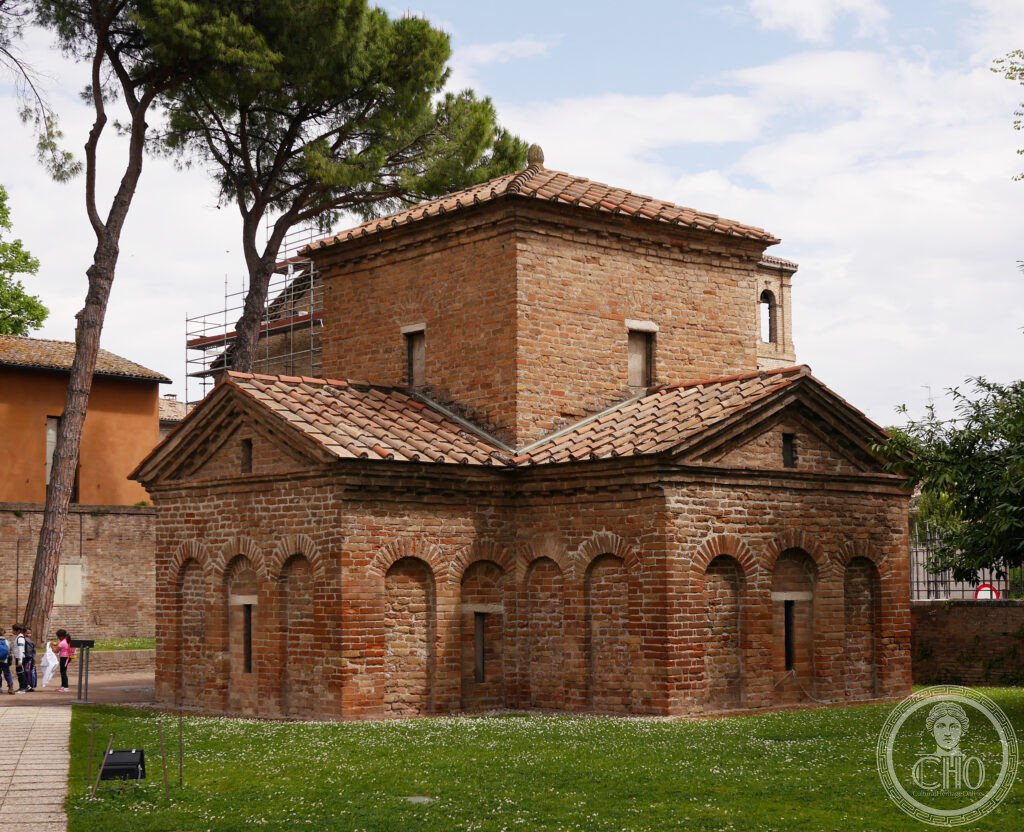
Ravenna holds eight early Christian and Byzantine monuments raised between the fifth and sixth centuries, when the city was in turn capital of the Western Roman Empire, the Ostrogoth kingdom and the Byzantine exarchate. Their interiors carry one of the most complete surviving mosaic cycles from that period, including the paired portraits of Justinian and Theodora at San Vitale.
At a glance
Ravenna served as the capital of the Western Roman Empire from 402, when Emperor Honorius moved the imperial court from Milan, until 476. It then became the seat of the Ostrogoth Kingdom of Italy under Theodoric the Great, and after 540 the capital of the Byzantine Exarchate under Justinian I. Each of these courts commissioned mosaic decoration for the city’s churches and mausolea, so the surviving cycles trace a continuous line of work running from the 430s to the middle of the sixth century.
Eight monuments make up the group recognised by UNESCO in 1996: the Mausoleo di Galla Placidia, the Battistero Neoniano, the Basilica di Sant’Apollinare Nuovo, the Battistero degli Ariani, the Basilica di San Vitale, the Mausoleo di Teodorico, the Basilica di Sant’Apollinare in Classe and the Cappella Arcivescovile.
Key facts
- San Vitale: begun around 527 under Bishop Ecclesius and consecrated in 547; its architect is not recorded.
- Plan: an octagonal double-shell church with a seven-lobed apse, unusual for its time and later taken as a model for Charlemagne’s Palatine Chapel in Aachen.
- Justinian mosaic: on the south apse wall, the emperor appears frontal and haloed, flanked by Bishop Maximian, clergy and the imperial guard.
- Theodora mosaic: on the north apse wall, the empress and her retinue are shown at the threshold of the sanctuary.
- Oldest cycle: the Mausoleo di Galla Placidia, of around 430, holds the earliest of the eight mosaic programmes.
- Inscription: the group of eight monuments was placed on the UNESCO World Heritage List in 1996, reference 788bis.
History
Ravenna became the Western imperial capital in 402, when Honorius transferred the court from Milan; the surrounding marshes offered a defensive advantage that the open plain around Milan lacked, a choice that seemed vindicated when Alaric’s Visigoths sacked Rome in 410. The city remained capital of the Western Empire until 476. Galla Placidia, daughter of Theodosius I, had been taken hostage during that same sack of Rome; she later returned to Ravenna and acted as regent for her son Valentinian III between 423 and 437. The mausoleum built in her name was probably never used for her burial, since she died in Rome.
After 476, Theodoric the Great ruled Ravenna as king of the Ostrogoths from 493 to 526, keeping much of the Roman administrative structure and senatorial class in place and, though himself an Arian Christian, tolerating the Nicene Catholic population. Byzantine forces under General Belisarius reconquered Italy between 535 and 540, and Ravenna fell without a siege after its citizens were persuaded the two sides had reached terms on the city’s independence. Justinian I then commissioned the San Vitale and Sant’Apollinare in Classe mosaics as monuments to the reconquest.
Centuries later, Dante Alighieri, exiled from Florence in 1302, spent his final years in Ravenna under the protection of Guido Novello da Polenta and died there in September 1321. His tomb, a Neoclassical building of 1780 next to the Basilica di San Francesco, draws more visitors than any other site in Ravenna apart from San Vitale; Florence has repeatedly asked for the return of his remains, and Ravenna has always refused.
What you see
At San Vitale, the octagonal nave opens onto a semidome where Christ, shown young and beardless in the manner of early sixth-century Ravenna rather than the bearded Pantocrator of later Byzantine art, sits on a blue globe flanked by archangels and offers the crown of martyrdom to San Vitale. Below, on the two long apse walls, the mosaics of Justinian and Theodora face each other, each surrounded by courtiers and clergy rendered in fine detail, down to the Chi-Rho on a soldier’s shield and the embroidered Magi on the hem of Theodora’s robe.
The nearby Mausoleo di Galla Placidia is small and cruciform, its vault covered in a deep blue ground against which the Good Shepherd sits among his flock in a still largely naturalistic, Roman manner. The Battistero Neoniano and the Battistero degli Ariani, both octagonal, carry ceiling mosaics of the Baptism of Christ surrounded by processing apostles, the second built for Ravenna’s Arian Christian community. In Sant’Apollinare Nuovo, long processions of virgins and martyrs move along the nave walls toward Christ and the Virgin. Outside the city, at Classe, the apse of Sant’Apollinare in Classe shows the saint standing in a schematic paradise landscape of grass, trees and sheep, while the Mausoleo di Teodorico, built of Istrian limestone under a single monolithic stone roof, stands apart from the group in having no mosaic decoration at all.
Practical information
- Combined ticket: a multi-site pass covering most of the eight monuments, excluding the Cappella Arcivescovile, can be bought at the tourist office in Piazza San Francesco; check the official Ravenna tourism channels for current terms and validity.
- Time needed: allow several hours to take in the main group of monuments in the city centre, since the mosaic programmes reward slow looking.
- Classe: Sant’Apollinare in Classe lies outside the city centre and is usually visited as a separate stop.
Getting there
The monuments are concentrated in central Ravenna, with San Vitale on Via San Vitale, while the Basilica di Sant’Apollinare in Classe stands about five kilometres south of the city. Current transport options and access details are best checked through Ravenna’s official tourism information.
Nearby
- Tomba di Dante — in the city centre, next to the Basilica di San Francesco; the poet’s tomb, built in 1780.
- Basilica di Sant’Apollinare in Classe — about 5 km south of Ravenna, with its apse mosaic of Sant’Apollinare in paradise.
- Battistero degli Ariani — in the city centre, the baptistery built for Ravenna’s Arian community.
- Mausoleo di Teodorico — on the edge of the city, the unadorned stone tomb of the Ostrogoth king.
Sources
- UNESCO World Heritage List
- Ravenna Tourist Office
Find it on the map
See this place and what’s around it →📷 Become a Cultural Heritage Online photographer
Share your photos of places: they stay published under your name as the author. The more they're seen, the more you get noticed — and soon a contest will reward the most appreciated photos.
Log in or sign up free to add a photo