
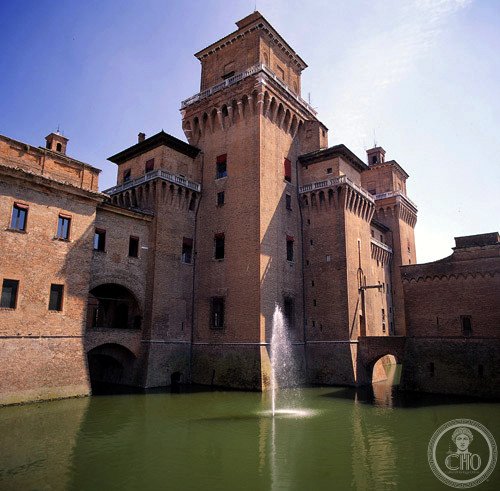
Ferrara grew from a medieval river town into the seat of the Este court and then, in the 1490s, into the first city in Europe to be doubled in size according to a single planned Renaissance grid. The castle, the cathedral and Biagio Rossetti’s new quarter still stand as built.
At a glance
Ferrara was ruled by the Este family for over three centuries and became one of the most culturally active courts of the Italian Renaissance, drawing poets, painters and musicians from across Europe. In 1492 Duke Ercole I d’Este commissioned the architect Biagio Rossetti to double the size of the city to the north, an undertaking known as the Addizione Erculea and regarded as the first systematically planned Renaissance urban extension in Italy. The moated Castello Estense, the Cathedral of San Giorgio and Rossetti’s own Palazzo dei Diamanti remain the principal landmarks of the historic centre.
Key facts
- Este rule: the Este dynasty governed Ferrara from 1240 to 1598, using the Castello Estense as their seat.
- Addizione Erculea: Biagio Rossetti’s planned extension of the city, commissioned in 1492 and largely built by around 1510.
- Corso Ercole I d’Este: the straight main axis of the new quarter, running for roughly three kilometres from the castle moat to the northern wall.
- Palazzo dei Diamanti: built between 1493 and 1567, faced with several thousand diamond-shaped marble blocks.
- UNESCO status: Ferrara was inscribed as a World Heritage Site in 1995, with the listing extended in 1999 to include the Po Delta.
History
The Castello Estense was begun under Nicolò II d’Este as a fortified, moated seat with four towers. Under Niccolò III d’Este the court became notorious for a family scandal: in 1425 the duke discovered that his young wife Parisina Malatesta and his illegitimate son Ugo were lovers, and had both executed within the castle. The episode later inspired Byron’s poem Parisina and Donizetti’s opera Lucrezia Borgia.
Through the fifteenth century the Este court became a major centre of the arts, hosting the medallist Pisanello, the Flemish painter Roger van der Weyden and Piero della Francesca, and giving rise to the distinctive Ferrara School of painting associated with Cosimo Tura, Francesco del Cossa and Ercole de Roberti. Ludovico Ariosto was born in Ferrara in 1474 and wrote Orlando Furioso there; Torquato Tasso grew up at the Este court and completed Gerusalemme Liberata during his years in the city.
In 1492, the same year Ercole I d’Este became duke, Rossetti began the Addizione Erculea, doubling Ferrara’s footprint with a planned grid of streets. The Este line ended in 1597 when the last male heir died without legitimate issue; Pope Clement VIII annexed Ferrara to the Papal States, and the Este moved their court to Modena in 1598. Ferrara remained under papal rule until it joined unified Italy in 1860, and the historic centre was inscribed by UNESCO in 1995, with the listing extended in 1999 to cover the Po Delta.
What you see
The Castello Estense still stands at the heart of the city, its four towers and surrounding moat largely intact; the cell traditionally identified with Parisina’s imprisonment can be visited and is marked with a plaque. Facing the castle, the Cathedral of San Giorgio shows its construction in layers on a single facade, with a Romanesque lower zone from 1135, Gothic additions from the following two centuries, and a Renaissance upper section added in the sixteenth century; the portal sculpture and the Last Judgement tympanum are notable survivals, and the adjoining Cathedral Museum holds further Este-era art.
Walking north along the Corso Ercole I d’Este traces Rossetti’s planned axis through the Addizione Erculea. At the main intersection stands the Palazzo dei Diamanti, its facade covered in thousands of angled marble bosses that catch the light differently as the viewer moves past, an effect said to be most visible in the afternoon. The palace now houses the Pinacoteca Nazionale di Ferrara, whose collection of Ferrara School painting, including works by Tura and del Cossa, is considered one of the best places to see this style. Further along Via Ariosto stands the poet’s own house, viewable from the street and occasionally open by appointment. The city’s Renaissance walls form a continuous circuit that can be walked or cycled, and the stretch at the north-east corner gives a clear view over the Addizione Erculea’s street grid.
Practical information
- Castello Estense: open to visitors most days, with the dungeon accessible as a separate guided option; check the castle’s own visitor information for current arrangements.
- Palazzo dei Diamanti and Pinacoteca: open most days; temporary exhibitions run alongside the permanent Ferrara School collection, so it is worth checking the current programme in advance.
- City walls: the full Renaissance circuit is open for walking or cycling at any time.
- Best season: spring and autumn are recommended, as summer in the Po plain is hot and humid; July brings the Ferrara Summer Jazz Festival, which draws international musicians to the city.
Getting there
Ferrara is well connected by train from Bologna, with the station a short walk or cycle ride from the Castello Estense, and is also reachable from Venice and Milan with a change of train. The city is flat and considered one of the most cycle-friendly in Italy, and the main sights of the historic centre and the Addizione Erculea can comfortably be covered by bicycle, with rental available near the station.
Nearby
- Po Delta — added to Ferrara’s UNESCO listing in 1999 as an extension of the original inscription, covering the wetland landscape at the mouth of the River Po.
Sources
- UNESCO
- George Gordon Byron, Parisina
- Gaetano Donizetti, Lucrezia Borgia
- Ludovico Ariosto, Orlando Furioso
- Torquato Tasso, Gerusalemme Liberata
Find it on the map
See this place and what’s around it →📷 Become a Cultural Heritage Online photographer
Share your photos of places: they stay published under your name as the author. The more they're seen, the more you get noticed — and soon a contest will reward the most appreciated photos.
Log in or sign up free to add a photo