
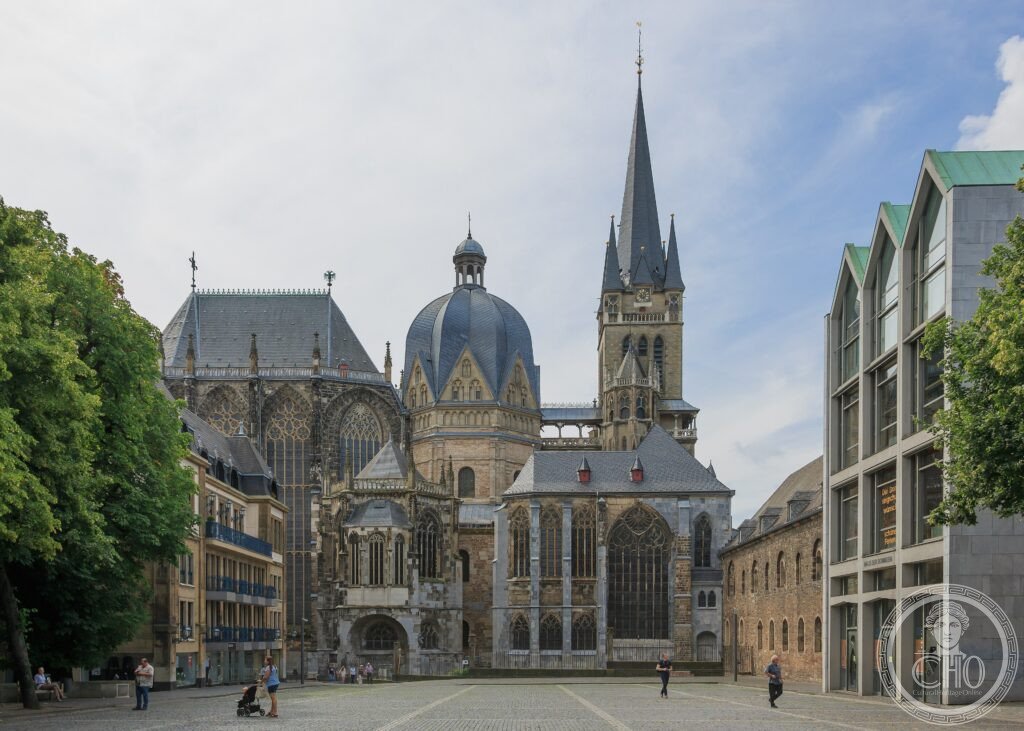
Aachen Cathedral began as Charlemagne’s Palatine Chapel, a domed octagon built to match the grandeur of Rome and Byzantium. Thirty Holy Roman Emperors were later crowned within its walls, and it became the first building ever placed on the UNESCO World Heritage List.
At a glance
At the heart of Aachen Cathedral stands the Carolingian octagon that Charlemagne commissioned as his palace chapel, consecrated in 805 CE. Its architect, Odo of Metz, is the only Carolingian-era architect whose name survives in the records. The double-shell structure, with a sixteen-sided outer wall around an eight-sided inner rotunda rising to a dome some 31.5 metres high, drew directly on the Byzantine church of San Vitale in Ravenna, a deliberate echo intended to place Charlemagne’s new empire on equal footing with Rome and Constantinople.
The chapel went on to serve as the coronation church of the Holy Roman Empire and, from the twelfth century, as a major pilgrimage site following the canonisation of Charlemagne himself.
Key facts
- Consecrated: 805 CE, in Charlemagne’s presence
- Architect: Odo of Metz
- Dome height: around 31.5 metres
- Coronations held here: Holy Roman Emperors and kings, from Otto I in 936 CE to Ferdinand I in 1531 CE
- UNESCO status: inscribed in 1978, the first site ever added to the World Heritage List
History
Charlemagne began using Aachen as his preferred residence from 768 CE and established it as the permanent capital of the Carolingian Empire in 794 CE. On Christmas Day 800 CE, Pope Leo III crowned him Emperor of the Romans in Rome, a title that gave the Aachen project its imperial ambition. The Palatine Chapel itself was built between roughly 792 and 805 CE under Odo of Metz and consecrated with Charlemagne present. He died in 814 CE and was buried within the chapel, though the precise original location of his grave is debated.
Otto I was crowned here in 936 CE, the first of thirty subsequent coronations that continued into the sixteenth century. In 1165 CE, Emperor Frederick Barbarossa arranged the formal canonisation of Charlemagne, a move that served his own political rivalry with the papacy but also created the Aachen pilgrimage, drawing crowds to venerate the emperor’s relics and the cathedral’s four Great Relics, still displayed every seven years. The building itself grew over the centuries: an Ottonian westwork tower was added around 1000 CE, and a Gothic choir was built between 1355 and 1414 CE to accommodate the growing number of pilgrims. A town fire in 1656 CE caused further damage. In 1978, Aachen Cathedral became the first site ever inscribed on the UNESCO World Heritage List, a distinction owed to the alphabetical listing of the inaugural round of twelve sites rather than any ranking of importance, though it has since become closely associated with the World Heritage programme itself.
What you see
The Carolingian octagon remains the heart of the building, its gold-ground mosaic ceiling a modern recreation of the original medieval design showing Christ enthroned among the twenty-four elders. Ancient Roman columns, brought north from Ravenna and Rome by Charlemagne himself, still stand in their original positions, a rare direct physical link to the Roman Empire. The bronze entrance doors, complete with their wolf’s-head handles, date from around 800 CE and remain in daily use some twelve centuries later.
On the upper gallery sits Charlemagne’s marble throne, assembled from plain Roman marble slabs with no ornamentation, used for royal enthronements from 800 CE until 1531 CE. The Cathedral Treasury, or Domschatzkammer, holds one of the most significant collections of Carolingian and medieval goldsmith work anywhere, including the Karlsschrein, the gilded reliquary shrine made for Charlemagne’s remains around 1215 CE under Frederick II, the Ottonian Lothair Cross from around 1000 CE, and the Bust Reliquary of Charlemagne of around 1350 CE, said to contain the crown of his skull. The Gothic choir, built between 1355 and 1414 CE, is lit by seven tall stained-glass windows among the largest to survive from the medieval Gothic period in Germany, and several further chapels, including the Hungarian Chapel of 1367 CE, were added during the Ottonian and Hohenstaufen periods.
Practical information
- Access: the main nave, the Carolingian octagon and the choir are open to visitors free of charge during visiting hours; guided tours of the cathedral run at intervals from the main entrance
- Treasury and throne: access to the Cathedral Treasury and to Charlemagne’s throne is arranged separately; check the cathedral’s official channels for current terms
- Great Relics: displayed publicly every seven years, with the next showing due in 2028
Getting there
Aachen is well connected by rail, with regular services from Cologne, from Brussels, and from Amsterdam via Eindhoven, as well as by road from Cologne along the A4 Autobahn. The cathedral stands in the historic centre of Aachen, within walking distance of the main railway station.
Nearby
- Domschatzkammer (Cathedral Treasury) — adjoining the cathedral, housing its collection of Carolingian and medieval goldsmith work
Sources
- UNESCO World Heritage Committee
Find it on the map
See this place and what’s around it →
📷 Become a Cultural Heritage Online photographer
Share your photos of places: they stay published under your name as the author. The more they're seen, the more you get noticed — and soon a contest will reward the most appreciated photos.
Log in or sign up free to add a photoIs this page about you?
This page is read by travellers and heritage enthusiasts who find it on Google. Tell us how you are connected to this place and we will take it from there.