
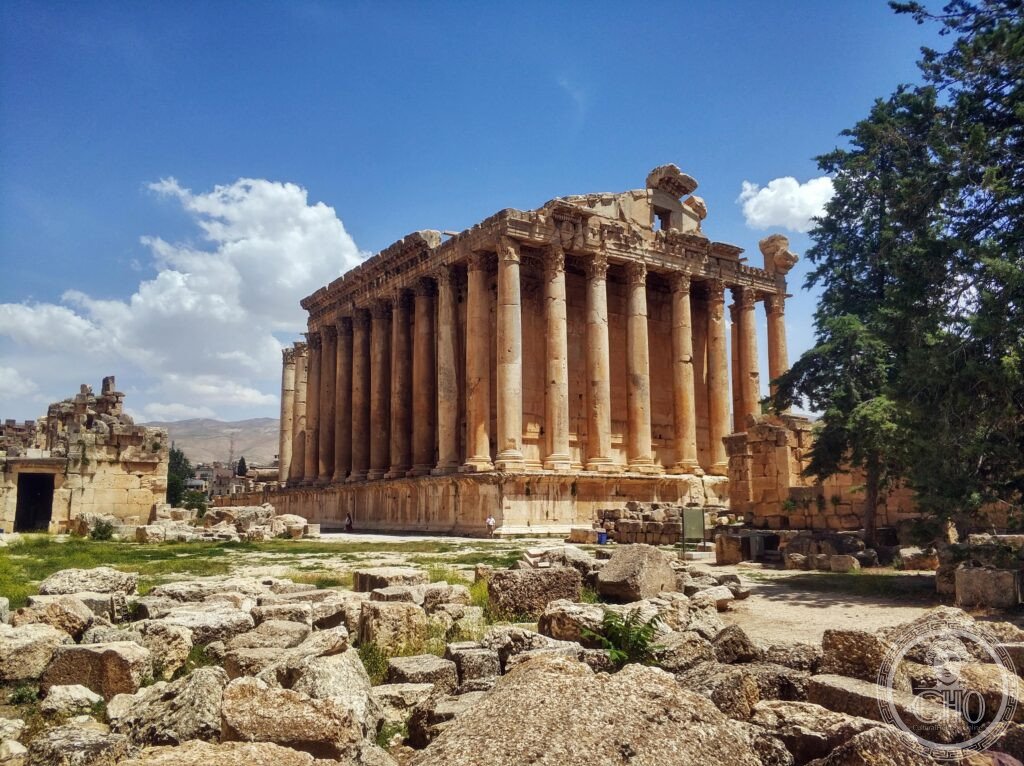
Baalbek preserves the largest temple complex the Romans ever built, raised over Roman Syria’s most sacred site. Six towering columns still mark the Temple of Jupiter, and beneath its podium lie three stone blocks of such size that no ancient writer ever explained how they were moved or lifted into place.
At a glance
Baalbek, known to the Romans as Heliopolis, stands in Lebanon’s Beqaa Valley. Its name comes from Phoenician: Baal, meaning lord or master, and Bek, the local name for the valley, so Baalbek means Lord of the Beqaa Valley. Under Roman rule the site was dedicated to the Heliopolitan Triad, a local reworking of older gods: Jupiter Heliopolitanus, linked to storm and sky and descended from the Phoenician Baal; Venus Heliopolitana, goddess of fertility; and Mercury, identified with the Phoenician Adonis.
The scale of the complex is what sets Baalbek apart. The Temple of Jupiter is larger in area than the Parthenon in Athens and than the Temple of Hadrian at Ephesus, and its columns were cut from some of the largest stone drums ever quarried in antiquity.
Key facts
- Temple of Jupiter: the largest Roman temple ever built, roughly 88 by 89 metres, with an original height of about 52 metres including its roof.
- Columns: originally 54 Corinthian columns, each about 20 metres tall and 2.2 metres in diameter; six survive today, the rest lost to earthquakes, reuse as building material, or dismantling for a Byzantine church built inside the temple after 535 CE.
- The Trilithon: three stone blocks in the temple’s western podium wall, each about 750 tonnes and 21 metres long, set roughly 7 metres above ground level and among the largest stones ever placed in a human construction.
- The Quarry Stone: known locally as the Stone of the Pregnant Woman, an unfinished block of around 1,000 tonnes still lying in the quarry near the temples, apparently abandoned as too heavy to move.
- Temple of Bacchus: about 69 metres long with 42 Corinthian columns, widely regarded as the best-preserved Roman temple of its size anywhere.
History
The site was already sacred by the second millennium BCE, when a Phoenician cult of Baal, the storm god, was tied to a spring at the foot of the Anti-Lebanon mountains. After Alexander the Great passed through the Beqaa Valley, the Seleucid king Antiochus IV Epiphanes began a Hellenistic sanctuary here.
Julius Caesar founded Baalbek as a Roman colony in 47 BCE, and construction of the Temple of Jupiter began under Augustus. The complex grew over roughly two and a half centuries, with the Temple of Bacchus completed under Antoninus Pius. In 535 CE the emperor Justinian ordered pagan temples closed, and a Byzantine church was built inside the Temple of Jupiter using stone taken from its colonnade.
Following the Islamic conquest of 634 CE, Baalbek’s Roman stones were reused in an Arab fortress, later modified by the Mamluks. An earthquake in 1759 brought down the temple’s northern colonnade, leaving only six of the original 54 columns standing.
What you see
Visitors approach through the Propylaea, the monumental entrance gate whose columns once stood 12 metres tall; only the foundations survive in full. Beyond lies an unusual hexagonal forecourt, followed by the Great Court, where semicircular exedrae along the long sides once gathered worshippers before the main temple.
The Temple of Jupiter’s six remaining columns dominate the view across the Beqaa Valley from the temple platform. A staircase beneath the podium leads to the Trilithon, the three enormous stones set into the western wall.
The Temple of Bacchus, standing largely intact, keeps its decorated ceiling coffers and a monumental doorway nearly 12 metres tall, carved with an elaborate program of gods and mythological scenes considered among the finest surviving examples of Roman decorative carving. South of the main complex, the small circular Temple of Venus, with its concave niches, is one of the few surviving examples of Roman round temple design.
Practical information
- Opening and entry: hours and entry fees change; check the site’s official channel before travelling.
- Security: the Beqaa Valley has been affected by regional conflict in recent years; current travel advisories from national governments should be checked before planning a visit.
- Coordinates: 34.0040° N, 36.2090° E.
Getting there
The nearest international airport is Beirut Rafic Hariri International, roughly 87 kilometres to the west. From Beirut, shared taxis run from the Cola transport hub and buses run from Dawra bus station; both routes reach Baalbek, though journey times and fares should be checked locally rather than assumed in advance.
Nearby
- Anjar — about 55 kilometres southwest, a UNESCO World Heritage Site inscribed in 1984 and the only Umayyad city in Lebanon.
Sources
- UNESCO
Find it on the map
See this place and what’s around it →📷 Become a Cultural Heritage Online photographer
Share your photos of places: they stay published under your name as the author. The more they're seen, the more you get noticed — and soon a contest will reward the most appreciated photos.
Log in or sign up free to add a photoDo you manage this place?
This page is read by travellers and heritage enthusiasts who find it on Google. Keep it accurate — and make it work for you. Free for non-profit heritage institutions.