
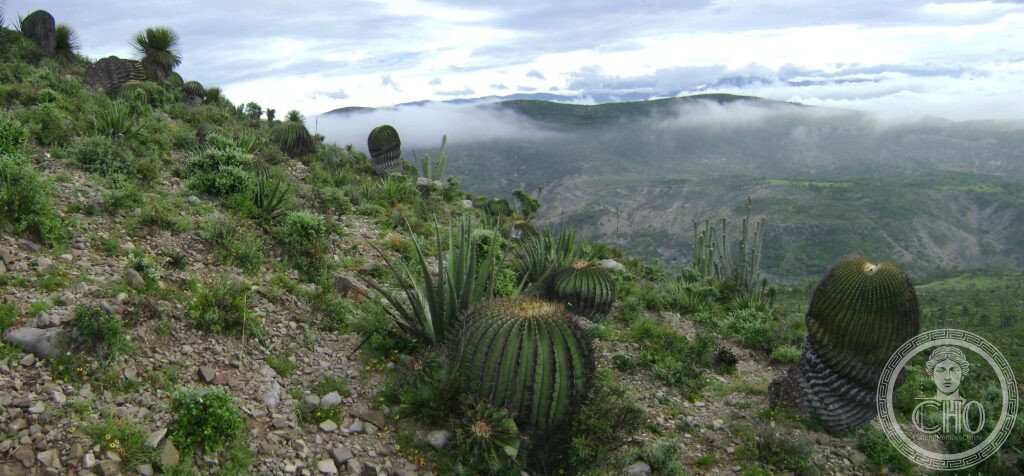
A rain-shadow valley on the Puebla-Oaxaca border holds the most biodiverse dryland ecosystem in the Western Hemisphere and the archaeological evidence for the domestication of maize and chili, the agricultural experiments that reshaped world food history.
At a glance
The Tehuacán-Cuicatlán Valley sits in a rain shadow between the Sierra Madre del Sur and the Sierra Madre Oriental, one of the driest parts of Mexico with annual rainfall of only 300 to 500 millimetres. Despite this aridity, the valley supports 294 species of cactus, 83 of them found nowhere else on Earth, a concentration said to exceed that of the Sonoran Desert or the Atacama.
Giant columnar cacti, Pachycereus weberi, rise up to 12 metres and can be over a century old, forming dense forests across the hillsides that are among the most striking botanical landscapes in the Americas. The valley is also a centre of agave diversity, with 25 species providing the raw material for pulque, mezcal and fibre in pre-Hispanic times, and it is where wild teosinte was first cultivated into domesticated maize, the ancestor of all corn grown today.
Key facts
- Location: straddles the Puebla-Oaxaca state border, central Mexico
- Protected area: a 145,000-hectare arid valley
- Biodiversity: 294 cactus species, 83 endemic; 25 agave species
- Agricultural significance: earliest known domestication of maize in the Americas and one of the primary centres of chili domestication
- Hydraulic heritage: pre-Hispanic underground aqueducts known as puquios or botaderos, built on the same principle as Persian qanats
History
The valley’s principal pre-Hispanic cultures were the Popoloca, a Nahua-related people present from around 900 CE, and the Mixtec, whose highland civilisation expanded into the valley between 1200 and 1500 CE. The Mixtec left the most substantial architectural remains, at the site of Cuthá on Cerro Colorado, where a ceremonial centre with pyramid bases and stone tombs includes painted murals depicting the 365-day and 260-day calendar cycles.
The valley’s deeper significance lies in its role in agricultural history. Excavations led by Richard MacNeish between 1960 and 1964, particularly the Coxcatlán Cave sequence, produced the earliest evidence in the Americas of maize domestication, dated to roughly 5,000 to 3,500 BCE, when wild teosinte was selectively cultivated by early Mesoamerican farming communities. Microbotanical evidence from cave sites also points to chili pepper domestication in the valley as early as 7,500 BCE, with modern varieties including jalapeño, serrano, ancho, mulato, pasilla and chile de agua descended from these Tehuacán cultivars.
Between roughly 900 and 1500 CE, the Popoloca and Mixtec built the puquio system, underground channels that carried water from springs to terraced milpa fields without loss to evaporation. The system is thought to have irrigated enough land to support a pre-colonial population in the valley of more than 50,000 people.
What you see
Given the scale of the protected area, most visitors concentrate on a few accessible points. The drive along Federal Highway 125 between Tehuacán in Puebla and Huajuapan de León in Oaxaca cuts through the heart of the cactus forest, with several pull-off viewpoints offering views of the columnar Pachycereus stands. The CANTE botanical garden at Tehuacán holds one of the finest specialised cactus collections in the Americas, drawing specimens from across the valley.
Coxcatlán Cave, reached from the village of Coxcatlán, is the site of MacNeish’s maize-domestication excavations and now houses a small museum. Near the village of San Marcos Tlapazola, sections of the puquio aqueducts can be visited with local guides.
Practical information
- Best time to visit: the dry season, October to May, with cactus flowering concentrated in March and April
- Climate: altitude of around 1,600 metres moderates temperatures through the year
- Where to stay: Tehuacán serves as the main base, with a small number of midrange hotels including Hotel México Inn and Hotel Iberia
- Guided visits: local guides can be arranged for the puquio aqueducts near San Marcos Tlapazola; check current arrangements with local operators
Getting there
Tehuacán is reached from Mexico City by car along the Tehuacán-Orizaba expressway or by ADO bus from the TAPO terminal, and from Oaxaca City via Highway 135D. Tehuacán itself makes the most practical base for exploring the valley.
Nearby
- Peñafiel Mineral Springs — in Tehuacán itself; the mineral springs that gave the city its reputation, with a bottling plant still in operation and a spa tradition dating back to the 16th century
- Monte Albán — about 2.5 hours south, near Oaxaca City; the Zapotec archaeological site with pyramids, a ballcourt and an observatory, dating from 500 BCE to 700 CE, inscribed as a UNESCO World Heritage Site in 1987
- Oaxaca City — around 2.5 hours away; known for its mezcal, mole negro and chocolate traditions
Sources
- Wikipedia
- Richard MacNeish
- UNESCO
Find it on the map
See this place and what’s around it →📷 Become a Cultural Heritage Online photographer
Share your photos of places: they stay published under your name as the author. The more they're seen, the more you get noticed — and soon a contest will reward the most appreciated photos.
Log in or sign up free to add a photo