
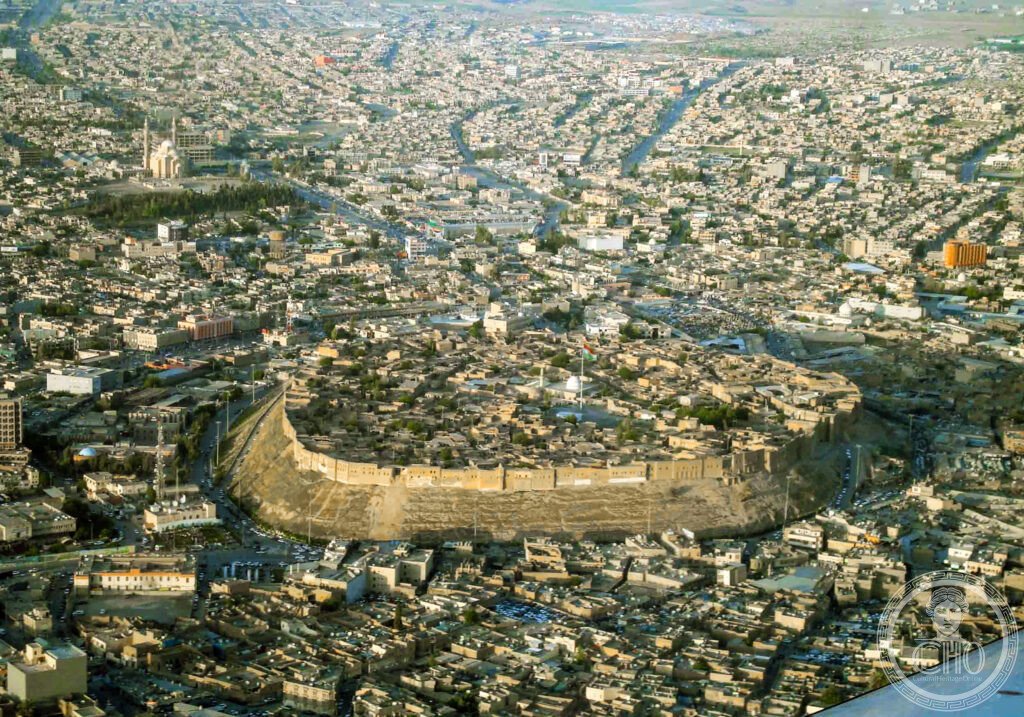
Rising some 30 metres above modern Erbil, this oval mound has carried a continuous city for at least six thousand years, through Assyrian, Median, Achaemenid, Parthian, Sassanid, Arab, Mongol, Ottoman and Kurdish hands, making it one of the longest continuously inhabited urban sites on earth.
At a glance
The Citadel of Erbil, known locally as the Qal’a or Hawler, is an oval tell roughly a kilometre in circumference, rising between 26 and 32 metres above the surrounding plain. Its summit is entirely covered by the dense townhouses of three historic quarters, the Serai, the Topkhana and the Takya, divided by two internal streets that meet at a central plaza inside the rebuilt Ottoman gateway.
A restoration programme led with UNESCO and the Aga Khan Fund for Culture, begun in 2007, has seen residents relocated so that archaeological work and conservation could proceed across the whole mound, with only one family remaining to preserve the site’s legal status as an inhabited city. Around 200 traditional courtyard houses, built with high blank street walls, an internal courtyard, vaulted iwan reception rooms and wind-catch towers for ventilation, are being restored.
Key facts
- Location: Erbil (Hawler), capital of the Kurdistan Region of Iraq.
- Form: an oval mound, or tell, about one kilometre in circumference and 26 to 32 metres high.
- Occupation: continuous settlement since at least the 5th millennium BCE, over roughly 6,000 years.
- Ancient name: Arbela, the Assyrian Arba’ilu, associated with a major temple of the goddess Ishtar.
- Status: inscribed as a UNESCO World Heritage Site in 2014.
History
Under the Assyrians the city was known as Arbela and housed one of the empire’s most important temples of Ishtar, whose oracles were consulted by kings Esarhaddon and Ashurbanipal before military campaigns; cuneiform tablets recording these prophecies survive from Nineveh. After the fall of Nineveh in 612 BCE the city passed briefly under Median control before the Achaemenid Persian conquest, serving as a staging point for Persian campaigns to the west.
Arbela gave its name to the decisive battle fought nearby in October 331 BCE, more precisely at Gaugamela, where Darius III had stationed his treasury at Arbela. Alexander the Great defeated the larger Persian army, Darius fled through the city, and Alexander seized the treasury there, an engagement that ended the Achaemenid Empire and opened his campaign eastward. In the centuries that followed, Sumerian, Akkadian, Median, Achaemenid, Seleucid, Parthian, Sassanid, Arab, Mongol, Ottoman and Kurdish communities each added their layer to the mound, and the present gateway to the citadel was rebuilt under Ottoman rule.
What you see
Visitors enter through the main gateway on the south side, an Ottoman-era structure with a vaulted entrance passage leading to the central plaza. From there the three historic quarters, the Serai, the Topkhana and the Takya, open out for walking, their dense townhouses lining narrow lanes; some restored courtyard houses are opened to the public during heritage events.
Within the citadel stands the Kurdish Textile Museum, holding a collection of Kurdish weaving, costume and embroidery. The minaret of the 17th-century Mulla Afandi Mosque rises at the summit, and its base offers views over the modern city, while certain rooftop terraces give panoramic views across the Erbil Basin from the mound’s full elevation.
Practical information
- Visa: the Kurdistan Region does not require a separate Iraq visa; a Kurdistan Region visa is issued on arrival to a range of nationalities, including EU, US and UK citizens — check current requirements with the relevant authority before travelling.
- Museum access: the Kurdish Textile Museum is open during set hours within the citadel; check current times and admission with the museum directly.
- Safety: the Kurdistan Region is generally regarded as stable for tourism, though travellers should check current government travel advisories before departure.
- Surroundings: the Qaysari Bazaar, with its silversmiths, spice market and fabric sellers, adjoins the citadel directly.
Getting there
Erbil International Airport (EBL) receives flights from Istanbul, Dubai, London Heathrow, Frankfurt, Amman, Beirut and Doha. The citadel stands in the centre of Erbil, close to international hotel chains such as Rotana, Sheraton and Marriott, and is easily combined with a visit to the Erbil Bazaar and the Kurdish Textile Museum.
Nearby
- Tell Gomel (Gaugamela) — about 70 km southwest, the probable site of the Battle of Gaugamela of 331 BCE, an unmarked tell on open agricultural land near the Mosul road.
- Shanidar Cave — about 100 km north, reached through the Rawanduz Gorge; the cave where Ralph Solecki of Columbia University excavated nine Neanderthal skeletons in 1960, including the so-called Flower Burial, though the flower hypothesis has since been partly questioned; it remains a major Palaeolithic site and can be visited as a day trip from Erbil with a guide.
Sources
- Wikipedia, Erbil Citadel
- Wikipedia, Battle of Gaugamela
- Wikipedia, Arbela, Assyria
- UNESCO, Erbil Citadel
Find it on the map
See this place and what’s around it →📷 Become a Cultural Heritage Online photographer
Share your photos of places: they stay published under your name as the author. The more they're seen, the more you get noticed — and soon a contest will reward the most appreciated photos.
Log in or sign up free to add a photo