
Few places in the Mediterranean carry as many layers as Butrint. A Greek colony, a Roman city, a Byzantine bishopric and a Venetian outpost each left their ruins on the same forested peninsula above the Vivari Channel, making the site one of Albania’s most complete records of continuous habitation.
At a glance
Butrint was inhabited continuously from around the 8th century BCE to the 15th century CE, passing in turn through Greek, Roman, Byzantine and Venetian hands before being abandoned after the Ottoman conquest of 1462. Virgil’s Aeneid places a new Troy here, built by the Trojan exiles Helenus and Andromache, complete with a stream renamed the Simois and a wall called Pergamum after their lost city. Julius Caesar and later Augustus both looked to Butrint as a site for a colony of retired legionaries, displacing the existing Greek population in the process.
Key facts
- Location: Sarandë District, on Albania’s Ionian coast, on a forested peninsula above the Vivari Channel.
- Period of habitation: roughly the 8th century BCE to the 15th century CE.
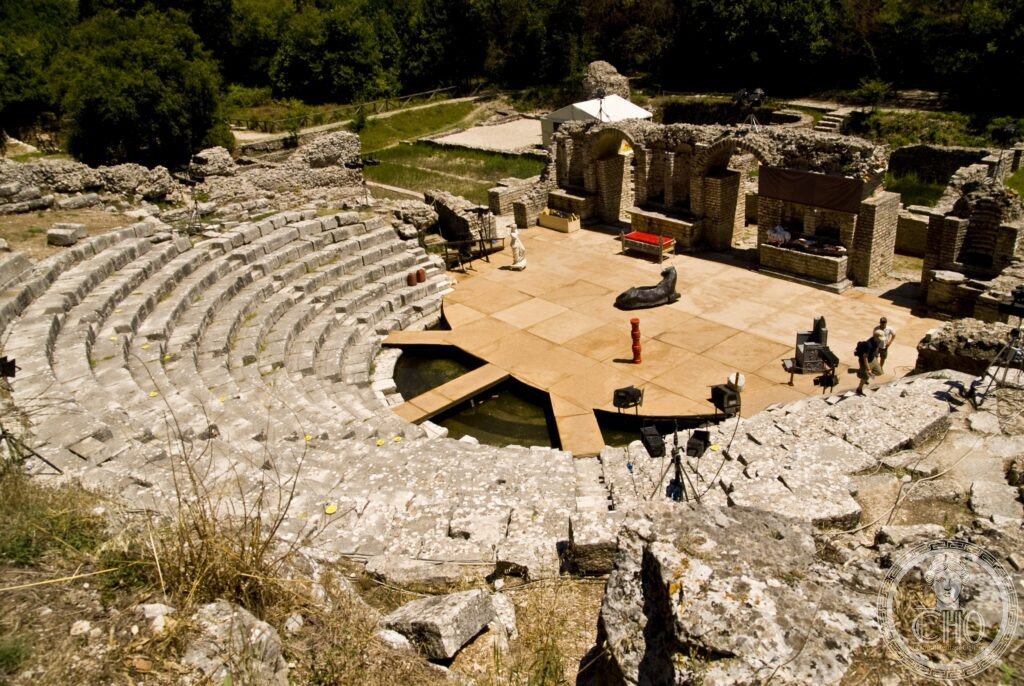
- Roman amphitheatre: originally Greek, built in the 3rd century BCE and remodelled as a Roman theatre in the 2nd century CE, with a capacity of around 2,500.
- Baptistery: a 6th-century octagonal building holding the largest and finest early Christian mosaic floor in Albania.
- Venetian castle: a triangular fortress built in the 15th century on the far bank of the channel.
- Coordinates: 39.7460° N, 20.0230° E.
History
The Roman orator Cicero had a close friend, Titus Pomponius Atticus, who owned a large estate at Butrint; Cicero’s surviving letters to Atticus mention the property repeatedly and record his own wish to visit, a sign of how the estate contributed to the city’s prosperity in the late Republic.
During the Communist period, from 1945 to 1991, the whole area around the ruins was absorbed into a state agricultural farm. Systematic archaeological work stopped for decades, and some of the inscriptions and portable finds from the site were removed to Tirana.
What you see
The Sanctuary of Asclepius, dating to the 4th century BCE, is the most important Greek structure at Butrint. Dedicated to the healing god, it drew pilgrims seeking cures and has produced numerous votive inscriptions; in the 6th century CE it was converted into a Christian basilica. Nearby stands the Lion Gate, also 4th century BCE, where a carved lion’s head set above the threshold ranks among the finest examples of Greek gate sculpture surviving in the Balkans.
The amphitheatre, begun as a Greek theatre and rebuilt by the Romans, preserves its stage building and part of its original seating and is considered the best-preserved ancient theatre in Albania; it occasionally still hosts performances. The baptistery’s mosaic floor, showing peacocks, birds, deer, dolphins and geometric patterns, is kept under a protective wooden cover, though sections remain visible. Across the Vivari Channel, reached by rowboat, the Venetian castle gives the widest view over the site and the surrounding forest.
Getting there
Butrint lies close to Sarandë on Albania’s southern coast. Travellers commonly fly into Corfu, in Greece, and cross by ferry to Sarandë, or fly into Tirana and continue south by road. From Sarandë, Butrint is reached by taxi or tour bus.
Nearby
- Ksamil Beach — about 5 km north; a stretch of small sandy beaches with four tiny offshore islands, known for some of the clearest water on this part of the Adriatic.
- Sarandë — about 18 km north; a lively Riviera town with the visible remains of the Roman city of Onchesmos along its harbour promenade, a large Greek-speaking community, and views across the Ionian Sea to Corfu.
Sources
- Wikipedia, Butrint
- Wikipedia, Baptistery of Butrint
- Wikipedia, Vivari Channel
- UNESCO, Butrint, WHS reference 570
Find it on the map
See this place and what’s around it →📷 Become a Cultural Heritage Online photographer
Share your photos of places: they stay published under your name as the author. The more they're seen, the more you get noticed — and soon a contest will reward the most appreciated photos.
Log in or sign up free to add a photo