
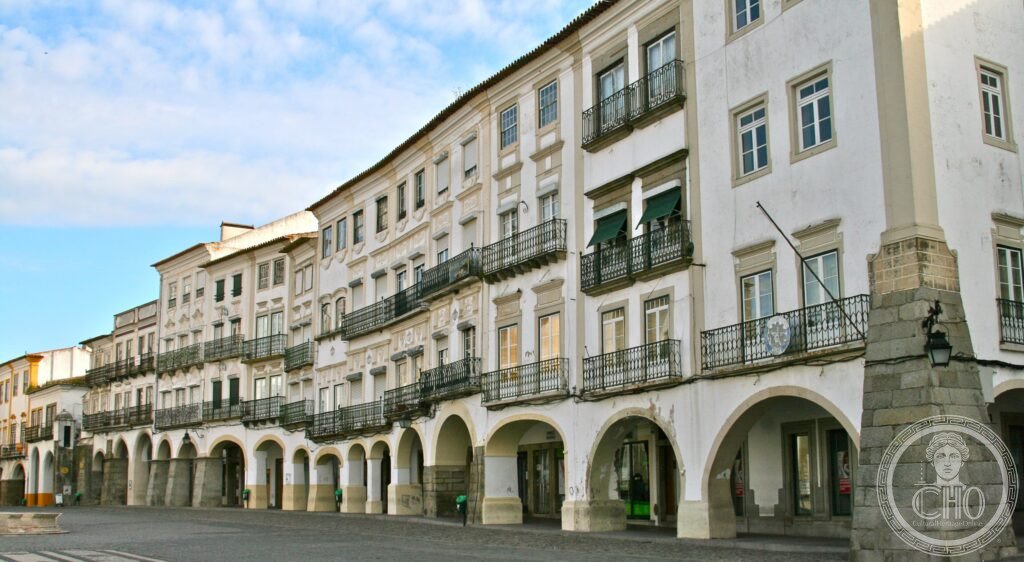
Behind medieval walls in the Alentejo plain, Évora keeps a Roman temple, a Gothic cathedral and a chapel lined with the bones of thousands of monks all within walking distance of one another, a rare concentration of layered history in a small, still-lived-in city.
At a glance
Évora was founded as the Roman municipium of Liberalitas Iulia in the 1st century BCE under Julius Caesar and became one of the most important settlements in the province of Lusitania. It later fell under Moorish rule from 715 to 1165, when it was taken by the Portuguese king Afonso Henriques; the street pattern of the old centre still follows the Moorish layout. The city sits amid the Alentejo plain, a landscape dominated by cork oak forests that supply a large share of the world’s cork.
Key facts
- Roman Temple: built in the 1st-2nd century CE, granite with white limestone capitals, 13 of an original 18 Corinthian columns still standing. Long known as the Temple of Diana, though the name is a later misattribution and the temple may have served the Imperial cult.
- Chapel of Bones: built by Franciscan friars around 1516 inside the Church of São Francisco, its walls and pillars lined with the bones and skulls of roughly 5,000 monks exhumed from overcrowded graveyards.
- Sé Cathedral: begun in 1186 and completed in 1250, the largest Gothic cathedral in Portugal, combining a Romanesque choir and apse with a Gothic nave and façade.
- Medieval walls: 14th-century fortifications, the most complete surviving set of medieval city walls in Portugal, encircling almost the whole old centre.
- University of Évora: founded by the Jesuits in 1559 under King João III.
- World Heritage status: the historic centre of Évora was inscribed as a UNESCO World Heritage Site in 1986.
History
The Roman temple survived the centuries partly by accident: in the Middle Ages it was pressed into service as a slaughterhouse and later incorporated into a defensive wall, which preserved its columns rather than destroying them.
Between the 15th and early 17th centuries Évora functioned as something like a second capital of Portugal, with the royal court spending long periods in residence. The Jesuit university, founded in 1559, reinforced the city’s standing as a centre of learning. Water was brought into the city by the Aqueduto da Prata, built in 1537 in the Roman engineering tradition and running some 18 kilometres, its arches passing directly between houses as it enters the walls.
What you see
At the centre of the old town, the Praça do Giraldo holds a marble fountain from 1571 by Afonso Álvares; the square was also the site of Inquisition executions in the 16th century. Nearby stands the Church of São Francisco, built between 1508 and 1519 in Manueline-Gothic style and the largest church in Évora, which houses the Chapel of Bones within its interior. Sections of the older Almohad inner wall, dating from the 12th century, survive within the later medieval fortifications. The Roman temple, with its granite columns and limestone capitals, remains visible from the street. The cathedral’s roof and terraces can be walked, giving views over the city and the surrounding Alentejo plain.
Practical information
- Viewing the Roman Temple: the exterior can be seen freely from the street; check current arrangements for any interior access via the official heritage authority.
- Chapel of Bones and Cathedral: both charge an entry fee; current prices should be confirmed with the respective sites before visiting.
- Time needed: the historic centre is compact and walkable, and a full day allows a reasonably thorough visit.
- Best season: spring and autumn are more comfortable than the height of summer, when temperatures in the Alentejo climb very high.
Getting there
Évora is reached from Lisbon by direct bus or train, and by car from Seville across the border in Spain. The town itself is best explored on foot once inside the walls.
Nearby
- Cromeleque dos Almendres — about 15 km west; a megalithic complex of 95 standing stones arranged in an oval, dating to the 5th-4th millennium BCE and predating Stonehenge, rarely crowded.
- Monsaraz — about 55 km east; a small fortified hilltop village above the Alqueva reservoir, with a castle built in 1167 and rebuilt in 1306, known for its sunset views over the lake.
- Mérida, Spain — about 90 km east; a Roman archaeological site inscribed as a UNESCO World Heritage Site in 1993, with a Roman theatre from 25 BCE still used for a summer classical theatre festival, a Roman bridge, and an amphitheatre from 30 BCE.
Sources
- Wikipedia
- UNESCO
Find it on the map
See this place and what’s around it →📷 Become a Cultural Heritage Online photographer
Share your photos of places: they stay published under your name as the author. The more they're seen, the more you get noticed — and soon a contest will reward the most appreciated photos.
Log in or sign up free to add a photo