
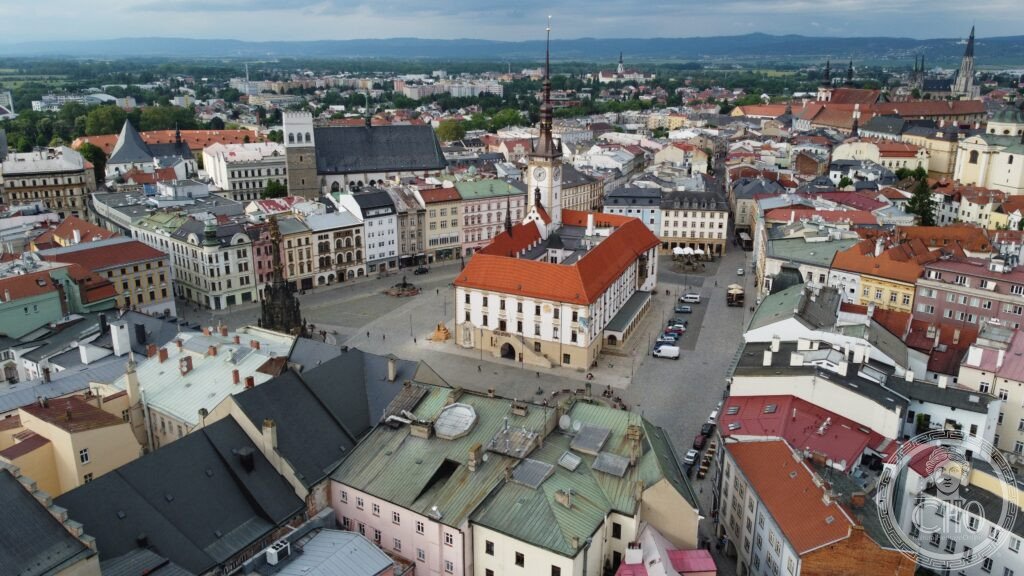
Olomouc’s Upper Square holds the Column of the Holy Trinity, the largest Baroque sculptural ensemble in Central Europe, inscribed on the UNESCO World Heritage List in 2000. Six Baroque fountains, a Romanesque rotunda and a lively university population fill out a historic centre that stands comparison with Prague but draws far fewer visitors.
At a glance
Olomouc was for centuries the capital of the Margraviate of Moravia and remains the region’s second most important historic city after Brno. Its Baroque core is dominated by the Column of the Holy Trinity, a UNESCO-listed monument, and by a set of six fountains scattered across the squares. The city’s astronomical clock was redecorated in the Socialist Realist style in 1955, replacing its original saints with figures of workers, and it is now an unusual survival of that iconography. Palacký University, founded in 1573 and the second oldest in the Czech Republic after Charles University in Prague, gives the town a student atmosphere that sits comfortably alongside its heritage status.
Key facts
- Column of the Holy Trinity: built between 1716 and 1754, begun by Václav Render, 35 metres tall, carrying 18 gilded statues with the Holy Trinity at the apex; a small chapel with an intact 18th-century gilded altar sits in its base.
- Six Baroque fountains: Jupiter (1707), Neptune (1683), Caesar (1725), Arion (1725), Triton (1709) and Mercury (1727), the last being the only surviving Baroque Mercury fountain in Central Europe.
- Rotunda of St Catherine: a 12th-century Romanesque rotunda, the best preserved of its kind in Moravia, standing on the site of the former Přemyslid palace.
- Cathedral of Saint Wenceslas: founded in 1131 by Bishop Jindřich Zdík and later rebuilt in Gothic and Neo-Gothic style; the tallest church in Moravia.
- Palacký University: founded in 1573, the second oldest university in the country.
History
Olomouc was the seat of the Přemyslid princes, rulers of Bohemia and Moravia, from the early 12th century, and the Romanesque palace and rotunda that survive today date from this period. The city later became the capital of the Margraviate of Moravia and was heavily fortified by the Habsburgs, who made it the largest fortified city in the region; most of these defences were dismantled in the 19th century, though their outline lives on in the modern ring road.
During the Thirty Years’ War, Swedish troops occupied Olomouc for eight years, an occupation that devastated the population but, paradoxically, cleared the way for the extensive Baroque rebuilding that followed, including the Column of the Holy Trinity and the fountains. In 1848 the young Emperor Franz Joseph I was crowned King of Bohemia in the city, an event the sources also associate with the presence of Napoleon III, though this detail should be treated with some caution.
What you see
The Upper Square is dominated by the Column of the Holy Trinity and the Neptune Fountain, while the adjoining Lower Square holds the Hercules Fountain and the Caesar Fountain, the latter commemorating the legendary founding of the city by Julius Caesar, a myth much favoured in the Baroque period. The Cathedral of Saint Wenceslas, rebuilt over its Romanesque foundations in Gothic and Neo-Gothic style, was the venue for the coronation of several Přemyslid kings and Habsburg emperors. Next to it stands the Přemysl Palace, a Romanesque structure with a later Gothic upper floor and the oldest surviving secular stone building in Moravia.
Practical information
- Access: the Column of the Holy Trinity and the surrounding squares are free to view; the chapel in the column’s base can be visited on guided tours, details available through the city’s official tourism channels.
- Getting around: the historic centre is compact and can be covered comfortably on foot in half a day.
- Day-trip base: Olomouc makes a convenient base for visiting Kroměříž, a short distance to the south.
Getting there
Olomouc is reached by direct train from Prague and from Vienna, with regular services connecting both cities to Olomouc’s main station; it is also an easy rail excursion from Brno. Exact timetables and journey times are best checked with the national rail operator before travelling.
Nearby
- Kroměříž — a short distance south; the Archbishop’s Palace and its Baroque gardens, one of which is UNESCO-listed, along with the Flower Garden designed by Filiberto Luchese in 1666; the town briefly hosted the Austrian Parliament in 1848.
- Brno — roughly an hour away by fast train; the country’s second city, home to the Villa Tugendhat by Mies van der Rohe, a UNESCO World Heritage Site and his only house in Czech territory, and to the Cathedral of Saints Peter and Paul.
Sources
- Wikipedia, Olomouc
- Column of the Holy Trinity, Olomouc
- Astronomical clock, Olomouc
- UNESCO, Holy Trinity Column in Olomouc, WHS reference 1121
Find it on the map
See this place and what’s around it →
📷 Become a Cultural Heritage Online photographer
Share your photos of places: they stay published under your name as the author. The more they're seen, the more you get noticed — and soon a contest will reward the most appreciated photos.
Log in or sign up free to add a photo