
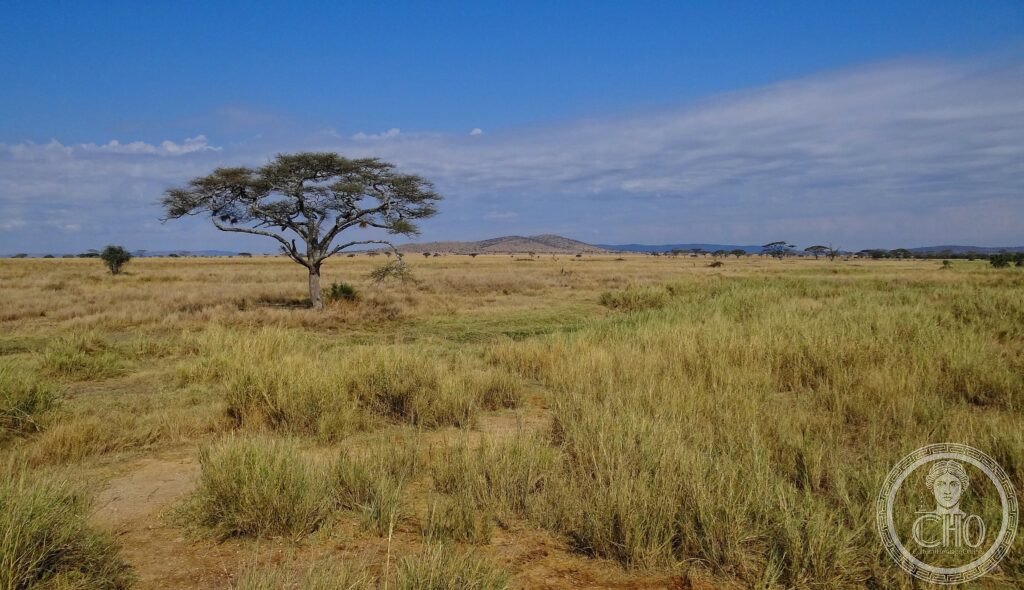
Each year around 1.5 million wildebeest, together with hundreds of thousands of zebra and gazelle, move in a vast clockwise circuit across the Serengeti’s open plains. The result is one of the largest land migrations on Earth, played out on a landscape of grassland, woodland and granite kopjes that has changed little for millions of years.
At a glance
The name Serengeti comes from the Maasai word siringet, meaning endless plains, and the description still fits. The park covers savanna, woodland and scattered granite outcrops known as kopjes, set within an ecosystem thought to be several million years old. It is one of the flattest large landscapes on Earth, which is part of why the migrating herds and their predators are so visible from a distance.
The Serengeti ecosystem does not stop at the park boundary: it extends across the border into Kenya’s Maasai Mara National Reserve, and the wildebeest migration crosses back and forth between the two countries every year.
Key facts
- Area: Serengeti National Park covers 14,763 km², adjoining the 3,629 km² Ngorongoro Conservation Area to the south.
- The migration: around 1.5 million wildebeest, 250,000 zebra and 350,000 Thomson’s gazelle move in an annual clockwise circuit of roughly 1,200 km.
- Calving season: most calves are born within a few weeks in January and February on the southern plains near Ndutu, a strategy that overwhelms predators with numbers.
- Wildlife: all five of Africa’s Big Five species are present, along with more than 500 recorded bird species.
- Lion research: the Serengeti Lion Project, begun by the American biologist George Schaller in 1966, is the world’s longest-running study of a wild animal population.
- Coordinates: approximately 2.3333° S, 34.8333° E.
History
Maasai communities arrived in the Serengeti area in the eighteenth century and lived alongside its wildlife without hunting it for food. In 1929 the British colonial administration declared the area a game reserve, and Serengeti National Park was formally established in 1951. The creation of the park led to the displacement of Maasai communities from land they had long used.
International attention grew after the German zoologist Bernhard Grzimek and his son Michael made the documentary film Serengeti Shall Not Die, which won an Academy Award in 1959 and helped bring the ecosystem’s importance to a wider audience. The park was inscribed as a UNESCO World Heritage Site in 1981; the neighbouring Ngorongoro Conservation Area was separately inscribed in 1979.
What you see
The classic way to experience the Serengeti is the game drive, typically at dawn or dusk, when predators such as lion, leopard and cheetah are most active and the plains are lit at their best. Kopjes rising from the grassland are favoured vantage points for big cats and are also home to klipspringers, small antelope adapted to climbing rock.
Some visitors take a hot-air balloon flight over the plains at first light, drifting above the migration or the woodlands of Central Serengeti before landing for a bush breakfast.
Practical information
- When to go: January and February are best for the calving season on the southern plains, June and July for the Mara River crossings in the north; the shoulder months of October–November and March–April bring greener landscapes and different birdlife.
- Access to the park: internal flights run to the Seronera airstrip in Central Serengeti; road transfers are also possible from Arusha.
- Accommodation: options range from luxury tented camps to simpler public campsites, with some camps moving seasonally to follow the herds. Migration-season camps should be booked well ahead through the relevant operator or park authority.
- Combining with Ngorongoro: many visitors take a multi-day itinerary covering the Ngorongoro Crater, the Serengeti and Olduvai Gorge before returning to Arusha.
Getting there
The usual approach is to fly into Kilimanjaro International Airport, near Arusha, Tanzania’s main safari hub, or into Julius Nyerere International Airport in Dar es Salaam, followed by an internal flight or road transfer. Direct scheduled flights also serve the Seronera airstrip inside Central Serengeti; check current routings and timetables with the airlines or park authority before travelling.
Nearby
- Ngorongoro Crater — around 60 km east of the Serengeti, a UNESCO World Heritage Site inscribed in 1979; the world’s largest intact volcanic caldera, its floor supporting a dense concentration of large mammals and often rated one of the best places in Africa to see all the Big Five in a single day.
- Olduvai Gorge — around 50 km from Ngorongoro; the site where Louis and Mary Leakey discovered fossils of Homo habilis and Australopithecus boisei, with a small on-site museum.
- Mount Kilimanjaro — around 200 km east of Arusha, a UNESCO World Heritage Site inscribed in 1987; Africa’s highest mountain at 5,895 metres, climbed by several established routes including the Marangu and Lemosho routes, with its glaciers reported to be retreating.
Sources
- Wikipedia, Serengeti National Park
- Wikipedia, Great Wildebeest Migration
- Wikipedia, Ngorongoro Conservation Area
- UNESCO, Serengeti National Park, World Heritage Site reference 156
- George B. Schaller, The Serengeti Lion: A Study of Predator-Prey Relations, University of Chicago Press, 1972
Find it on the map
See this place and what’s around it →📷 Become a Cultural Heritage Online photographer
Share your photos of places: they stay published under your name as the author. The more they're seen, the more you get noticed — and soon a contest will reward the most appreciated photos.
Log in or sign up free to add a photo