
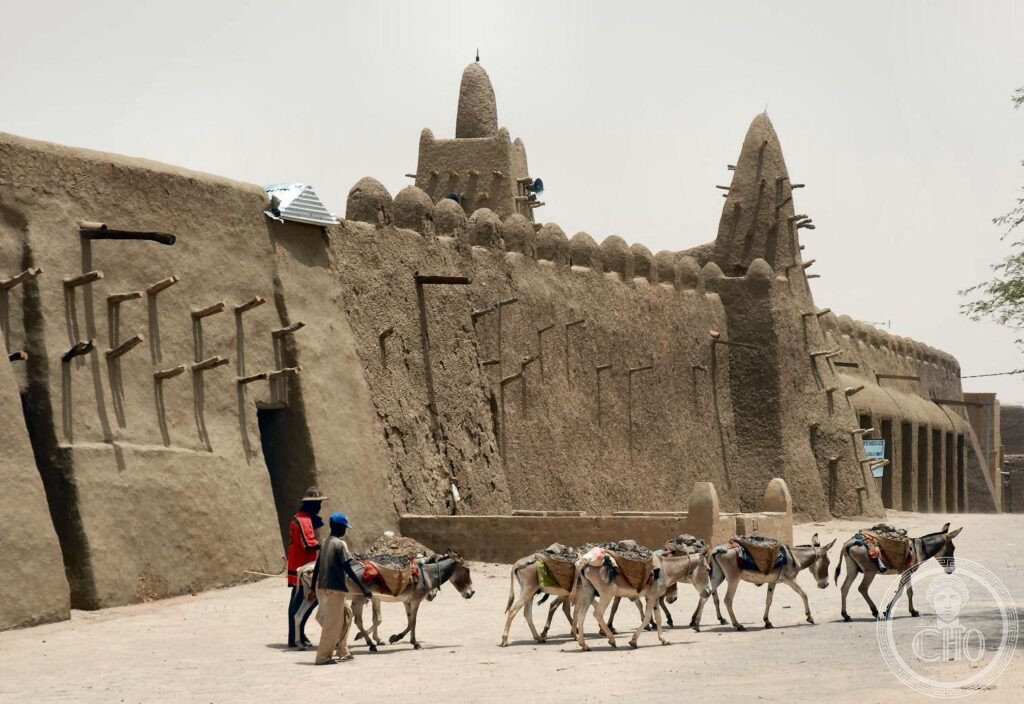
Once a mythical city of gold in the European imagination, Timbuktu was in reality a centre of Islamic scholarship at the meeting point of the trans-Saharan gold and salt trade. Its mosques, madrasas and hundreds of thousands of manuscripts still testify to a golden age that drew scholars from across the Islamic world.
At a glance
Timbuktu entered European consciousness as a legendary city of gold on the edge of the known world. The reality was a great centre of Islamic learning, commerce and culture, built on the trans-Saharan trade in gold and salt. Its libraries once held a vast body of manuscripts covering astronomy, mathematics, medicine, history, law and theology, many of which are now held and digitised at the Ahmed Baba Institute of Higher Islamic Studies and Research.
Key facts
- University of Sankore: the Sankore Mosque and its associated madrasas formed one of the largest universities in the medieval Islamic world, reportedly drawing thousands of students at its height and teaching subjects from astronomy and philosophy to theology and history.
- Ahmed Baba al-Timbukti: the scholar, who lived from 1556 to 1627, wrote over 40 books and is said to have kept a personal library of some 1,600 volumes.
- The 2012 destruction: Ansar Dine fighters destroyed the majority of Timbuktu’s ancient mausolea, claiming they violated an Islamic prohibition on idolatry. Ahmad al-Faqi al-Mahdi was later convicted by the International Criminal Court in 2016 for the destruction of this cultural heritage.
- Mansa Musa I: the Mali Empire ruler who commissioned the Djinguereber Mosque on his return from pilgrimage to Mecca in 1324-1325, and who is widely described by historians as among the wealthiest individuals in history.
- UNESCO status: Timbuktu was inscribed as a World Heritage Site in 1988 and placed on the List of World Heritage in Danger in 2012.
- Coordinates: 16.7666° N, -3.0026° W.
History
Timbuktu is thought to have been founded around 1100 by Tuareg nomads as a seasonal camp. It grew into a crossroads of the trans-Saharan trade, with gold flowing north from West Africa and salt flowing south from the Saharan mines of Taghaza, so valuable in the region that it was at times traded weight for weight with gold.
The city came under the Mali Empire, founded around 1235 by Sundiata Keita, and later under the Songhai Empire, which conquered Timbuktu in 1468 and reached its height under Askia Muhammad. In 1591 Moroccan forces under Ahmad al-Mansur defeated the Songhai, using firearms against the Songhai bows, and Timbuktu’s fortunes declined thereafter. French forces occupied the city in 1894, and it became part of independent Mali in 1960. Timbuktu was inscribed as a UNESCO World Heritage Site in 1988.
What you see
Three great mosques dominate the historic centre: the Djinguereber Mosque, built in 1327 at the commission of Mansa Musa I; the Sankore Mosque, once the centre of the University of Sankore; and the Sidi Yahia Mosque, built around 1400, whose door was said by legend not to be opened until the end of the world, a legend broken when Ansar Dine forced it open in 2012.
All three mosques are built in the Sahelian style, of mud brick plastered with banco, a technique that requires the whole community to replaster the walls together each year before the rainy season.
Practical information
- Manuscripts: the Ahmed Baba Institute holds and digitises much of the surviving manuscript collection; many old Timbuktu families also hold private collections, which local guides can sometimes arrange to visit.
- Restoration: some of the mausolea destroyed in 2012 have since been partially reconstructed with UNESCO support, the first such reconstruction completed in 2015.
- Security: the security situation in northern Mali has remained unstable since the 2012 Tuareg rebellion and Ansar Dine occupation, despite the French Operation Serval in 2013 and the ongoing UN stabilisation mission, MINUSMA. Many governments continue to advise against non-essential travel to the region, and this should be checked before any visit is planned.
Getting there
Timbuktu is reached by flying to Bamako and then taking a domestic flight to Timbuktu Airport, or by river, via the Niger River ferry from Mopti, a journey of several days depending on water levels. The cooler dry season, from November to February, is generally considered the more comfortable time to travel. Current travel advisories for northern Mali should be checked before planning a visit.
Nearby
- Djenné — around 570 km south, a UNESCO World Heritage Site since 1988, home to the Great Mosque of Djenné, the world’s largest mud-brick building, reconstructed in 1907 on 13th-century foundations, and sharing the same Sahelian architectural tradition as Timbuktu.
- Mopti and the Inland Niger Delta — around 600 km south, a river port town known locally as the Venice of Mali and the gateway for Niger River pinasse journeys, close to Dogon Country and the Bandiagara Escarpment, a UNESCO World Heritage Site since 1989.
- The Sahara Desert — Timbuktu sits at the desert’s southern edge, with camel treks possible to the dunes near Bourem and Tuareg camps nearby; salt caravans still travel north to Taoudenni, around 1,000 km distant.
Sources
- Wikipedia
- UNESCO
- Mahmud Kati, Tarikh al-fattash (Chronicle of the Seeker)
Find it on the map
See this place and what’s around it →📷 Become a Cultural Heritage Online photographer
Share your photos of places: they stay published under your name as the author. The more they're seen, the more you get noticed — and soon a contest will reward the most appreciated photos.
Log in or sign up free to add a photoIs this page about you?
This page is read by travellers and heritage enthusiasts who find it on Google. Tell us how you are connected to this place and we will take it from there.