
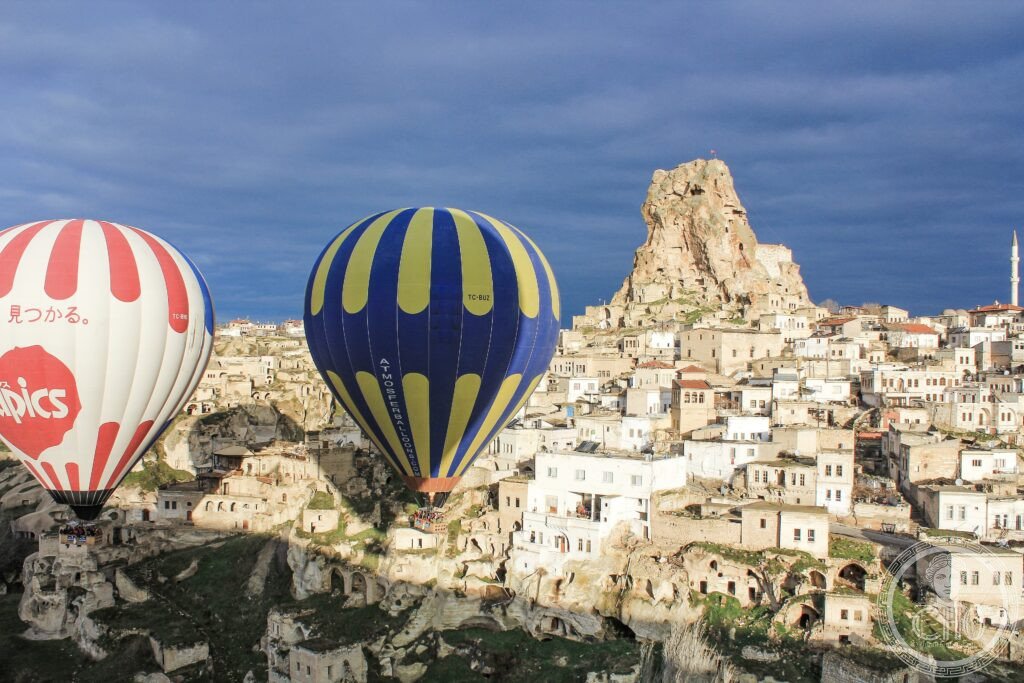
Cappadocia pairs a volcanic landscape of wind-carved cones with a thousand years of rock-cut Christian settlement. Around Göreme, Byzantine monks hollowed churches and whole communities dug entire cities into the soft tuff below ground, leaving a place where geology and human history are inseparable.
At a glance
Göreme National Park and the Rock Sites of Cappadocia were inscribed as a UNESCO World Heritage Site in 1985 under both natural and cultural criteria: natural for the fairy chimney landscape, cultural for the Byzantine rock-cut churches and underground cities. The whole region formed from consolidated volcanic ash thrown out by the Erciyes and Hasan volcanoes, later eroded over millions of years into the cones and pillars now known as fairy chimneys, or Peri Bacaları.
Cappadocia is also linked to the fourth-century Cappadocian Fathers, Basil the Great, Gregory of Nyssa and Gregory of Nazianzus, whose theological writings connect the landscape to the early Christian church.
Key facts
- Heritage status: UNESCO World Heritage Site, Göreme National Park and the Rock Sites of Cappadocia, inscribed 1985 (natural and cultural).
- Göreme Open Air Museum: around 30 rock-cut Byzantine churches within roughly one square kilometre, with frescoes including those of the Dark Church and the Sandals Church.
- Underground cities: Derinkuyu descends some 85 metres across 18 levels and could once shelter a large population; it connects to Kaymaklı by an underground tunnel.
- Balloon flights: hot-air balloons launch before sunrise and drift over the Rose, Red and Pigeon valleys.
- Coordinates: 38.6432° N, 34.8287° E.
History
The earliest underground chambers in the region date to the Phrygians, in the eighth and seventh centuries BCE. Earlier still, the Hittite Empire had its heartland in Anatolia, and Assyrian merchants established trading colonies known as karums in Cappadocia in the early second millennium BCE.
Christianity shaped the region deeply from late antiquity, with the fourth-century Cappadocian Fathers born here. The underground cities were expanded and used intensively during the Arab raids of the seventh to tenth centuries CE, offering refuge to local communities. Seljuk Turks arrived in the eleventh century, and Byzantine Christians continued to live in Cappadocia under Seljuk rule. The landscape’s dual natural and cultural significance was recognised by UNESCO in 1985.
What you see
The Cappadocian UNESCO zone spans a wide area of eroded volcanic valleys studded with fairy chimneys in shades of rose, ochre, cream and grey, most vivid at sunrise and sunset. At Göreme, the Open Air Museum gathers a dense cluster of rock-cut churches decorated with Byzantine frescoes, some closed off for centuries and consequently well preserved.
Below ground, Derinkuyu descends through many levels cut with ventilation shafts, wine and oil presses, stables, churches and schools, evidence of a self-sufficient underground community. Uçhisar Castle occupies the highest point in the region, and Zelve Open Air Museum preserves a cave settlement inhabited until the mid-twentieth century.
Practical information
- Balloon flights: weather-dependent and subject to cancellation in high winds; it is advisable to book ahead in peak season and confirm directly with operators.
- Museum entry: a ticket is required for the Göreme Open Air Museum; check current arrangements with the site’s official channels.
- Underground cities: temperatures stay cool and constant year-round, so a light jacket is worth carrying regardless of season.
- Cave hotels: common throughout the region, built into the tuff and naturally insulated.
Getting there
Göreme is reached via Nevşehir Kapadokya Airport, west of the town, or Kayseri Erkilet Airport to the east, both served by domestic flights from Istanbul. An overnight long-distance bus also runs from Istanbul to Göreme. Many local hotels arrange pickup from the airport or bus station; it is worth confirming this when booking.
Nearby
- Derinkuyu Underground City — around 30 km south of Göreme; a combined ticket with Kaymaklı is generally recommended.
- Istanbul Historic Areas — roughly 700 km west; a UNESCO World Heritage Site inscribed in 1985, including Topkapı Palace, the Blue Mosque and Hagia Sophia.
- Ephesus — about 500 km west; inscribed as a UNESCO World Heritage Site in 2015, with the Library of Celsus and the Arcadian Way.
Sources
- Wikipedia, Cappadocia
- Wikipedia, Göreme Open-Air Museum
- Wikipedia, Derinkuyu underground city
- UNESCO, Göreme National Park and the Rock Sites of Cappadocia, WHS reference 357
- Spiro Kostof, Caves of God: Cappadocia and Its Churches, MIT Press, 1989
Find it on the map
See this place and what’s around it →📷 Become a Cultural Heritage Online photographer
Share your photos of places: they stay published under your name as the author. The more they're seen, the more you get noticed — and soon a contest will reward the most appreciated photos.
Log in or sign up free to add a photo