
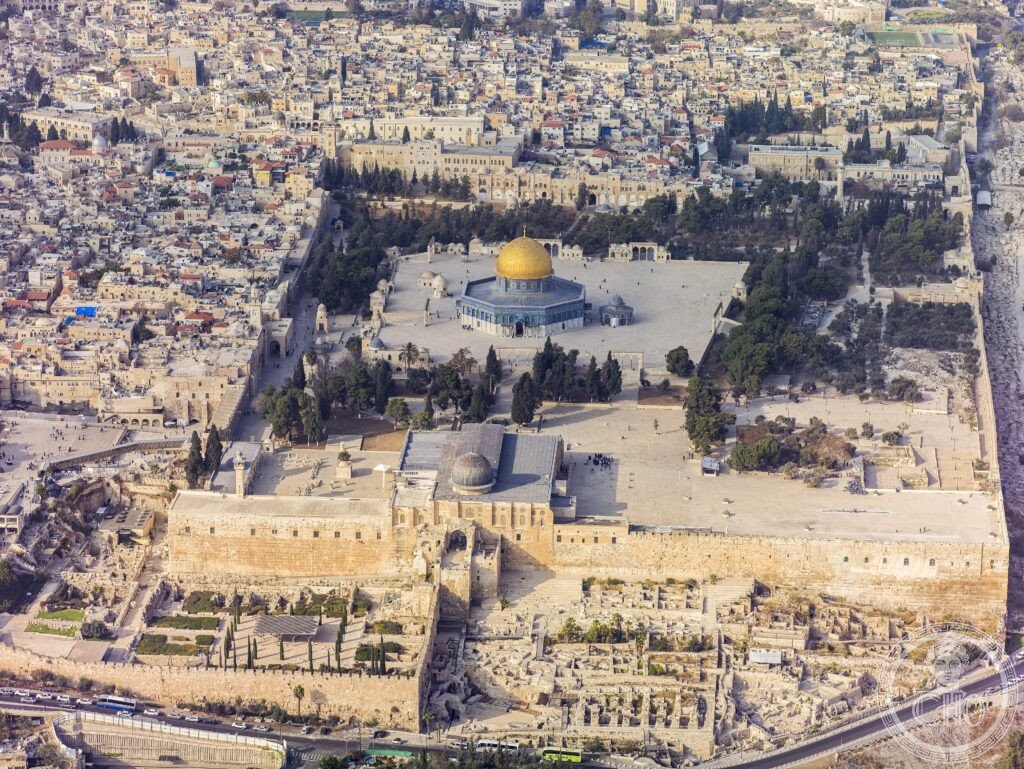
Under a single square kilometre holds the Western Wall, the Dome of the Rock and the Church of the Holy Sepulchre, within a few minutes’ walk of one another. No other place concentrates the sacred geography of three religions so tightly, and none has been fought over for so long or by so many.
At a glance
The Old City is the walled core of Jerusalem, under a square kilometre in extent, divided by long usage into four quarters — Muslim, Christian, Jewish and Armenian — and entered through gates in a circuit of walls built in the 1530s under the Ottoman sultan Suleiman the Magnificent, on far older foundations. Within it stand the sites that make the city central to Judaism, Christianity and Islam at once: the Temple Mount, known in Arabic as the Haram al-Sharif, with the Dome of the Rock and the al-Aqsa Mosque upon it; the Western Wall at its foot; and the Church of the Holy Sepulchre a few streets away. UNESCO inscribed the site in 1981 on a proposal by Jordan, and lists it without attribution to a State Party; it has been on the List of World Heritage in Danger since 1982.
Key facts
- The platform: the great raised esplanade at the south-east corner of the Old City was built up by Herod the Great in the last decades BC as the base for his enlargement of the Second Temple. Its retaining walls, of enormous dressed limestone blocks, are the oldest structures most visitors will stand beside.
- The Western Wall: a surviving stretch of that Herodian retaining wall, and the holiest place at which Jews pray, being the closest accessible point to where the Temple stood.
- The Dome of the Rock: completed in 691–692 under the Umayyad caliph Abd al-Malik, and the oldest Islamic building still standing anywhere. The rock it encloses is identified in Islamic tradition with the Prophet’s Night Journey, and in Jewish tradition with the Temple’s foundation.
- The Church of the Holy Sepulchre: built over the sites identified since the fourth century as those of the crucifixion and the tomb. Six Christian denominations share it under an arrangement known as the Status Quo, unchanged since the nineteenth century; by long-standing custom the keys are held and the door opened each morning by two Muslim families of the city.
- Heritage: UNESCO World Heritage Site, Old City of Jerusalem and its Walls, inscribed 1981; placed on the List of World Heritage in Danger the following year, where it remains.
- GPS: 31.7767° N, 35.2345° E
History
Settlement began not inside the present walls but on the ridge to the south, above the Gihon spring, and the archaeology there reaches back into the Bronze Age. The city became the centre of the Israelite kingdom, and its First Temple was destroyed by the Babylonians in 586 BC. The Second Temple, built after the return from exile and vastly enlarged by Herod, was destroyed by Roman forces in AD 70; what remained of Herod’s platform became the ground on which everything later was built.
Rome refounded the city as Aelia Capitolina; Constantine’s mother is credited with identifying the Christian holy places in the fourth century, and the first Church of the Holy Sepulchre followed. Muslim rule from 638 brought the building of the Dome of the Rock and al-Aqsa on the esplanade. The Crusaders took the city in 1099 and held it until Saladin’s reconquest in 1187. Mamluk and then Ottoman rule followed, and it was under the Ottomans that the present walls went up. The twentieth century brought British administration, the division of the city between 1948 and 1967, and the events since — a history whose consequences are still contested, and which this entry does not attempt to adjudicate.
What you see
The walls have seven gates in use, among them the Jaffa Gate on the west and the Damascus Gate on the north, the most elaborate of the Ottoman gateways. Inside, the streets are narrow, stepped, often covered, and the four quarters run into one another without much ceremony: the market lanes of the Muslim Quarter, the Christian Quarter around the Holy Sepulchre, the Jewish Quarter rebuilt after 1967 with the excavated Cardo of Roman Jerusalem exposed beneath it, and the quiet, largely closed Armenian Quarter, the smallest of the four and one of the oldest Armenian communities outside Armenia.
The esplanade above the Western Wall is the visual centre: the gold dome over Abd al-Malik’s octagon, its exterior sheathed in Ottoman tilework, and the silver-grey lead of al-Aqsa beyond. Access to the esplanade for non-Muslim visitors is limited to certain hours and is subject to change at short notice; prayer there by non-Muslims is not permitted under the arrangements in force.
Practical information
- Access: the Old City itself is open and free to walk; individual holy places have their own hours, dress codes and rules, and the esplanade has restricted visiting hours for non-Muslims. Arrangements change with circumstances — check locally on the day rather than relying on any published schedule.
- Dress and conduct: shoulders and knees covered everywhere; heads covered in several places; photography restricted or forbidden in parts of the holy sites. Fridays, Saturdays and religious festivals change what is open and how crowded it is.
- Underfoot: worn stone, steps and slopes throughout, and very little of the Old City is level or step-free.
Getting there
The Old City lies east of the modern centre of Jerusalem; the light rail stops near the Jaffa Gate and the Damascus Gate, and the walled area is entirely pedestrian. Tel Aviv is about an hour away by rail or road. GPS: 31.7767, 35.2345.
Nearby
- City of David — immediately south of the walls; the ridge where the earliest settlement stood, with the Gihon spring and Hezekiah’s rock-cut water tunnel.
- Mount of Olives — across the Kidron valley to the east; the ancient Jewish cemetery, the Garden of Gethsemane, and the view over the whole walled city.
- Bethlehem — about 10 km south, in the West Bank; the Church of the Nativity, a UNESCO World Heritage Site in its own right since 2012.
Sources
- UNESCO World Heritage Centre, Old City of Jerusalem and its Walls (reference 148), inscribed 1981 on a proposal by Jordan, on the List of World Heritage in Danger since 1982, with the state of conservation reports
- Encyclopaedia Britannica, Jerusalem and Dome of the Rock
- Israel Antiquities Authority — excavation reports for the Old City and its walls
Find it on the map
See this place and what’s around it →📷 Become a Cultural Heritage Online photographer
Share your photos of places: they stay published under your name as the author. The more they're seen, the more you get noticed — and soon a contest will reward the most appreciated photos.
Log in or sign up free to add a photo