

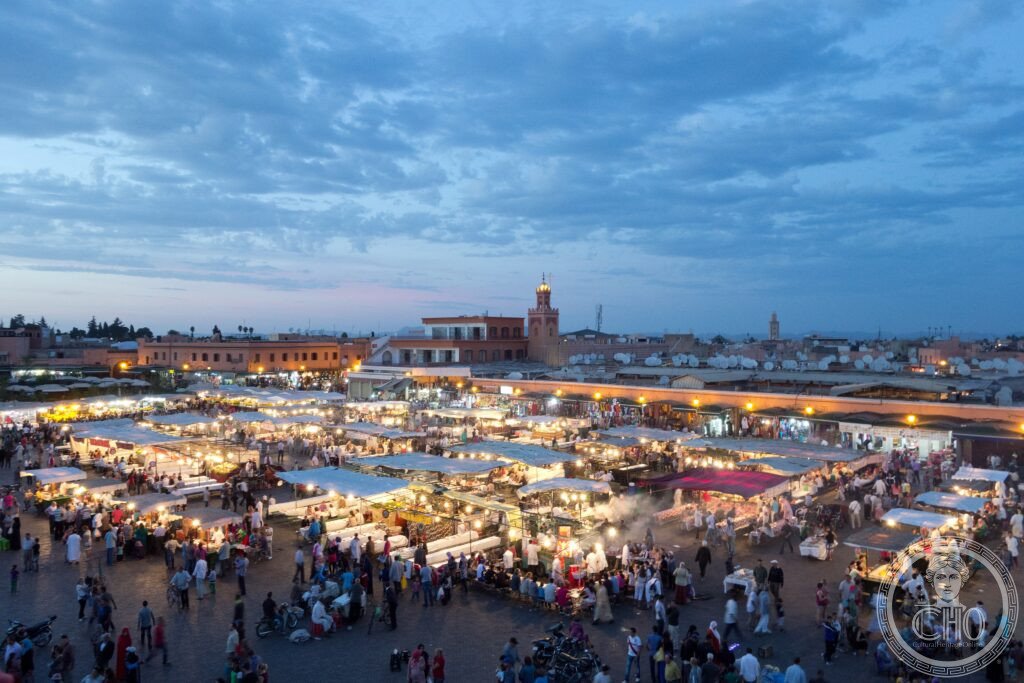
Founded in 1070 as the Almoravid imperial capital, the Medina of Marrakesh is a walled city of mosques, madrasas, gardens and souks built in the region’s rose-red clay. Its heart, the Djemaa el Fna, has functioned without interruption since the 11th century as market, stage and meeting ground.
At a glance
The Medina of Marrakesh is the historic walled city founded in 1070. Its ramparts, built of rammed earth known as pisé, run for roughly 19 kilometres around the old town. The characteristic rose-red tone of the walls and buildings comes from the local clay, intensified by a terracotta limewash that gives Marrakesh its nickname, the Red City.
At the centre of the medina lies the Djemaa el Fna, a large open square that has served since the 11th century as marketplace, entertainment ground and social hub. By day it hosts orange juice vendors, henna artists and performers; each evening food stalls appear rapidly to turn the square into an open-air kitchen, while Gnawa musicians play into the night. The square’s oral and performance traditions were recognised by UNESCO as Intangible Cultural Heritage in 2001.
Key facts
- Djemaa el Fna: a continuously used public square dating to the 11th century, home to storytellers, food stalls and Gnawa musicians; its living heritage was inscribed by UNESCO in 2001.
- Koutoubia Mosque: the principal Almohad monument of Marrakesh, its minaret built to a height of 69 metres on a 12.8-metre square base, and the model for the Giralda in Seville and the Hassan Tower in Rabat.
- Ben Youssef Madrasa: a Quranic college rebuilt under the Saadian dynasty in 1565, its courtyard and cells decorated with zellige tilework, carved stucco and cedarwood.
- Saadian Tombs: a royal necropolis sealed in 1672 and rediscovered in 1917.
- Jardin Majorelle: a garden begun in 1923 by the French painter Jacques Majorelle, later restored by Yves Saint Laurent and Pierre Bergé, who bought it in 1980.
- Heritage status: the Medina of Marrakesh was inscribed as a UNESCO World Heritage Site in 1985.
History
Marrakesh was founded in 1070 by the Almoravid dynasty, a Berber confederation from the Sahara led by Abu Bakr ibn Umar and consolidated under Yusuf ibn Tashfin, who made the city their capital. The Almoravids were succeeded by the Almohads, under whom Caliph Yaqub al-Mansur built the Koutoubia Mosque, the first of the three great Almohad minarets that also include the Giralda and the Hassan Tower.
Later dynasties added to the fabric of the medina. The Saadians rebuilt the Ben Youssef Madrasa in 1565 under Sultan Abdullah al-Ghalib and constructed a royal necropolis, the Saadian Tombs, which were sealed from view in 1672 and only rediscovered in 1917. In the twentieth century the medina continued to draw outside interest, most notably through the Jardin Majorelle, begun by the painter Jacques Majorelle in 1923 and later preserved by Yves Saint Laurent and Pierre Bergé.
What you see
The Koutoubia’s minaret rises in five decorated zones separated by cornices, its surfaces worked with interlaced sebka arch screens and a muqarnas cornice, and topped by four copper globes that diminish in size towards the summit. Across the medina, the Djemaa el Fna shifts through the day: daytime stalls and performers give way each evening to rows of grilled-meat and soup stalls, with storytellers, or haqqaoui, still reciting tales from classical Arabic literature to listeners gathered in a circle, and Gnawa musicians playing the krakeb castanets and the sentir lute into the night.
Inside the Ben Youssef Madrasa, every surface from floor to roofline is worked in one of three materials: geometric zellige tilework along the lower walls, carved stucco arabesques and Quranic inscriptions above it, and cedarwood corbels and window frames higher still, with a central courtyard pool reflecting the carved arcades. At the Jardin Majorelle, cobalt-blue pavilions and terracotta pots, in the shade Majorelle registered as Majorelle Blue, surround plantings assembled over decades; the adjoining Musée Yves Saint Laurent Marrakech, opened in 2017, displays the designer’s Moroccan-inspired work.
Practical information
- Access: the Djemaa el Fna and the medina’s streets are open to the public at all times; opening times for individual monuments such as the Koutoubia, the Ben Youssef Madrasa and the Saadian Tombs vary and should be checked with the relevant site or local tourist office before visiting.
- Tickets: the Ben Youssef Madrasa, the Saadian Tombs and the Jardin Majorelle charge entry fees; current prices are best confirmed through their official channels.
- Best time to visit the square: the character of the Djemaa el Fna changes markedly between daytime and evening, when the food stalls are set up.
Getting there
The medina occupies the historic centre of Marrakesh, in the Marrakesh-Safi Region of Morocco, and its principal sites, including the Koutoubia Mosque, the Djemaa el Fna and the Ben Youssef Madrasa, lie within walking distance of one another inside the walls. The Jardin Majorelle stands outside the old city and is reached separately.
Nearby
- Koutoubia Mosque — overlooks the Djemaa el Fna and marks the western edge of the medina.
- Ben Youssef Madrasa — within the medina, close to the souks north of the square.
- Saadian Tombs — within the medina’s southern quarter, near the Kasbah Mosque.
- Jardin Majorelle and Musée Yves Saint Laurent Marrakech — outside the medina walls, with the museum a short distance from the garden.
Sources
- UNESCO
Find it on the map
See this place and what’s around it →📷 Become a Cultural Heritage Online photographer
Share your photos of places: they stay published under your name as the author. The more they're seen, the more you get noticed — and soon a contest will reward the most appreciated photos.
Log in or sign up free to add a photo