

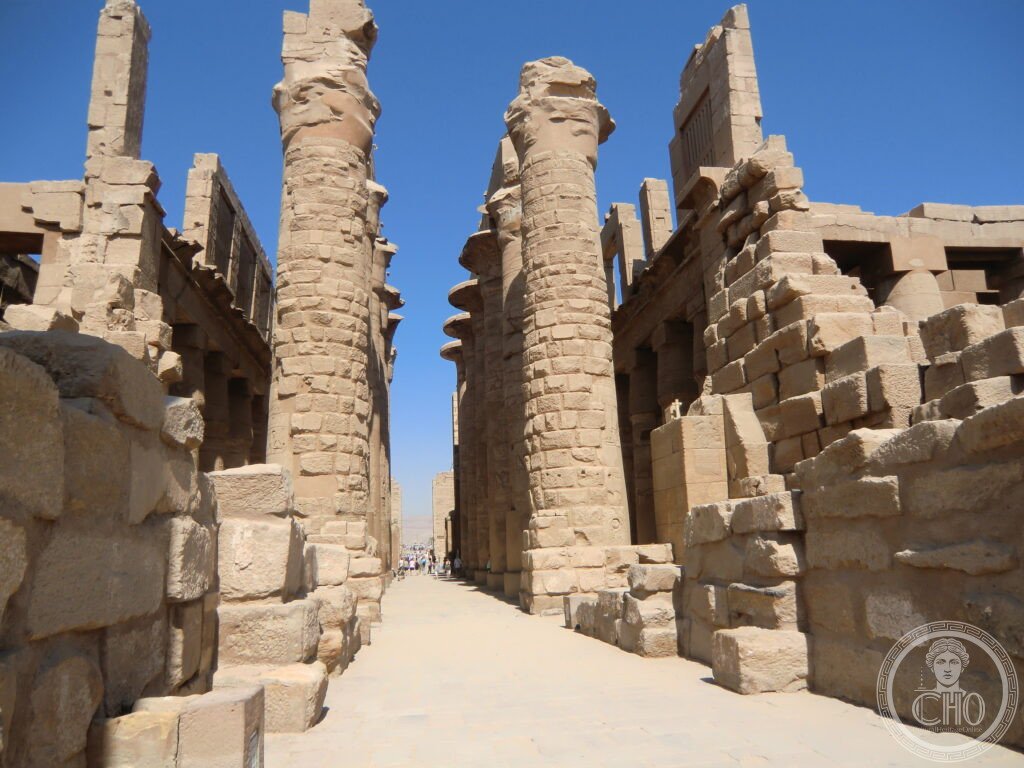
On a single bend of the Nile, Luxor holds the greatest concentration of ancient Egyptian monuments anywhere: the vast temple complex of Karnak, the temple of Luxor itself, and across the river the royal tombs of the Valley of the Kings. Together they mark the site of Thebes, capital of Egypt’s New Kingdom empire.
At a glance
Luxor is a city of roughly half a million people straddling the Nile in Upper Egypt, built over the ruins of ancient Thebes. The east bank holds the living city and its temples, Karnak and Luxor Temple among them; in ancient Egyptian belief the rising sun on this side stood for life. The west bank was given over to the dead: the Valley of the Kings, the Valley of the Queens, mortuary temples and the workers’ village of Deir el-Medina, associated with the setting sun and the afterlife.
Thebes became capital of a reunified Egypt around 2055 BCE under the 11th Dynasty and reached its greatest power during the New Kingdom, roughly 1550 to 1070 BCE, the era of Tutankhamun, Hatshepsut, Akhenaten and Ramesses II. It remained Egypt’s principal religious centre even after the political capital moved to Memphis and later Alexandria, and continued as a substantial city into the Ptolemaic and Roman periods.
Key facts
- Karnak Temple Complex: not a single temple but a complex of temples, pylons, obelisks and sacred lakes, extended by more than 30 pharaohs over about 1,700 years; it covers some 200 hectares.
- Great Hypostyle Hall: 134 papyrus-form columns in 16 rows, begun under Seti I and completed by Ramesses II; the 12 central columns rise 21 metres and measure 3.6 metres across.
- Luxor Temple: built mainly by Amenhotep III and completed by Ramesses II; its entrance once held two granite obelisks, one of which now stands in the Place de la Concorde in Paris.
- Avenue of Sphinxes: a three-kilometre processional way linking Luxor Temple to Karnak, originally lined with 1,350 sphinxes and excavated and restored between 2004 and 2021.
- Valley of the Kings: burial ground of the pharaohs of the 18th, 19th and 20th dynasties, with 63 known tombs including that of Tutankhamun, found intact by Howard Carter in 1922.
History
Thebes rose to prominence as the capital of Egypt after the 11th Dynasty reunified the country around 2055 BCE, and it remained the empire’s spiritual heart throughout the New Kingdom, when its temples and royal tombs were built or enlarged by successive pharaohs. Karnak alone was worked on by more than thirty rulers across some 1,700 years, making it as much a record of dynastic history as a single monument.
Even after the administrative capital shifted north, Thebes kept its religious importance into the Ptolemaic period and remained a significant city under Roman rule, when a fort was built inside the courtyard of Luxor Temple and Roman decoration was painted directly over the Egyptian reliefs. A mosque was later raised on top of the temple’s east pylon in the 12th century, its floor level sitting at the height of the ancient colonnade below, a vivid sign of how many layers of history are stacked on this one site.
In the twentieth century the Valley of the Kings drew international attention with the discovery of Tutankhamun’s intact tomb in 1922. More recently, the Avenue of Sphinxes connecting Karnak and Luxor Temple was excavated and restored between 2004 and 2021, and conservation work at Luxor Temple between 2021 and 2022 uncovered original Egyptian coloured reliefs beneath the Roman plaster.
What you see
At Karnak, the Great Hypostyle Hall is the single most overwhelming space: 134 stone columns crowded together, the twelve tallest carved with closed papyrus-bud capitals and the smaller ones with open papyrus capitals, faint traces of the original blue, green, red, yellow and white paint still visible on some of the carved scenes. Ten pylons mark successive gateways into the Amun precinct, the best preserved being the Pylon of Ramesses II, decorated with reliefs of the Battle of Kadesh and the peace treaty that followed it. Beside the Sacred Lake stands a large granite scarab associated with the god Khepri, around which visitors still walk in a ritual circuit said to bring good luck.
Luxor Temple, closer to the Nile corniche, shows a similarly layered history: a single surviving entrance obelisk, courtyards built by Amenhotep III and Ramesses II, the remains of a Roman fort within the temple courtyard, and the Abu Haggag Mosque perched on the ancient east pylon. On the west bank, the Valley of the Kings holds dozens of rock-cut royal tombs, among them the modest tomb of Tutankhamun and the far larger, elaborately painted tomb of Seti I, one of the longest in the valley.
Practical information
- Tickets and access: entry arrangements, combined tickets and any special access to individual tombs change periodically; check the current arrangements through Egypt’s official tourism and antiquities channels before visiting.
- Tutankhamun’s treasures: the gold funerary objects from KV62, including the coffin and mask, are now displayed at the Grand Egyptian Museum in Giza rather than at Luxor itself.
- Two-bank visit: Karnak and Luxor Temple sit on the east bank, while the Valley of the Kings, Valley of the Queens and Deir el-Medina lie across the river on the west bank, so a visit typically requires crossing the Nile.
Getting there
Luxor lies on the Nile roughly 700 kilometres south of Cairo, on the east bank of the river, with the Karnak and Luxor temples within the city itself and the Valley of the Kings reached by crossing to the west bank.
Nearby
- Colossi of Memnon — west bank, two fallen seated statues about 18 metres high, marking the site of a vanished mortuary temple.
- Valley of the Queens — west bank, burial ground of royal wives and children complementing the Valley of the Kings.
- Deir el-Medina — west bank, the preserved village of the workers who built the royal tombs.
Sources
- UNESCO
- Grand Egyptian Museum
Find it on the map
See this place and what’s around it →📷 Become a Cultural Heritage Online photographer
Share your photos of places: they stay published under your name as the author. The more they're seen, the more you get noticed — and soon a contest will reward the most appreciated photos.
Log in or sign up free to add a photo