
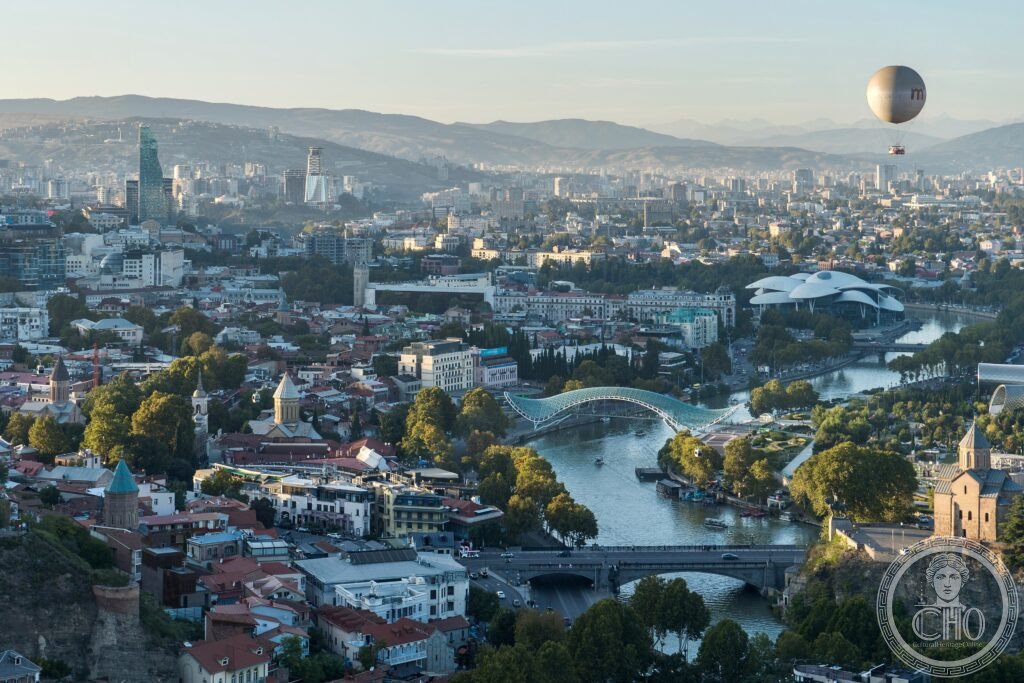
The most unexpectedly beautiful old city in the Caucasus and one of the least visited great historic cities in Europe. Tbilisi, the Georgian capital founded in the 5th century over natural sulphur hot springs, combines carved wooden balcony architecture unlike anything else in the region, some of the oldest Christian churches in the world, the most distinctive natural wine culture outside Italy and France, and the legendary hospitality of a culture that genuinely treats guests as gifts from God.
At a glance
The Historic Districts of Tbilisi (the old city (Dzveli Tbilisi; Georgian: ძველი თბილისი); the area including the Narikala Fortress, the Abanotubani (Sulphur Baths Quarter), the Kala (Old Town Quarter), the Metekhi cliff and church, the Sololaki district (19th-century Tbilisi), and the Avlabari district; population of the city of Tbilisi approximately 1.1 million; the historic core is a compact zone of approximately 3 km²) is located in the eastern part of Georgia, in the Mtkvari (Kura) River valley, approximately 100 km from the Caspian Sea. The city was founded by King Vakhtang I Gorgasali of Iberia (r. c. 447–502 AD) according to Georgian tradition (the legend: during a hunting expedition, the king or his hawk killed a pheasant; the pheasant fell into a hot sulphur spring and was miraculously healed; the king decided to build his capital over the healing springs; the name “Tbilisi” (Georgian: თბილისი) means “warm city” (from Georgian: თბილი (tbili) = warm) and refers to the sulphur springs). The natural hot springs still supply the sulphur bathhouses of the Abanotubani district. The characteristic carved wooden balconies (Georgian: მოჩუქურთმებული აივანი) that overhang the narrow lanes of the old city are the defining architectural element. They project outward from the upper floors of the old houses, sometimes cantilevering 2–3 m over the street, providing shade and social life simultaneously. The style (Persian-influenced decorative woodcarving; Safavid-era architecture; first introduced in the 16th–17th century during Georgian cultural exchange with Persia) is found nowhere else in exactly this combination.
Key facts
- The sulphur baths of Abanotubani: the most distinctive spa tradition in the Caucasus. The sulphur baths — Georgian: გოგირდის აბანო, gogirdis abano — give the Abanotubani district its name, the “bath district” in the south-eastern corner of the old city: the domed brick structures visible from across the river are the rooftop vents of underground bathhouses built over the springs. The water comes out at approximately 37–44°C, and its sulphur content gives it a distinctive smell, close to rotten eggs, which bathers stop noticing almost at once. The springs have been in use since at least the 5th century, and the bathhouses above them were built in the 17th–19th centuries, some in the Safavid Persian style, some in the Russian imperial style after the Russian Empire took Tbilisi in 1801. Alexander Pushkin bathed here in 1829, during his journey to Erzerum, and his account in A Journey to Arzrum is the most vivid literary description of the place: “I have never in my life encountered, either in Russia or Turkey, something more luxurious than the Tiflis baths”. Alexandre Dumas, the French novelist, followed in 1858, on his Caucasian journey. The private rooms, each with its own pool, rent for approximately GEL 30–60, EUR 10–20, per person an hour, attended by a kesegeli, a masseur who gives a full-body scrub and massage: the most complete traditional bathing experience in the Caucasus outside Istanbul.
- Georgian natural wine: the world’s oldest continuous wine tradition. Georgia is the oldest wine-producing country in the world (the earliest archaeological evidence of winemaking at Gadachrili Gora, near Tbilisi, dates to approximately 6000 BCE — the oldest confirmed wine production anywhere on Earth). The qvevri (Georgian: ქვევრი; a large egg-shaped clay vessel buried underground for wine fermentation; the vessel is sealed with beeswax; the grapes (including skins, seeds, and stems (the full grape must)) are pressed into the vessel and left to ferment for 6 months; the result is amber wine (orange wine) of exceptional tannin, complexity, and longevity; this 8,000-year-old winemaking method is UNESCO Intangible Cultural Heritage (2013)). The Rkatsiteli and Saperavi varieties (the two most important Georgian grape varieties; Rkatsiteli (white) and Saperavi (red) are the backbone of Georgian wine production; Saperavi (the name means “dye” in Georgian; the grape has red flesh, not just red skin — one of the few grape varieties in the world with tinted juice; it produces very dark, tannic, long-lived red wines); the Kakheti region (60 km east of Tbilisi; the principal wine region of Georgia; the Alazani River valley; the most important wine villages are Telavi, Sighnaghi, and Kvareli; a 1-day excursion from Tbilisi combining wine country with the medieval monastery of Bodbe and the walled town of Sighnaghi)).
- Georgian polyphonic music: the only ancient polyphonic tradition in Europe outside of Gregorian chant. Georgian polyphonic singing — Georgian: მრავალხმიანობა, mravalxmianoba — is a three-voice tradition, sometimes more, unique to the country and the oldest surviving polyphony in Europe. Each of the three voices sings an independent melodic line: unlike Western harmonisation, none of them follows a lead, and they move apart and together into harmonic structures that are dissonant and resolvable in equal measure. The tuning is not Western equal temperament either, and the particular sound cannot be produced by Western-trained singers without specific training in the Georgian system. UNESCO listed it as Intangible Cultural Heritage in 2001. The most important ensembles are the Rustavi Choir, founded 1968 and the best known internationally, and the Anchiskhati Choir, which sings in the Anchiskhati Basilica in the old city.
- Heritage: National Cultural Heritage of Georgia. Historical significance equivalent to UNESCO WHS level.
- GPS: 41.6941° N, 44.8337° E.
History
Foundation legend (c. 455–502 AD; King Vakhtang Gorgasali; the pheasant-in-the-spring origin story). Ancient capital of the Iberian Kingdom (later the Kingdom of Georgia). Arab conquest (7th–9th century; Tbilisi (Tiflis) was the capital of the Tbilisi Emirate (the Umayyad and Abbasid administrative centre in the Caucasus); the Narikala Fortress was greatly strengthened). Georgian Golden Age (11th–13th century; King David the Builder (r. 1089–1125) recaptured Tbilisi from the Arabs in 1122; the greatest period of Georgian culture and architecture; Queen Tamar (r. 1184–1213); Shota Rustaveli wrote The Knight in the Panther’s Skin (c. 1205; the national epic of Georgia) in this period). Mongol destruction (1236; Genghis Khan’s grandson Batu Khan razed the city). Subsequent invasions (Timur 1386, 1394, 1403; Ottoman and Persian struggles 16th–18th century; the city changed hands between the Ottomans and the Persians multiple times; the Persian Shah Abbas I destroyed Tbilisi in 1615 and deported much of the population to Persia). Russian annexation (1801; the Georgian Kingdom of Kartli-Kakheti was annexed by Russia; Tbilisi became the capital of the Russian Viceroyalty of the Caucasus). Georgian independence (1918; the Democratic Republic of Georgia; 1921 Soviet occupation; Soviet Georgian SSR; Georgian independence restored 1991 with the collapse of the USSR). Post-independence instability (1991–2003; civil war; Rose Revolution 2003). Current development (2003–present; the historic districts are undergoing both restoration and controversial new development).
What you see
The entrance to the old city from the Meidan (Peace Square; the main public square at the boundary of old and new Tbilisi; the massive Roman column (controversially placed here in 2007 by then-mayor and later President Mikheil Saakashvili)). The Anchiskhati Basilica (the oldest surviving church in Tbilisi; 6th century AD; built by the son of King Vakhtang; the most important early Christian building in Georgia; the Anchiskhati icon (a 6th-century icon of the Virgin and Child said to have been brought from Anchi in Tao-Klarjeti; one of the most sacred objects in Georgian Orthodox Christianity)). The Metekhi Church (the Church of the Dormition of the Virgin Mary; rebuilt 13th century on a dramatic rock promontory above the Kura river; the most dramatic church site in Tbilisi; the equestrian statue of Vakhtang Gorgasali in front). The Narikala Fortress (a 30-min walk or cable car from the Rike Park; the walls are walkable; the view of the old city rooftops and the Kura River from the fortress is the best in the city). The Abanotubani district (the Persian-style domed brick bath-houses; the sulphur springs; the Orbeliani Baths (the Blue Mosque-style bathhouse with the elaborate Persian tile and stucco facade; the most photographed building in old Tbilisi)).
Practical information
- Getting there: Tbilisi International Airport (TBS) lies 18 km south-east of the centre. From there, Metro Line 2, the Akhmeteli-Varketili line, runs to Isani station, and the old town is a walk or a short taxi away; Bus 37 goes into the city in approximately 45 min for approximately GEL 1, EUR 0.35, and the fixed-price official airport taxi costs approximately GEL 30–40, EUR 10–13. The Tbilisi Metro is the cleanest and most reliable public transit system in the South Caucasus, 23 stations at approximately EUR 0.30 a journey, with single-platform stations very similar to those of the Moscow Metro. Turkish Airlines offers the most connections via Istanbul, approximately 3–4h from western European cities; Wizz Air and Ryanair fly direct from several European cities, as do LOT Polish Airlines and Austrian Airlines. From Amsterdam–Schiphol or London Heathrow the journey is approximately 5–6h of flight time via Istanbul.
- The Georgian table (supra): the most elaborate hospitality tradition in the Caucasus. The supra — Georgian: სუფრა, literally “tablecloth” — is a feast at which every guest sits at a long table covered end to end with dishes. The most important role belongs to the tamada, the toastmaster, a person of rhetorical skill and social standing who leads the toasts in a fixed ritual sequence: the first is always to Peace (მშვიდობა, mshvidoba), the second to Georgia, the third to hosts and guests, and the rest to family, the dead, the young. The food begins with khachapuri, cheese bread, the most important Georgian dish, in several regional forms. Adjaruli khachapuri is the most dramatic: a boat-shaped bread filled with molten suluguni cheese, a raw egg and a pat of butter, which you stir together and eat from the bread boat with torn pieces of crust. Imeruli khachapuri is a flat round, the simplest and the commonest daily bread. Then come the khinkali, soup dumplings whose meat-and-spice filling sits in broth inside the dough: you pick one up by the knot on top, bite a small hole, suck out the broth and eat the rest, leaving the knot, the kudi or “hat”, on the plate — counting the discarded kundzi tells everyone how many a guest has eaten. Last is mtsvadi, Georgian shashlik, pork, lamb or beef skewered and grilled over vine-wood charcoal.
- The Kakheti wine region: the most important Georgian wine destination. A 1-day excursion from Tbilisi. Kakheti (the Alazani River valley; 60 km east of Tbilisi (1h 30 min by marshrutka (minibus) or taxi); the wine estates (Shumi Winery in Tsinandali; the Twins Wine Cellar (Napareuli); Jakeli Wines (Telavi region); most offer tasting and qvevri visits); Sighnaghi (the “City of Love”; a small walled town (the only completely walled city in Georgia) on a ridge above the Alazani valley with a view to the Greater Caucasus mountains; the city wall (a 4.5 km circuit entirely walkable; the towers and gates intact); the Bodbe Convent (2 km outside Sighnaghi; the Georgian Orthodox convent at the tomb of St. Nino (the 4th-century Cappadocian woman who converted Georgia to Christianity in 327 AD; the most important saint in Georgian Orthodoxy)))).
Getting there
Tbilisi Airport (18 km; Metro+walk or taxi EUR 10–13). Flights via Istanbul or direct from Europe. GPS: 41.6941, 44.8337.
Nearby
- Mtskheta. 22 km north-west of Tbilisi (30 min by marshrutka or taxi). The ancient capital of Georgia and UNESCO WHS. Mtskheta (UNESCO WHS 1994; the Svetitskhoveli Cathedral (the most important church in Georgia; the Living Pillar Cathedral; 1010–1029 AD by architect Arsukisdze; the largest medieval church in Georgia; the burial place of St. Chiton (the robe of Christ, supposedly brought to Mtskheta by a Georgian Jew after the Crucifixion; the robe is buried under the altar column; the “living pillar” was said to grow from the robe; the most sacred site in Georgian Christianity); the Jvari Monastery (567–604 AD; the oldest surviving church in Georgia; on a cliff above the confluence of the Mtkvari and Aragvi Rivers — the view of the two rivers meeting below the monastery, with Mtskheta in the valley and the Caucasus in the distance, is one of the most completely Georgian landscapes in existence; made famous by Mikhail Lermontov’s poem Mtsyri (1840)))).
- Kazbegi (Stepantsminda) and the Greater Caucasus. 160 km north of Tbilisi (2h 30 min by marshrutka along the Georgian Military Highway; the most dramatic mountain road in the Caucasus). The Gergeti Trinity Church and the highest mountains in Europe. Kazbegi (the town of Stepantsminda (formerly and commonly Kazbegi); the Gergeti Trinity Church (Tsminda Sameba; the Holy Trinity Church; 14th century; on a rocky spur at approximately 2,170 m altitude immediately below the summit of Mount Kazbek (5,047 m; the fifth highest peak in the Caucasus); the church appears in virtually every postcard of Georgia because its position — a perfect medieval stone church on a triangular rock outcrop with the snow-capped Kazbek visible directly behind it — is one of the most dramatic mountain architecture views in the world; the 2h walk from the town up to the church (approximately 500 m vertical gain) is achievable by any fit walker in good weather)). The Georgian Military Highway (the pass road from Tbilisi to Vladikavkaz in Russia via the Jvari Pass; the most historically significant road in the Caucasus; used by Persian, Ottoman, Russian, and Soviet armies for millennia; the Ananuri Fortress (a 16th–17th century Georgian castle complex in a dramatic position above the Zhinvali reservoir on the Military Highway; 72 km from Tbilisi; the most photogenic stop on the drive north)).
- Uplistsikhe Cave Town. 80 km west of Tbilisi (1h 30 min by road). The most important pre-Christian archaeological site in the Caucasus. Uplistsikhe — Georgian: უფლისციხე, “Lord’s Fortress” — is a rock-hewn cave town on the Mtkvari, the Kura, occupied from approximately 1000 BCE to the 10th–13th centuries AD and carved into volcanic tuff, a stone easy to cut and durable, the same material as the cave churches of Cappadocia in Turkey. At its height, between the 1st century BC and the 3rd century AD, approximately 20,000 people lived here. Cut from the rock are streets and dwellings, a pagan temple whose ceiling carries the vine ornament of the grape and which is the oldest surviving pagan religious structure in Georgia, 1st century BC, a court of justice that is the most elaborate hall of the complex, wine cellars with qvevri-shaped cisterns hollowed from the stone — the most important ancient evidence of Georgian winemaking — and a 10th-century Christian church raised over the former temple.
Sources
- Wikipedia, Tbilisi. Old Tbilisi. Georgian polyphonic singing, accessed June 2026.
- Donald Rayfield, Edge of Empires: A History of Georgia, Reaktion Books, 2012.
- UNESCO Intangible Heritage, Georgian Polyphonic Singing, inscribed 2001. Georgian Qvevri winemaking, inscribed 2013.
Find it on the map
See this place and what’s around it →📷 Become a Cultural Heritage Online photographer
Share your photos of places: they stay published under your name as the author. The more they're seen, the more you get noticed — and soon a contest will reward the most appreciated photos.
Log in or sign up free to add a photo