

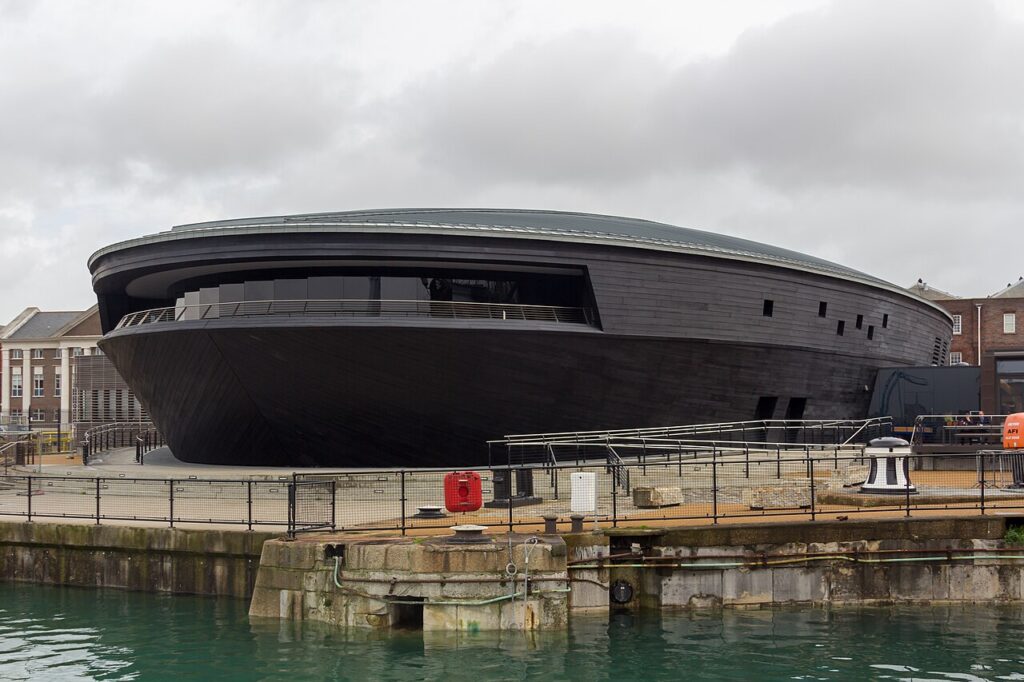
Henry VIII’s warship raised from the Solent – half a hull and 19,000 objects freezing one Tudor afternoon, archaeology’s Pompeii of the sea.
At a glance
- Type
- Museum ship (wreck)
- Period
- Ship 1511; sank 1545; raised 1982
- Style
- Tudor carrack
- Location
- Historic Dockyard, Portsmouth, UK
- Coordinates
- 50.8020, -1.1090
- Loss
- Battle of the Solent, 19 July 1545, the king watching
Overview
The Mary Rose heeled and sank before Henry VIII’s eyes off Southsea in 1545; the Solent’s silts kept her starboard half and 19,000 belongings – longbows by the chest, surgeons’ tools, the dog Hatch’s skeleton – until 1982’s televised raising, sixty million watching the Tudor world surface. The elliptical museum wraps hull and finds face to face, deck by deck.
History
Thirty-four years the king’s favourite, rebuilt heavier, she turned with gunports open – overloading’s verdict still argued. The Deane brothers’ 1830s diving first touched her; McKee’s 1960s obsession refound the site, Prince Charles dived the digs – underwater archaeology’s coming-of-age project. Conservation’s decades of sprays ended 2016 in the dry reveal.
Architecture and Design
Galleries mirror the missing port side – artifacts placed at their found stations across from the timbers; the crew’s faces reconstructed from bone meet visitors at eye level. The airlocked balconies’ final reveal walks the open hull’s breath.
Cultural significance
The Mary Rose is Britain’s time capsule – daily Tudor life undisturbed by editing – and maritime archaeology’s methods born; with HMS Victory next berth, Portsmouth’s dockyard spans the wooden walls’ centuries.
Visiting today
Dockyard tickets bundle Victory and Warrior; allow ninety minutes for the Rose’s decks. The bow-to-stern balcony at hull level rewards patience’s queue.
Getting there
Portsmouth Harbour station adjoins the dockyard gate; ferries cross from Gosport.
The spray system built around the hull ran through 522 metres of pipework and 315 nozzles, delivering about 40,000 litres of polyethylene glycol a day.
Sources and resources
Find it on the map
See this place and what’s around it →Record researched and written by Luigi De Marchi for Cultural Heritage Online, 2026.
At auction this weekArt Deco glass, lighting and furniture are sold at auction every weekPieces from the 1920s and 1930s are open for bidding today on Catawiki, where an expert checks each lot before it goes live.See what is open on Catawiki →
Advertisement. Pictured, from the Cleveland Museum of Art (CC0) and not for sale: three pieces of Lalique glass, 1920 to 1931. How we handle this
📷 Become a Cultural Heritage Online photographer
Share your photos of places: they stay published under your name as the author. The more they're seen, the more you get noticed — and soon a contest will reward the most appreciated photos.
Log in or sign up free to add a photo