
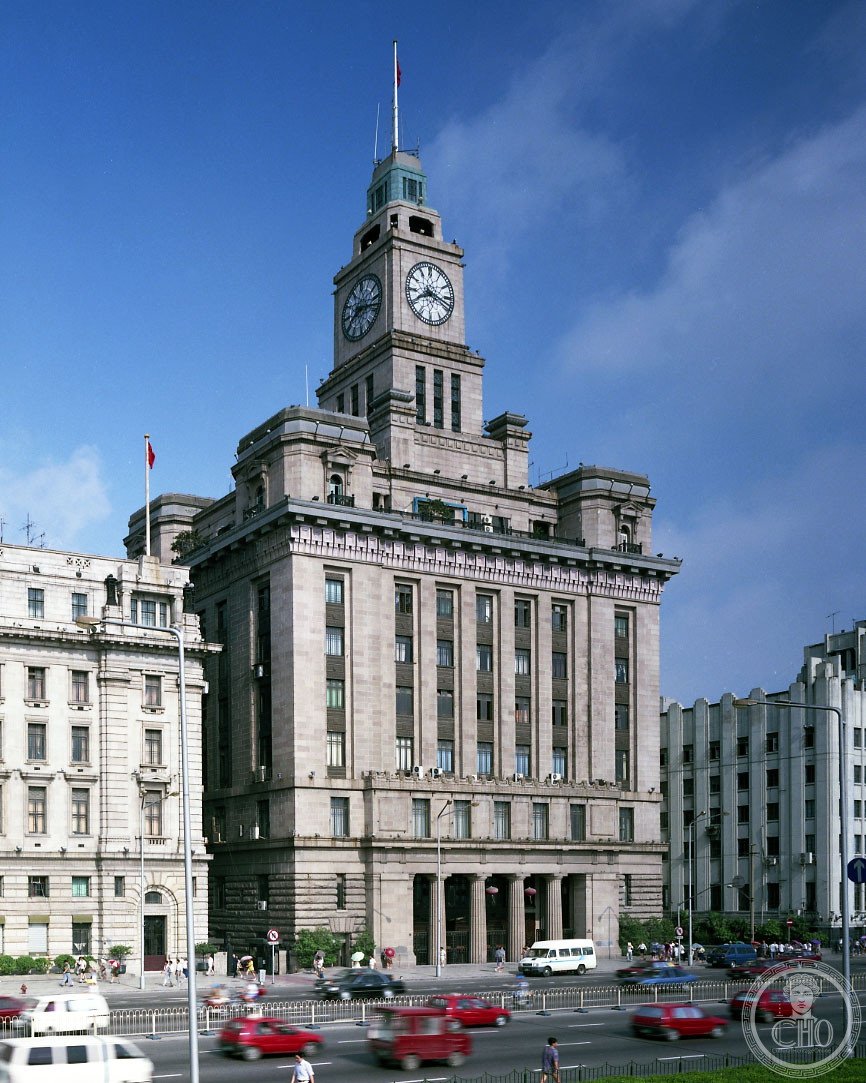
The Shanghai Customs House at number 13 on the Bund is one of the most storied buildings in East Asia, its clock tower — known affectionately as Big Ching — dominating the Shanghai skyline since 1927. Designed by Palmer & Turner, the city leading architectural firm of the colonial era, the building replaced an 1857 predecessor as the seat of the Imperial Maritime Customs Service and later the People Republic customs authority. The tower mechanism was explicitly modeled on London Big Ben, making it the only Chinese building to house a Big Ben replica — a deliberate statement of Shanghai aspirations to stand as a world trading capital equal to London. The building survived Japanese occupation, the Cultural Revolution, and the radical reshaping of modern Shanghai, remaining in continuous use by the customs authority throughout. Its bass clock tone, which boomed across the Huangpu River waterfront for decades, was silenced during the Japanese occupation when the bells were melted for the war effort, and replaced during the Mao era by loudspeakers playing revolutionary anthems. Today Big Ching rings again, restored to its original mechanism, marking the hours above one of the world most photographed historic waterfronts.
At a glance
- Type
- Government Office / Customs Authority
- Period
- 1927
- Style
- Neoclassical / Art Deco
- Location
- 13 The Bund (Zhongshan East 1st Road), Shanghai, China
- Coordinates
- 31.2416° N, 121.4894° E
- Architect(s)
- Palmer & Turner (George Leopold Wilson, partner in charge)
Overview
The Shanghai Customs House is the authoritative institutional anchor of the Bund, the famous colonial-era waterfront that lines the western bank of the Huangpu River. The building houses the Shanghai branch of China Customs and has done so in one form or another since the 1850s. Palmer & Turner designed the 1927 structure with a Greek Revival colonnaded base — six giant Doric columns framing the main entrance — and an Art Deco tower rising above, creating a silhouette that reads clearly from ships approaching the port. The building is a Shanghai Municipal Heritage Site and a key anchor of the Bund Historic Conservation Area.
History
The site has served Shanghai customs since the 1850s under the Imperial Maritime Customs Service, which was administered for decades by British inspector-generals. The 1857 building was demolished when the expanding commerce of early 20th-century Shanghai demanded something grander. Construction of the current building began in 1925 and was completed in 1927. During the Japanese occupation from 1941, the clock mechanism bells were confiscated and melted for the war effort; the tower fell silent. After 1949 the building passed to the People Republic of China; during the Cultural Revolution (1966-1976) the clock played “The East is Red” and “Sailing the Seas Depends on the Helmsman” on the hour from amplifiers. The original chime mechanism was eventually restored and Big Ching rings again today.
Architecture & Design
Palmer & Turner brought to the Customs House the same monumental grammar they applied to other Bund landmarks including the HSBC Building (1923) next door. The ground floor presents six massive Greek Doric columns in granite, creating a covered portico appropriate to the climate and the solemnity of a customs authority. The tower, rising to roughly 67 meters, transitions from the classical base into a more angular Art Deco profile, capped by the clock housing. The clock faces are approximately five meters in diameter; the bell mechanism was calibrated to replicate the Westminster chime sequence of London Big Ben. Interiors feature coffered ceilings, marble floors, and bronze fittings consistent with the grandeur expected of an institution collecting duties on millions of tons of commercial cargo annually.
Cultural significance
The Shanghai Customs House represents the high-water mark of treaty-port Shanghai — the era when the city was simultaneously Chinese, British, American, French, and Japanese, and when its customs revenues funded infrastructure across the Qing and early Republican state. The Big Ching clock is one of the most charged objects in modern Chinese urban history: silenced by war, conscripted for propaganda, finally restored to its original purpose. The building entire lifespan — colonial commerce, Japanese occupation, revolutionary socialism, economic reform — mirrors in miniature the history of modern China.
Visiting today
The Customs House exterior and the surrounding Bund promenade are freely accessible at all hours. The building interior is not open to the public as it remains an active government office. The Bund is most atmospheric at dusk and after dark, when both the historic western waterfront and the Pudong skyline across the river are illuminated. Guided heritage walking tours of the Bund depart regularly from the Peace Hotel and cover the Customs House as a primary stop.
Getting there
Metro Line 2 (East Nanjing Road station, exit 6) places visitors at the northern end of the Bund, a five-minute walk from the Customs House. Line 10 (Yuyuan Garden station) approaches from the south. Multiple bus routes serve Zhongshan East 1st Road. Shanghai Pudong International Airport (PVG) is 30 km east; Hongqiao Airport (SHA) is 15 km west; both connect to the city center by metro.
Sources & resources
Find it on the map
See this place and what’s around it →Record researched and written by Luigi De Marchi for Cultural Heritage Online, 2026.
📷 Become a Cultural Heritage Online photographer
Share your photos of places: they stay published under your name as the author. The more they're seen, the more you get noticed — and soon a contest will reward the most appreciated photos.
Log in or sign up free to add a photoIs this page about you?
This page is read by travellers and heritage enthusiasts who find it on Google. Tell us how you are connected to this place and we will take it from there.