
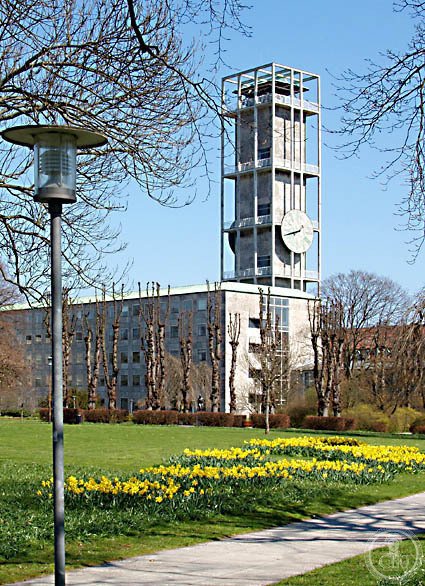
Completed in 1941 to a design by Arne Jacobsen and Erik Møller, Aarhus City Hall stands as one of the defining works of Danish Functionalism — a movement that translated the social optimism of the interwar years into disciplined, humane architecture. The building sits at the heart of Aarhus city centre, its slender clock tower rising above a body clad in Norwegian marble, a concession to civic tradition that Jacobsen initially resisted but which ultimately gave the building its commanding presence. Inside, Hans Wegner designed every piece of furniture to complement the spaces, creating a rare example of total design in a public institution. The building has provoked debate since its inauguration: too austere for some, too modern for others, and yet unmistakably a civic landmark. Today Aarhus City Hall is listed as a protected building and widely regarded as a cornerstone of twentieth-century Scandinavian architecture.
At a glance
- Type
- City Hall
- Period
- 1937–1941
- Style
- Danish Functionalism / Scandinavian Modernism
- Location
- Rådhuspladsen, Aarhus, Denmark
- Coordinates
- 56.153° N, 10.203° E
- Architect(s)
- Arne Jacobsen and Erik Møller
Overview
Aarhus City Hall is the administrative centre of Denmark’s second-largest city, housing the offices of the municipality and the city council chamber. The decision to build a new city hall was taken in 1937 following an architectural competition, which Jacobsen and Møller won with a rigorous Functionalist proposal. The completed structure balances civic authority with modernist restraint: open floor plates, rational fenestration, and a public ground floor designed to be accessible and welcoming. Its clock tower, added after public pressure, became a beloved element of the Aarhus skyline.
History
The 1937 competition drew entries from across Scandinavia. Jacobsen and Møller’s winning scheme departed sharply from the neo-classical traditions that dominated civic architecture at the time, proposing instead a building of clean volumes and functional clarity. Construction began in 1938, with the building inaugurated on 2 June 1941, even as Denmark was under German occupation. In the postwar decades the building became a reference point for Danish architects working through the tensions between modernism and craft tradition, and Jacobsen’s subsequent career owed much to the lessons of this commission.
Architecture & Design
The main block is a rectilinear slab clad in light grey Norwegian slate marble, with a regular grid of windows punctuating the facade. The clock tower, slender and abstract, topped by a gilded clock face, provides a vertical counterpoint that anchors the composition to the city’s scale. Inside, the council chamber and principal rooms are finished with warm timber and textiles. Hans Wegner’s bespoke furniture programme, coordinated across offices, meeting rooms, and corridors, makes the building a virtually complete Gesamtkunstwerk of mid-century Danish design.
Cultural significance
Aarhus City Hall is a pivotal work in the canon of twentieth-century Nordic architecture. It demonstrated that Functionalism could be both principled and humane. The building shaped Jacobsen’s international reputation and influenced a generation of Danish architects. It is listed and protected under Danish heritage law, and is regularly cited in architectural histories of the modern movement in Scandinavia.
Visiting today
Aarhus City Hall remains a working municipal building and is open to the public during office hours. Guided tours are available and must be booked through the Aarhus municipality website. The council chamber and principal historic interiors are typically included on guided visits. The tower is occasionally open for panoramic views over the city.
Getting there
The city hall is located at Rådhuspladsen, a short walk from Aarhus Central Station and directly served by multiple city bus lines. The building faces Store Torv and is easily reached on foot from the city centre shopping streets. Bicycle parking is available immediately outside, in keeping with Aarhus’s cycling culture.
Sources & resources
Find it on the map
See this place and what’s around it →Record researched and written by Luigi De Marchi for Cultural Heritage Online, 2026.
📷 Become a Cultural Heritage Online photographer
Share your photos of places: they stay published under your name as the author. The more they're seen, the more you get noticed — and soon a contest will reward the most appreciated photos.
Log in or sign up free to add a photoIs this page about you?
This page is read by travellers and heritage enthusiasts who find it on Google. Tell us how you are connected to this place and we will take it from there.