

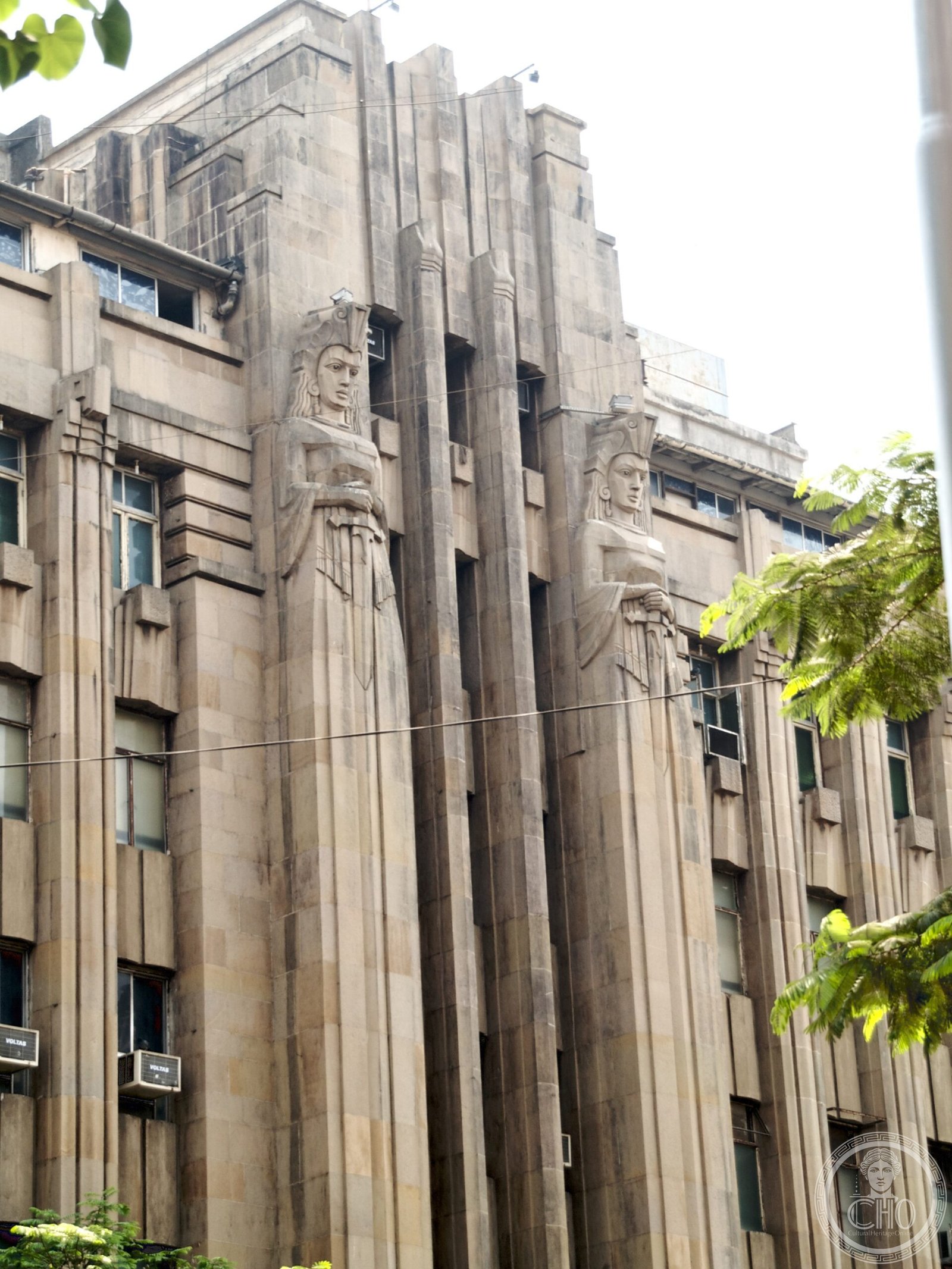
The New India Assurance Building stands on Mahatma Gandhi Road in the historic Fort district of south Mumbai as one of the finest Indo-Deco office buildings in Asia. Completed in 1937 to the designs of the firm Master, Sathe and Bhuta — with intricate sculptural reliefs by N. G. Pansare — this six-storey reinforced-concrete tower blends Western Art Deco geometry with a distinctly Indian symbolic programme: the facade is animated by carvings of Indian mythological motifs, swadeshi imagery and nationalist symbols that make it a singular document of colonial-era modernity. It forms part of the Victorian Gothic and Art Deco Ensembles of Mumbai, inscribed as a UNESCO World Heritage Site in 2018.
At a glance
- Style
- Art Deco (Indo-Deco)
- Completed
- 1937
- Architects
- Master, Sathe and Bhuta
- Sculptor
- N. G. Pansare
- Location
- 87 Mahatma Gandhi Road, Fort, Mumbai, India
- Floors
- 6
- Client
- New India Assurance Co. Ltd.
- Heritage status
- Part of UNESCO World Heritage Site (2018)
- Coordinates
- 18.9322° N, 72.8346° E
Overview
Rising above Mahatma Gandhi Road in Mumbai’s Fort district, the New India Assurance Building is a landmark of interwar Indian commercial architecture. Commissioned by New India Assurance Co. Ltd. — the insurance company founded by industrialist Sir Dorabji Tata in 1919 — it was designed by the Bombay firm Master, Sathe and Bhuta and completed in 1937. The building’s six storeys of reinforced concrete are distinguished by an exceptionally rich sculptural programme created by artist N. G. Pansare, whose carvings integrate Art Deco geometric vocabulary with Indian nationalist and mythological imagery. It sits at the heart of Mumbai’s UNESCO-listed Victorian Gothic and Art Deco ensemble, one of the world’s outstanding concentrations of interwar architecture.
History
New India Assurance was founded in 1919 by Sir Dorabji Tata, son of industrialist Jamsetji Tata, as one of India’s first major insurance enterprises under Indian ownership. The company prospered through the 1920s and by the mid-1930s required a landmark headquarters befitting its standing. Construction began in 1935 and the completed building was inaugurated in 1937. The design reflects the nationalist mood of the late colonial period: rather than adopting a purely European Art Deco idiom, the patrons and architects chose to embed the building’s surfaces with swadeshi symbolism and references to Indian cultural heritage, a deliberate assertion of Indian modernity. New India Assurance was nationalised in 1973 and continues to operate from this building today, making it one of the few interwar Bombay landmarks still serving its original institutional function.
Architecture & Design
The New India Assurance Building exemplifies the Indo-Deco mode that flourished in 1930s Bombay: a structural and compositional grammar drawn from Western Art Deco, inflected with Indian cultural content. The reinforced-concrete frame allows large window openings arranged in the vertical bays typical of interwar commercial buildings, while the facade’s surface is articulated by N. G. Pansare’s sculptural reliefs. Unlike the abstract ornament of European Art Deco, Pansare’s panels depict figures from Indian mythology, scenes of Indian agriculture and labour, and nationalist symbols — a visual manifesto of swadeshi self-reliance. The building’s verticality and stepped silhouette align it with the global Art Deco commercial type, but its iconographic programme makes it uniquely South Asian. This synthesis is precisely what UNESCO cited in inscribing the wider Fort ensemble in 2018.
Cultural significance
The New India Assurance Building occupies a special place in the story of Indian modernity. Built at the height of the independence movement, it demonstrates how Indian patrons and architects used the international language of Art Deco to make a statement about Indian agency and aspiration. The swadeshi carvings on its facade — depicting Indian workers, farmers and mythological heroes — were a subtle but legible rebuke to colonial subordination. As part of the UNESCO-listed Victorian Gothic and Art Deco Ensembles of Mumbai, the building now anchors global recognition of Bombay’s extraordinary architectural heritage. It is regularly cited in surveys of global Art Deco and has become a reference point for scholars of postcolonial architecture and nationalist symbolism in the built environment.
Visiting today
The New India Assurance Building operates as an active office and is not generally open to the public beyond the ground-floor lobby. The exterior, however, is fully accessible and best viewed from the pavement of Mahatma Gandhi Road. The richly carved facade can be studied at close range, and the surrounding Fort district — with its concentration of Victorian Gothic and Art Deco buildings — makes the area ideal for a self-guided walking tour. The Mumbai Art Deco Trust organises guided heritage walks in the area; check their website for the current schedule.
Getting there
The building is located at 87 Mahatma Gandhi Road in the Fort district of south Mumbai, near Flora Fountain. The nearest suburban rail station is Churchgate (Western Railway line), a 10-minute walk. By metro, take Metro Line 3 (Aqua Line) to Hutatma Chowk station, a five-minute walk. Numerous BEST bus routes serve Mahatma Gandhi Road. Taxis and auto-rickshaws are available throughout south Mumbai, though auto-rickshaws are restricted in the city’s southernmost districts.
Sources & resources
Find it on the map
See this place and what’s around it →Record researched and written by Luigi De Marchi for Cultural Heritage Online, 2026.
📷 Become a Cultural Heritage Online photographer
Share your photos of places: they stay published under your name as the author. The more they're seen, the more you get noticed — and soon a contest will reward the most appreciated photos.
Log in or sign up free to add a photoIs this page about you?
This page is read by travellers and heritage enthusiasts who find it on Google. Tell us how you are connected to this place and we will take it from there.