
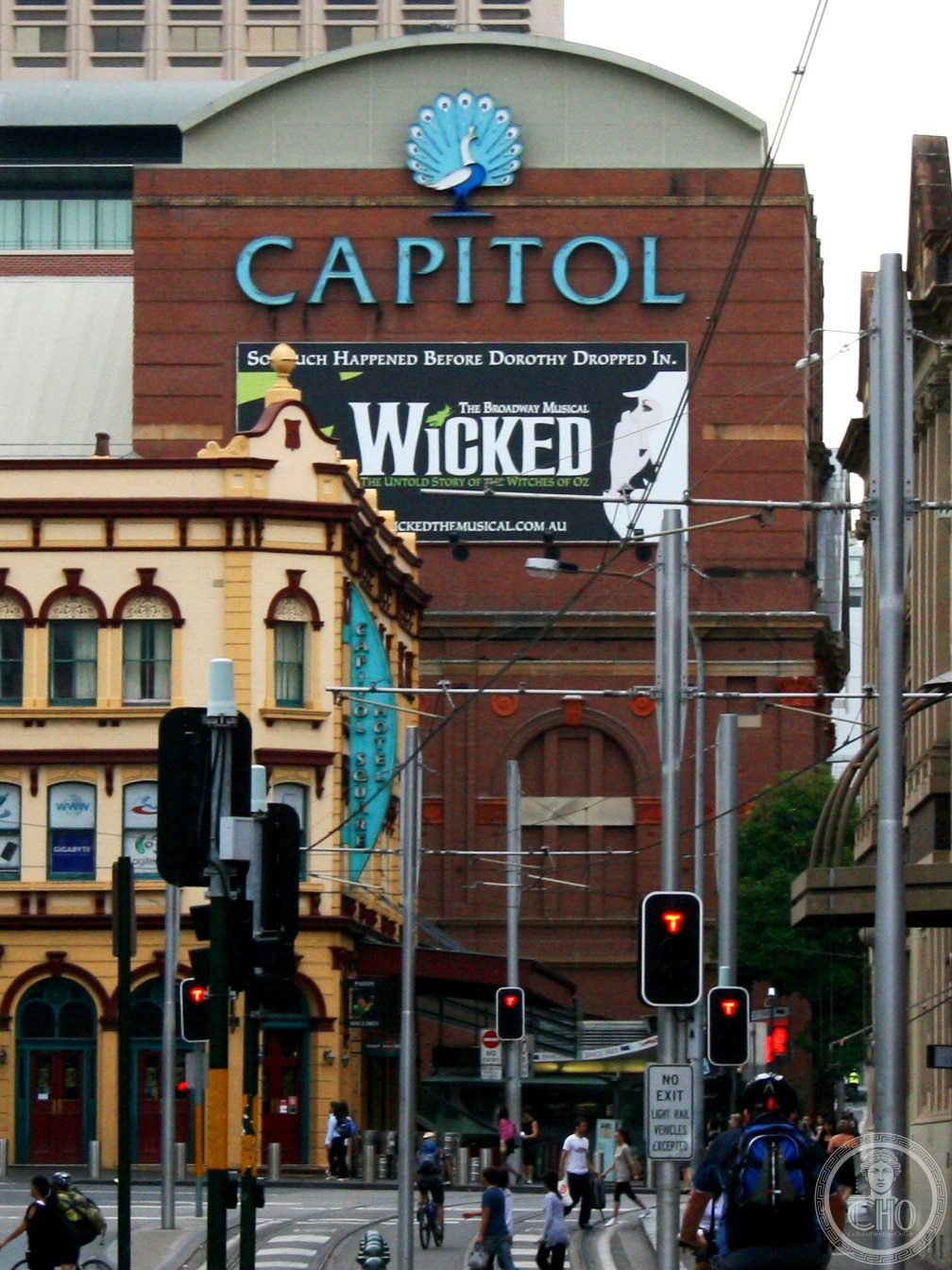
Sydney's Capitol Theatre is Australia's sole surviving atmospheric theatre substantially intact from the golden age of cinema palaces. Opened in 1928 on the site of Victorian-era produce markets, its dazzling interior replicates an Italian garden under a twilight sky, transporting audiences into an open-air fantasy before the curtain even rises.
At a glance
- Type
- Atmospheric theatre / performing arts venue
- Period
- 1927–1928 (conversion); original structure 1893
- Style
- Atmospheric / Atmospheric Moorish-Italian garden
- Location
- 3–15 Campbell Street, Haymarket, Sydney CBD, NSW, Australia
- Coordinates
- 33.8797° S, 151.2067° E
- Architect(s)
- Henry Eli White and John Eberson
Overview
The Capitol Theatre occupies a prominent position in Sydney's Haymarket district, steps from Central Station. Seating 2,094 patrons, it remains one of the largest legitimate theatres in Australia and one of the finest examples of the atmospheric theatre concept anywhere in the world. After a painstaking $30 million restoration completed in 1997, it returned to active use hosting major musical theatre productions, opera, and concerts. Its heritage listing on the NSW State Heritage Register in 1999 cemented its status as an irreplaceable part of the nation's cultural fabric.
History
The site began its life in 1893 as the Belmore Markets, a municipal produce hall that struggled commercially due to its distance from Darling Harbour. By 1916, the Wirth Brothers had converted the building into a hippodrome for circus performances. In 1927, architects Henry Eli White and John Eberson were commissioned to transform it once more, this time into a grand atmospheric movie palace. It opened as the Capitol Theatre on 7 April 1928 to immediate acclaim. The theatre hosted Australia's premiere of Jesus Christ Superstar in 1972 before falling into decline; a $30 million government-backed restoration between 1995 and 1997 returned it to its former glory.
Architecture & Design
John Eberson, pioneer of the atmospheric theatre style in the United States, brought his signature concept to Sydney: rather than a conventional proscenium box, the auditorium simulates an open Italian courtyard under a deep-blue vaulted ceiling dotted with projected stars and drifting clouds. The surviving interior courtyard is the only one of its kind remaining in Sydney. The exterior presents brick construction with ornamental terracotta capitals, stone cornices, rosettes, and decorative tiled panels. The design sits at the intersection of the Art Deco era and the romantic escapism of 1920s cinema culture, blending classical Mediterranean motifs with the theatrical grandeur of the machine age.
Cultural significance
As the only surviving substantially intact atmospheric theatre in Australia, the Capitol holds singular architectural importance. It stands as a direct link to an era when cinema-going was a fully immersive spectacle, designed to transport working-class audiences to exotic fantasy worlds. Its continuous life as a premier performance venue — from silent film to twenty-first-century Broadway tours — demonstrates how adaptive heritage can sustain living cultural institutions. NSW heritage listing in 1999 formally recognised its irreplaceable contribution to Australia's entertainment history.
Visiting today
The Capitol Theatre operates as an active commercial venue managed by Foundation Theatres (Sydney Lyric's parent company). Tickets for productions are available through the theatre's official website and major booking platforms. The historic auditorium is generally accessible only during ticketed performances; the foyer areas may be viewed before shows. Check the current season programme for upcoming musicals, operas, and concerts.
Getting there
The theatre is a five-minute walk from Central Station, served by all Sydney Trains lines. The Capitol Square light rail stop (L1/L2) sits directly behind the building. Buses along George Street and Hay Street stop nearby. Limited paid parking is available in the Haymarket area; public transport is strongly recommended for evening performances.
Sources & resources
Find it on the map
See this place and what’s around it →Record researched and written by Luigi De Marchi for Cultural Heritage Online, 2026.
📷 Become a Cultural Heritage Online photographer
Share your photos of places: they stay published under your name as the author. The more they're seen, the more you get noticed — and soon a contest will reward the most appreciated photos.
Log in or sign up free to add a photoIs this page about you?
This page is read by travellers and heritage enthusiasts who find it on Google. Tell us how you are connected to this place and we will take it from there.