
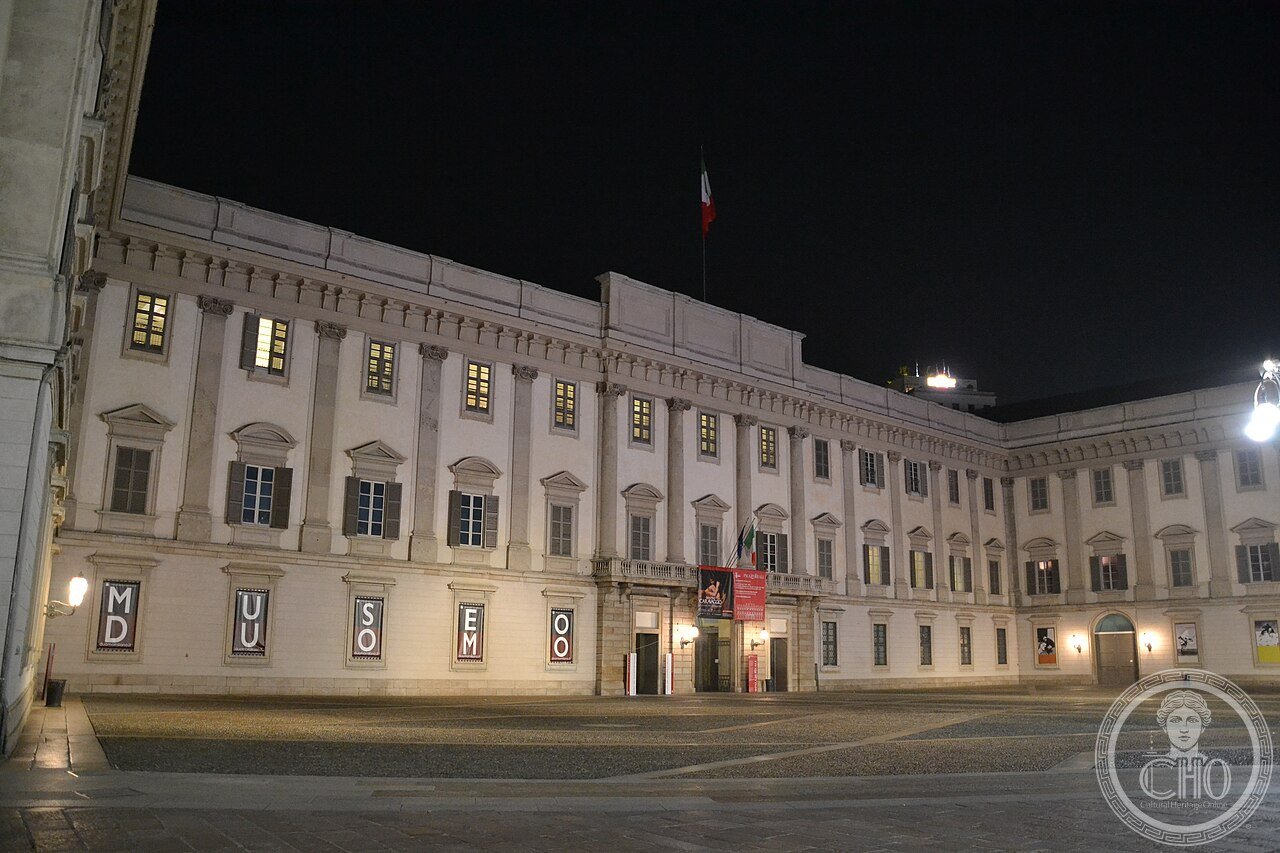
A neoclassical masterpiece on Piazza del Duomo, this former royal residence showcases centuries of artistic patronage and architectural transformation, from Renaissance splendor to Habsburg grandeur.
At a glance
The Royal Palace of Milan stands adjacent to Milan Cathedral, its facade forming a graceful recess that creates the intimate Piazzetta Reale. Once the seat of government for the city and Kingdom of Lombardy-Venetia, it became state property in 1919 and now hosts major exhibitions. The palace occupies what was originally a two-courtyard complex; the western portion was demolished to accommodate the cathedral’s expansion.
History
Under the Visconti family, the palace acquired imposing dimensions and Renaissance splendor. When Spanish governors arrived in 1535, they undertook extensive renovations, including construction of Milan’s first theater in 1594—a venue that survived until 1776, when it was demolished to make way for La Scala.
Austrian rule brought the palace to new heights. In 1769, Governor General Firmian commissioned Luigi Vanvitelli, architect of the Royal Palace of Caserta, to design a palace worthy of Habsburg prestige. When Vienna balked at the expense, Vanvitelli’s pupil Giuseppe Piermarini executed a more economical transformation between 1770 and 1778. Piermarini’s neoclassical redesign erased earlier Lombard elements, demolishing the entrance wing and reconfiguring the main courtyard into an open square.
The Napoleonic era brought decoration by Andrea Appiani and interventions by architect Luigi Canonica. After the Congress of Vienna, Austrian rule resumed, enriched by the artistic contributions of Francesco Hayez and Pelagio Pelagi. Heavy bombing in 1943 severely damaged the building; restoration began in 1980 under architect Alberico B. Belgiojoso and was completed by 2008.
What you see
Piermarini’s neoclassical facade dominates Piazza del Duomo. The Grand Staircase leads to the main floor, where a series of richly decorated rooms unfolds. The monumental Sala delle Cariatidi stands as the palace’s most significant surviving chamber; it occupies the site of the 18th-century theater and bears scars from wartime incendiary damage.
The Salone dei Festini, Audience Halls, and formal dining room exemplify late 18th-century elegance. Decorative schemes by Martino Knoller, Giocondo Albertolli, and Giuseppe Maggiolini exemplify the neoclassical aesthetic, while later Romantic-era touches reflect Hayez’s influence. The Church of San Gottardo, with its bell tower, was incorporated as the Royal Ducal Chapel.
Cultural significance
The Royal Palace embodies Milan’s evolution from Renaissance power to Habsburg administrative center. Its architectural transformation mirrors broader European shifts toward neoclassicism and reflects the city’s role in shaping artistic movements across centuries. The palace’s decoration commissioned works from leading Milanese painters and decorators, making it a repository of 18th and 19th-century artistic achievement. Today it functions as a vital exhibition venue, extending the patronage tradition that once defined its purpose.
Key facts
- Address: Piazza del Duomo, 12, 20122 Milan
- Coordinates: 45.462824617951206, 9.190782308578491
- Phone: 02 8846 5230
- Website: http://www.palazzorealemilano.it/
- Designed by: Giuseppe Piermarini (neoclassical renovation, 1770–1778); original structure dates to medieval period
Practical information
The palace is open to the public as an exhibition venue. Regular hours are Tuesday–Wednesday and Friday 9:30 a.m.–7:30 p.m.; Thursday and Saturday until 10:30 p.m.; Sunday 9:30 a.m.–7:30 p.m.; Monday 2:30 p.m.–7:30 p.m. Last admission is one hour before closing. Holiday hours may vary; check the official website for special schedules. Admission and exhibition details are available through the palace website or by telephone.
Getting there
The palace faces Piazza del Duomo in central Milan, immediately adjacent to Milan Cathedral and the Galleria Vittorio Emanuele II. Public transportation connects easily to the piazza; the Duomo metro station (Lines 1 and 3) is steps away.
See the place
Sources & resources
Find it on the map
See this place and what’s around it →Historical events at this place (19)
- 2018 ITALIANA. L'Italia vista dalla moda 1971-2001
- 2018 DURER e il RINASCIMENTO tra Germania e Italia
- 2018 IMPRESSIONISMO E AVANGUARDIE. Capolavori dal Philadelphia Museum of Art
- 2019 Mostra Antonello da Messina - Dentro la pittura
- 2018 Mostra Picasso a Palazzo Reale
- 2018 Beyond thestill image
- 2021 Monet in mostra a Milano
- 2023 Visita alla casa del Viceré: Eugenio di Beauharnais nella Milano napoleonica
- 2024 Mostra Fotografica: Brassaï. L’occhio di Parigi.
- 2024 Mostra: De Nittis. Pittore della vita moderna
- 2024 Mostra: Cézanne / Renoir. Capolavori dal Musée de l’Orangerie e dal Musée d’Orsay
- 2024 Dal Cuore alle Mani. Dolce&Gabbana
- 2024 Mostra: Tesori Riflessi
- 2024 Mostra: Valerio Adami. Pittore d’idee
- 2024 Mostra: Mike Bongiorno. Il centenario 1924 – 2024
- 2024 Mostra: Picasso lo straniero
- 2024 Mostra - Edvard Munch
- 2024 Mostra - Ugo Mulas. L’operazione fotografica
- 2026 OmoGirando la mostra “Robert Mapplethorpe, le forme del desiderio”
📷 Become a Cultural Heritage Online photographer
Share your photos of places: they stay published under your name as the author. The more they're seen, the more you get noticed — and soon a contest will reward the most appreciated photos.
Log in or sign up free to add a photoIs this page about you?
This page is read by travellers and heritage enthusiasts who find it on Google. Tell us how you are connected to this place and we will take it from there.