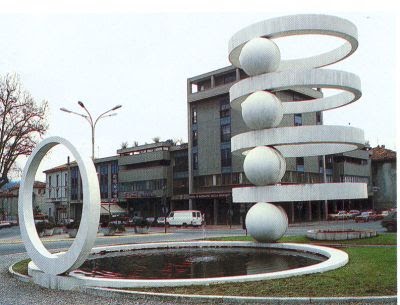
The Fontana di Camerlata, also known as Fontana a cerchi, is a fountain designed by architect Cesare Cattaneo and painter Mario Radice in 1936 for the Camerlata neighbourhood of Como, Lombardy. The collaborative work reflects the intersection of architecture and visual art characteristic of the Rationalist movement in interwar Italy.
Cattaneo was among the most promising voices of Italian Rationalism despite his exceptionally brief career. He studied at the Milan Polytechnic, graduating at age twenty-three in 1935, and had already begun to establish himself within Como’s circle of avant-garde architects and artists, which included Giuseppe Terragni and Alberto Sartoris. His partnership with painter Mario Radice on this fountain project demonstrates the movement’s integration of multiple artistic disciplines in public commissions.
About Cesare Cattaneo
Cattaneo (1912–1943) was a key figure in Italian Rationalism, producing significant architectural projects, theoretical writings, and realized buildings despite his short lifetime. He trained under Giuseppe Terragni and Pietro Lingeri and participated successfully in the 1934 and 1935 Littorali dell’Arte competitions.
Details
- Architect: Cesare Cattaneo
- Artist: Mario Radice
- Year: 1936
- Location: Camerlata, Como, Lombardy
- Movement: Italian Rationalism
Explore more: 10 heritage places in Como
Frequently asked questions
Who designed the Fontana di Camerlata?
The fountain was designed by architect Cesare Cattaneo and painter Mario Radice in 1936. Both were active members of Como’s Rationalist artistic circle.
What was Cesare Cattaneo’s significance?
Cattaneo was recognized as one of the most promising figures in Italian Rationalism, though his career ended prematurely with his death in 1943 at age thirty-one. He studied under Giuseppe Terragni and produced influential architectural projects and writings despite his brief lifetime.
Why did Cattaneo collaborate with a painter on this commission?
The collaboration between Cattaneo and Radice reflects Rationalism’s philosophy of integrating multiple artistic disciplines—architecture, painting, and design—into unified public works that served both functional and aesthetic purposes.