
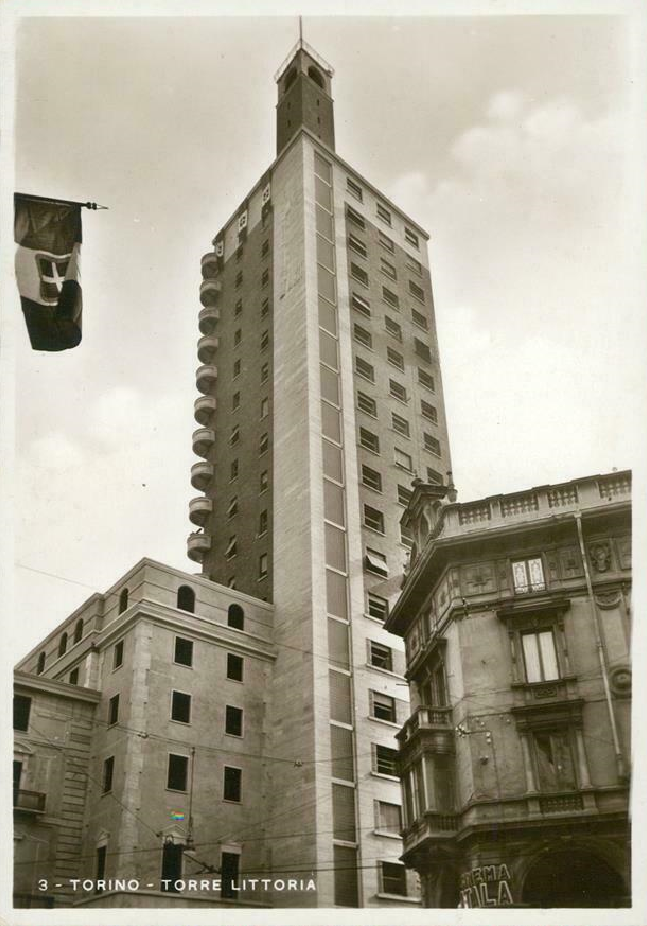
The Torre Littoria is a radio tower built in Turin between 1933 and 1934, designed by architects Armando Melis de Villa, Giovanni Bernocco and Giorgio Scanagatta.
Melis de Villa (1889–1961), trained at the Politecnico di Torino and graduated in 1920, was an active modernist architect and urban planner in Turin. He had participated in the Italian National Architecture Exhibition at Parco del Valentino in 1928 and worked with the GANT group (Giovani Architetti Novatori Torinesi—Young Innovating Turin Architects). The Torre Littoria represents his engagement with the rationalist architectural idiom that characterized Italian design in the interwar period. Melis de Villa’s career later extended into academic work; he held teaching positions at the Turin Politecnico from 1936 onward, eventually becoming professor ordinarius in 1957.
About Armando Melis de Villa
Melis de Villa was born in Iglesias in 1889 and established himself as a leading figure in Turin’s architectural modernism during the 1920s and 1930s. His work bridged practice and education, influencing Italian architectural thought through his tenure at the Politecnico di Torino and the Faculty of Architecture.
Details
- Designers: Armando Melis de Villa, Giovanni Bernocco, Giorgio Scanagatta
- Year: 1933–1934
- Location: Turin, Italy
- Typology: Radio tower
- Movement: Italian Rationalism
Explore more: 102 heritage places in Torino
Frequently asked questions
Who designed the Torre Littoria?
The tower was designed by architect Armando Melis de Villa, engineer Giovanni Bernocco, and Giorgio Scanagatta, completed in 1933–34.
Where is the Torre Littoria located?
The tower stands in Turin, in the Piedmont region of northern Italy.
What architectural movement does it represent?
The Torre Littoria exemplifies Italian Rationalism, the modernist architectural movement that flourished in Italy during the interwar years and emphasized functional form and geometric clarity.
Sources
- S1 — Ciucci, Giorgio. Gli architetti e il fascismo: architettura e città 1922-1944. Einaudi, 2002. ISBN 978-88-06-16310-5.
- S2 — Nicoloso, Paolo. Mussolini architetto: Propaganda e paesaggio urbano nell'Italia fascista. Einaudi, 2008. ISBN 978-88-06-19086-6.
Spotted an error? Write to editorial@culturalheritageonline.com and we correct it the same day.


