

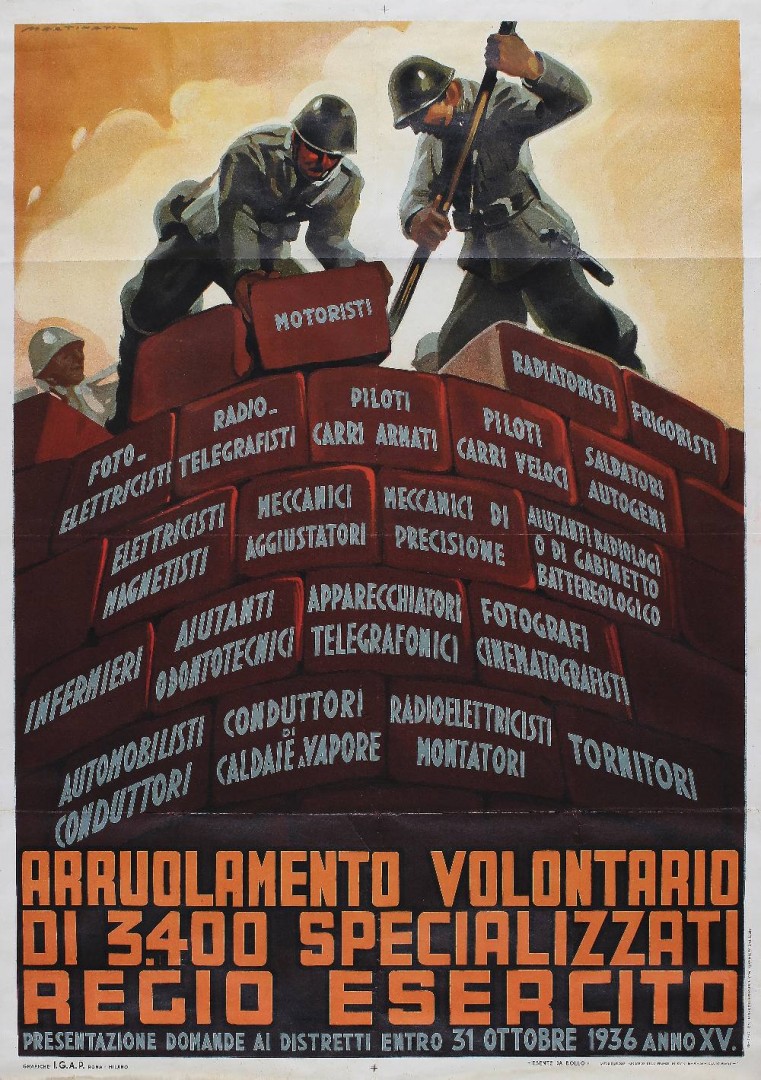
An advertising poster designed by Luigi Martinati in 1936. Martinati was an Italian illustrator, commercial artist and painter who built a prolific career in advertising design and cinematic illustration across several decades of the twentieth century.
Born in Florence on 31 December 1893, Martinati studied at the Accademia di Belle Arti before moving to Rome in 1911, where he apprenticed in the studio of poster painter Federico Ballester. From the 1920s onward, he dedicated himself to commercial advertising, producing posters across a wide range of subjects—from commercial advertisements to tourist campaigns, political propaganda to major celebratory events. By the 1930s, Martinati had established his own studio on Via Emanuele Filiberto in Rome, which he shared with colleague Tito Corbella. He worked closely with the A.P.E. printing house in Viale Castrense, which produced most of his output from the 1930s through the 1950s. Martinati became director of IGAP (Impresa Generale Affissioni Pubblicità), one of Rome’s leading advertising agencies, and collaborated with major film companies including Warner Brothers.
About Luigi Martinati
Martinati (1893–1983) was central to Rome’s commercial design culture during the interwar and postwar periods. His work spanned commercial promotion, tourism, and film publicity, making him a key figure in Italian twentieth-century advertising design.
Details
- Creator: Luigi Martinati
- Year: 1936
- City: Rome
- Object type: Advertising poster
- Studio location: Via Emanuele Filiberto, Rome
Explore more: 509 heritage places in Roma
Frequently asked questions
Who was Luigi Martinati?
Luigi Martinati (1893–1983) was an Italian illustrator, commercial artist and painter born in Florence. He established himself in Rome as one of the period’s most active advertising designers, producing posters for commercial, tourist, political and celebratory purposes between 1923 and 1941.
Where did Martinati work?
After moving to Rome in 1911, Martinati established his studio on Via Emanuele Filiberto by the 1930s. He directed IGAP, a major Roman advertising agency, and worked with the A.P.E. printing house in Viale Castrense, which produced most of his designs.
What subjects did Martinati design for?
Martinati created posters across diverse subjects including commercial advertisements, tourist campaigns, political propaganda and major public celebrations. He also collaborated extensively with film companies, particularly Warner Brothers, bringing cinematic subjects into his advertising work.
Sources
- S1 — Menegazzi, Luigi. Il manifesto italiano: 1882-1925. Electa, 1995. ISBN 978-88-435-5134-7.
- S2 — De Fusco, Renato. Storia del design. Laterza, 2002. ISBN 978-88-420-6623-1.
Spotted an error? Write to the editors and we correct it the same day.
At auction this weekPaintings, drawings and sculpture change hands at auction every weekOils, works on paper and signed prints are open for bidding today on Catawiki, where an expert checks each lot before it goes live.See what is open on Catawiki →


Advertisement. Pictured, from the Cleveland Museum of Art (CC0) and not for sale: Modigliani, Renoir, Toulouse-Lautrec. How we handle this