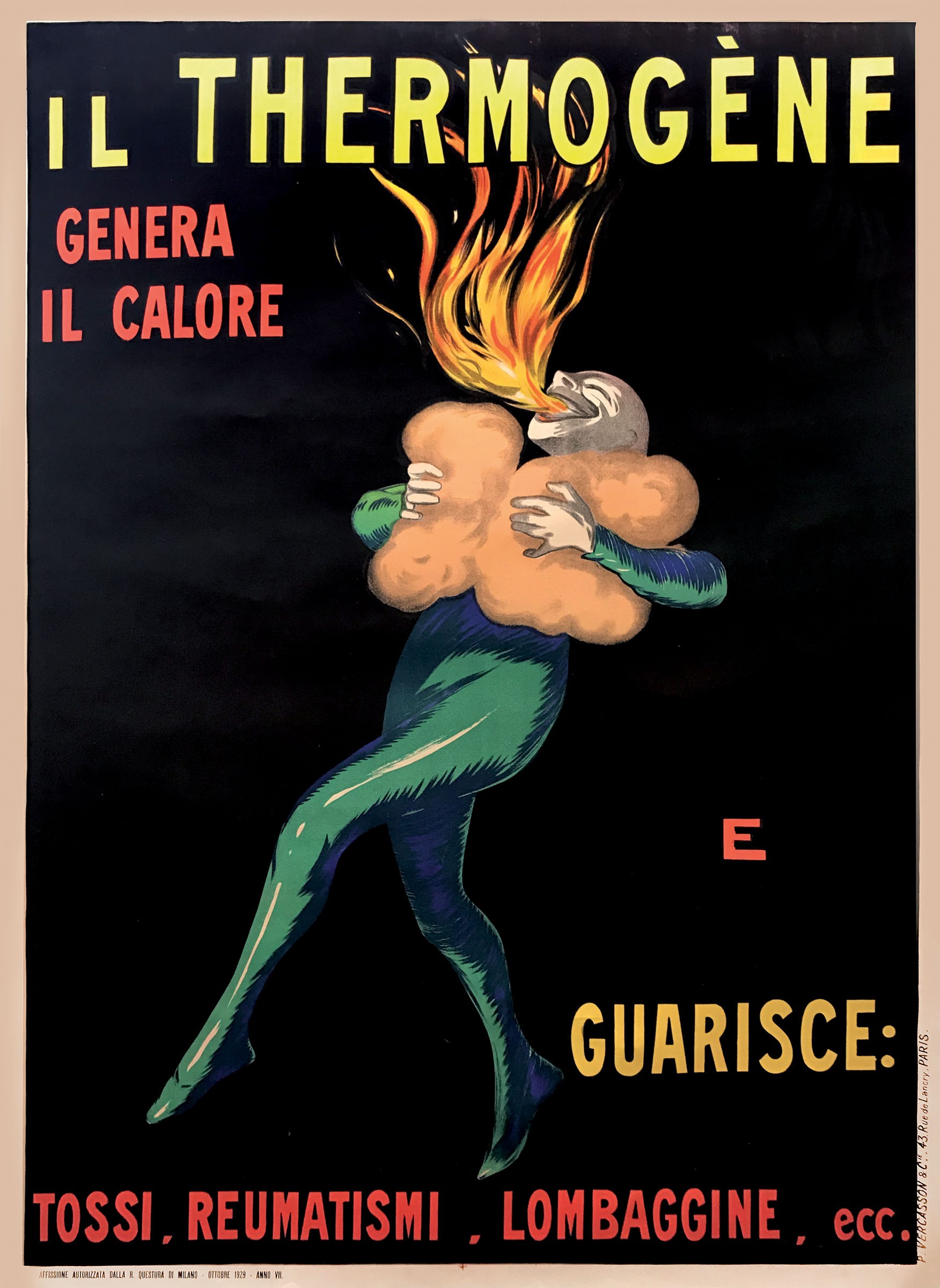
An advertising poster designed by Leonetto Cappiello in 1929. Cappiello was an Italian and French poster artist and painter who worked primarily in Paris and is widely regarded as a pioneer of modern advertising design.
Cappiello fundamentally transformed poster art through his distinctive visual approach. Breaking with the painterly tradition established by earlier poster artists such as Jules Chéret and Alfred Choubrac, he developed a revolutionary technique: bold, striking figures rendered against black backgrounds. This stark contrast created immediate visual impact and commercial appeal, distinguishing his work sharply from the aesthetic conventions of early advertising posters. His innovations established new standards for the medium and shaped the trajectory of twentieth-century poster design.
About Leonetto Cappiello
Leonetto Cappiello was an Italian and French designer and painter who based his career in Paris. He earned recognition as a foundational figure in modern advertising through his distinctive use of bold imagery and dramatic compositional contrast, techniques that proved both commercially successful and artistically influential across Europe.
Details
- Creator: Leonetto Cappiello
- Year: 1929
- Object type: Advertising poster
- Movement: Modern poster design
On video
Frequently asked questions
Who was Leonetto Cappiello?
Leonetto Cappiello was an Italian and French poster artist and painter who lived and worked primarily in Paris. He is recognized as a pioneering figure in modern advertising design and is often called the father of modern advertising because of his innovative approach to poster creation.
What made Cappiello’s posters different?
Cappiello was the first poster artist to use bold figures set against black backgrounds, creating striking visual contrast. This approach was almost the opposite of earlier poster artists, who worked in a more painterly tradition, making his work revolutionary for its commercial impact and visual clarity.
When was this poster created?
This advertising poster was created in 1929, during the height of Cappiello’s career in Paris.
Sources
- S1 — Menegazzi, Luigi. Il manifesto italiano: 1882-1925. Electa, 1995. ISBN 978-88-435-5134-7.
- S2 — De Fusco, Renato. Storia del design. Laterza, 2002. ISBN 978-88-420-6623-1.
Spotted an error? Write to editorial@culturalheritageonline.com and we correct it the same day.