
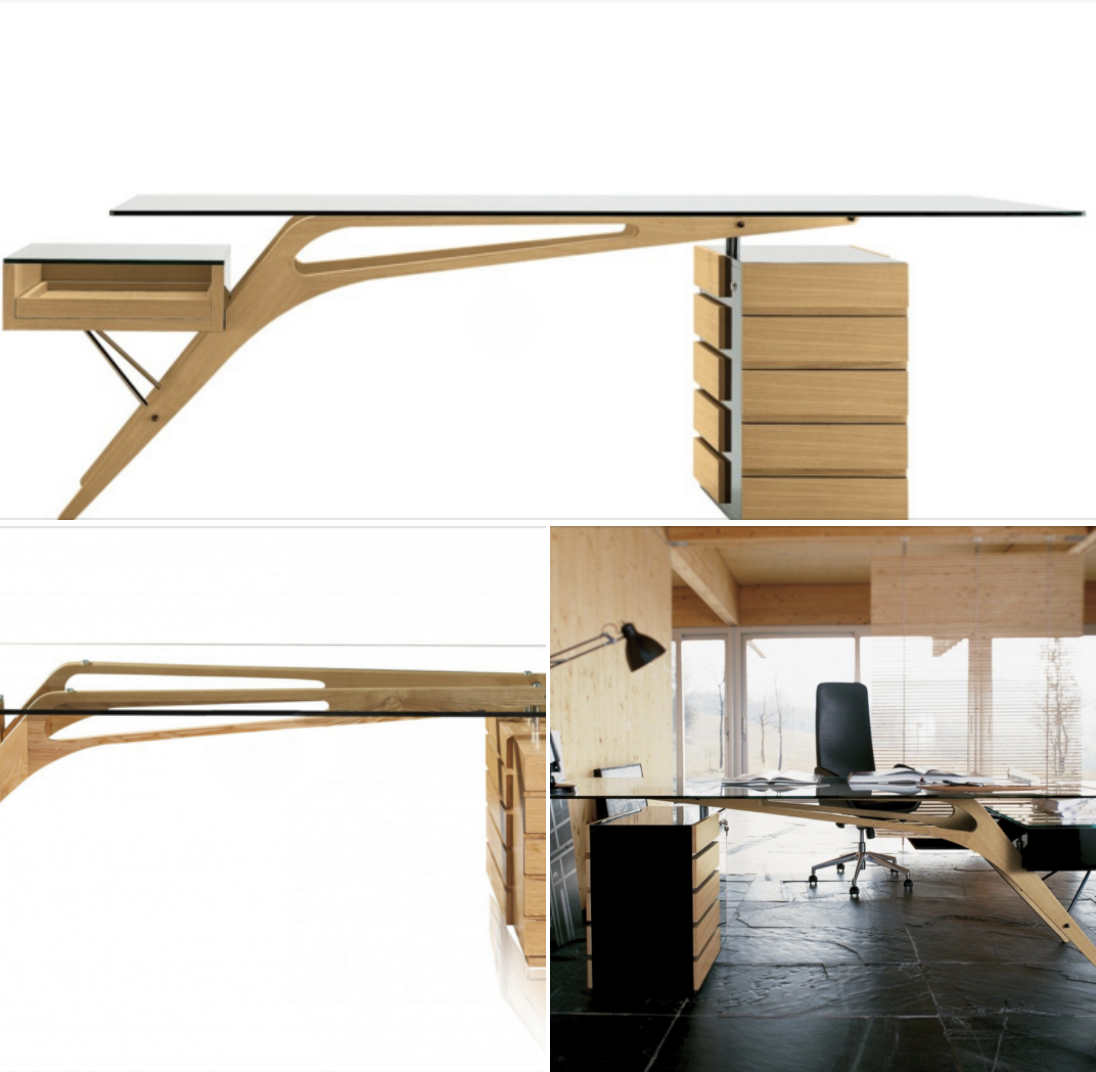
The Cavour Desk was designed by architect Carlo Mollino in 1949. Originally commissioned as part of the furnishings for the Orengo residence in Turin, the desk exemplifies the refined modernism of Italian design in the immediate post-war period. Its construction combines maple wood, 12 mm Securit glass and black mambrite, materials chosen to achieve both structural integrity and visual lightness.
Mollino’s approach to furniture design reflected his broader architectural philosophy, balancing functional precision with sculptural form. The desk’s clean lines and material contrasts were characteristic of the period’s embrace of industrial processes and new materials in domestic spaces. The work gained sufficient recognition that it entered industrial production, and today remains in commercial circulation through Zanotta S.p.A., the Italian furniture manufacturer.
About Carlo Mollino
Carlo Mollino (Turin, 1905–1973) was an Italian architect and designer whose work spanned modernism and the emerging Rationalist movement. Active across architecture, furniture and industrial design, Mollino developed a distinctive vocabulary that married geometric precision with organic sensibility.
Details
- Designer: Carlo Mollino
- Year: 1949
- Location: Originally designed for the Orengo residence, Turin
- Materials: Maple wood, 12 mm Securit glass, black mambrite
- Current manufacturer: Zanotta S.p.A.
Explore more: 102 heritage places in Torino
Frequently asked questions
Who designed the Cavour Desk?
The desk was designed by architect Carlo Mollino, a Turin-based modernist active in architecture and furniture design from the early twentieth century until 1973.
What materials was the original desk made from?
The desk was crafted in maple wood, 12 mm Securit glass and black mambrite, combining natural and industrial materials typical of post-war Italian design.
Where was it originally placed?
The desk was originally commissioned as part of the furnishings for the Orengo residence in Turin.
Sources
- S1 — De Fusco, Renato. Storia del design. Laterza, 2002. ISBN 978-88-420-6623-1.
- S2 — Pansera, Anty. Storia del disegno industriale italiano. Laterza, 1993. ISBN 978-88-420-4316-4.
Spotted an error? Write to editorial@culturalheritageonline.com and we correct it the same day.


