
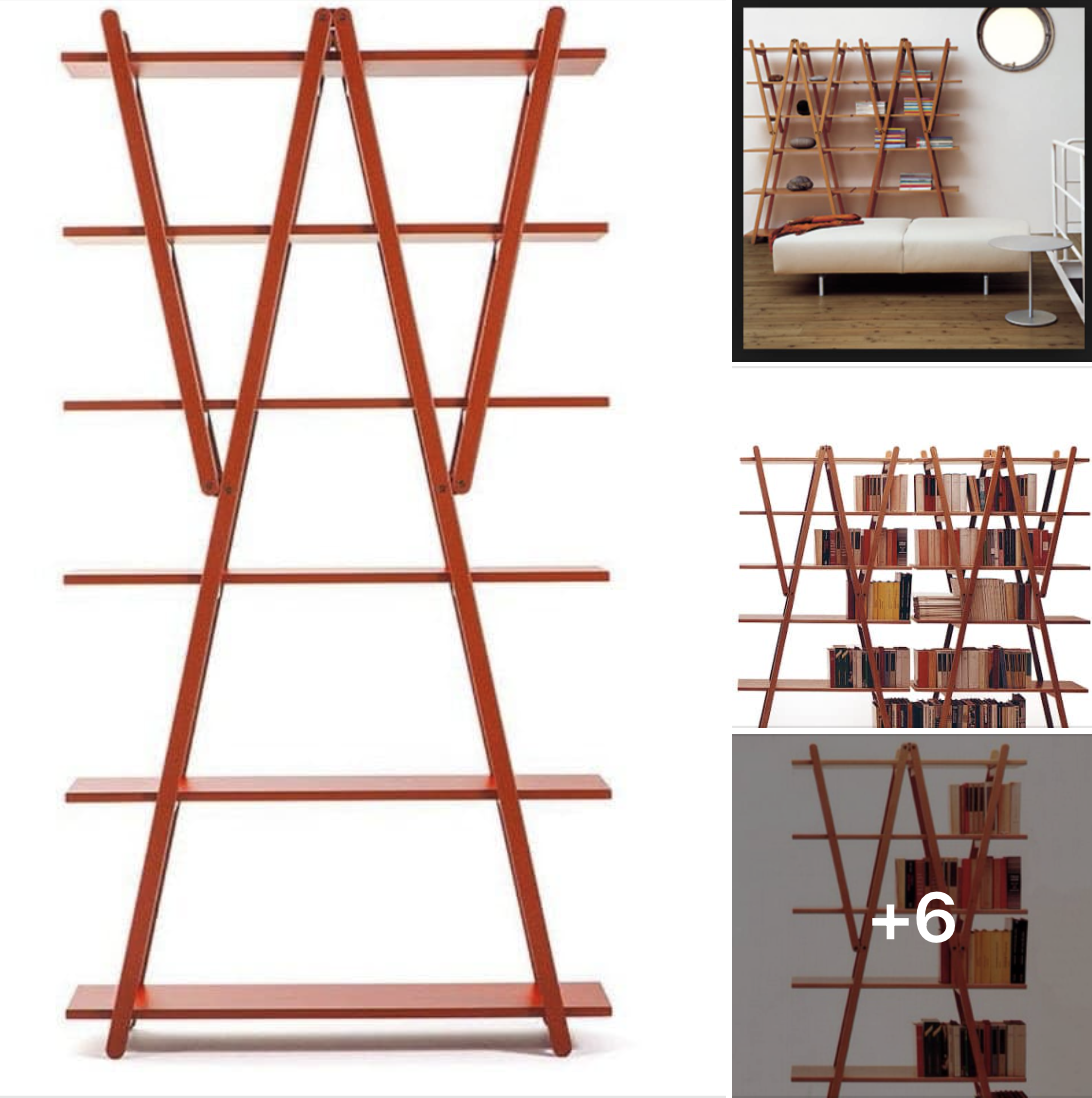
Vico Magistretti’s Nuvola Rossa bookcase, designed in 1977 and manufactured by Cassina, exemplifies modernist reduction applied to everyday domestic objects. Constructed in beech with natural evaporation finish, measuring 192 by 100 by 39.5 centimetres, the piece demonstrates Magistretti’s philosophy of rational design.
Concept and Structure
Magistretti described the design as embodying Mies van der Rohe’s principle of “less is more,” but pursued with increasing complexity of thought. Rather than treating the bookcase as a simple object, Magistretti reconceived its fundamental structure. He eliminated the lateral supports characteristic of traditional bookcases, instead integrating the structural frame with diagonal cross-bracing. This approach creates a freestanding unit stabilised by hinges, allowing the bookcase to move and adapt while remaining rigid in use.
Spatial Function
The Nuvola Rossa departs from the conventional wall-mounted library. Its design allows it to function as a room divider, separating and defining spaces rather than merely storing books against a wall. The flexible structure can be multiplied and arranged according to spatial needs, transforming the bookcase from a single-purpose storage object into an architectural element that reorganises domestic environments.
Frequently asked questions
What materials and dimensions define the Nuvola Rossa?
The bookcase is crafted from beech wood with natural evaporated finish in white and black Canaletto, measuring 192 centimetres high, 100 centimetres wide, and 39.5 centimetres deep.
How does the design eliminate traditional lateral supports?
Magistretti merged the structural frame with diagonal cross-bracing and hinged connections, creating stability through internal bracing rather than external side panels.
What distinguishes this bookcase as a spatial element?
Unlike wall-mounted bookcases, the Nuvola Rossa functions as a freestanding room divider that can be multiplied to define and separate interior spaces according to changing needs.
