
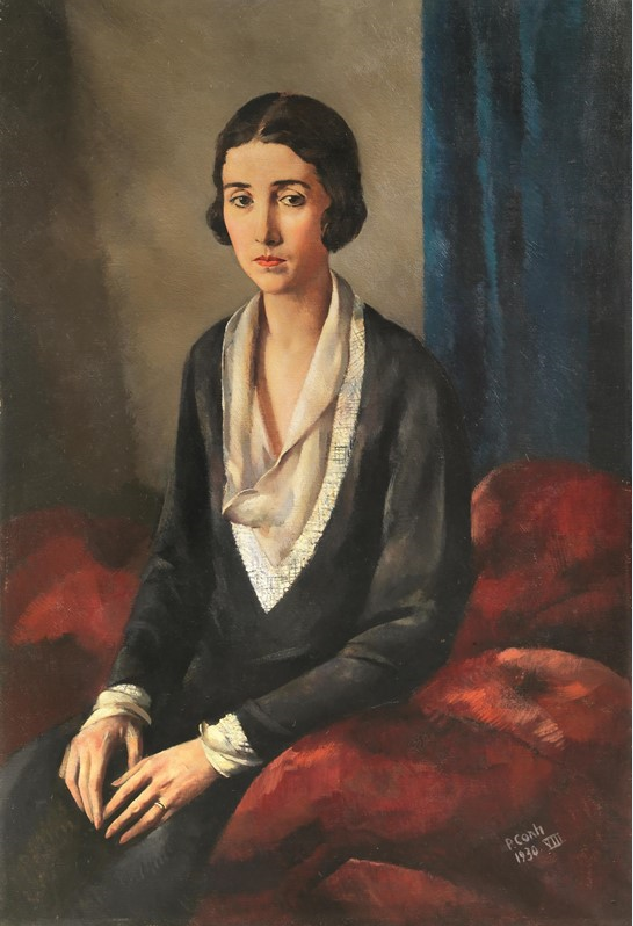
Primo Conti’s Portrait of Countess Jeanne Bombicci Pontelli, painted in 1930, belongs to a period of stylistic exploration in the Florentine artist’s career. Conti (1900–1988) was a futurist artist whose early association with the movement—formalized after meetings with Giacomo Balla and Filippo Tommaso Marinetti in 1917—gave way to diverse artistic interests in the 1920s.
By the time of this portrait, Conti had moved beyond strict Futurist doctrine into a broader modernist vocabulary. His work during this decade absorbed influences from Mannerism, Exoticism, and Pittura Metafisica, reflecting an intellectual curiosity that extended to theater and literature, particularly the innovations of Luigi Pirandello. The portrait exemplifies Conti’s capacity to synthesize multiple modernist languages while maintaining portraiture as a vehicle for artistic exploration.
About Primo Conti
Born in Florence in 1900, Conti demonstrated precocious ability in music, poetry, and painting from childhood. His early attraction to innovation led him into contact with Futurist circles by 1913. After 1917, he became an active contributor to the movement through paintings, drawings, and literary works including Imbottigliature, which earned praise from Marinetti. The 1920s represented his most experimental decade, during which he ranged across multiple styles and intellectual traditions.
Details
- Artist: Primo Conti
- Year: 1930
- Movement: Modernism, post-Futurism
- Subject: Countess Jeanne Bombicci Pontelli
On video
Frequently asked questions
Who was Primo Conti?
Primo Conti (1900–1988) was an Italian futurist artist born in Florence who joined the Futurist movement in 1917 after meeting Giacomo Balla and Filippo Tommaso Marinetti. During the 1920s, he broadened his artistic language to encompass Mannerism, Exoticism, and Pittura Metafisica.
What artistic movements influenced this work?
By 1930, Conti had moved beyond strict Futurism into a synthesis of modernist approaches developed through the 1920s, including elements of Exoticism and Pittura Metafisica alongside his earlier futurist training.
When did Conti become a Futurist?
Conti formally joined the Futurist movement in 1917, following meetings with Giacomo Balla in Rome and Filippo Tommaso Marinetti in Naples, though he had been attracted to Futurist ideas since 1913.
Sources
- S1 — Pontiggia, Elena. Il Novecento Italiano. Abscondita, 2003. ISBN 978-88-8416-048-5.
- S2 — Menegazzi, Luigi. Il manifesto italiano: 1882-1925. Electa, 1995. ISBN 978-88-435-5134-7.
Spotted an error? Write to editorial@culturalheritageonline.com and we correct it the same day.


