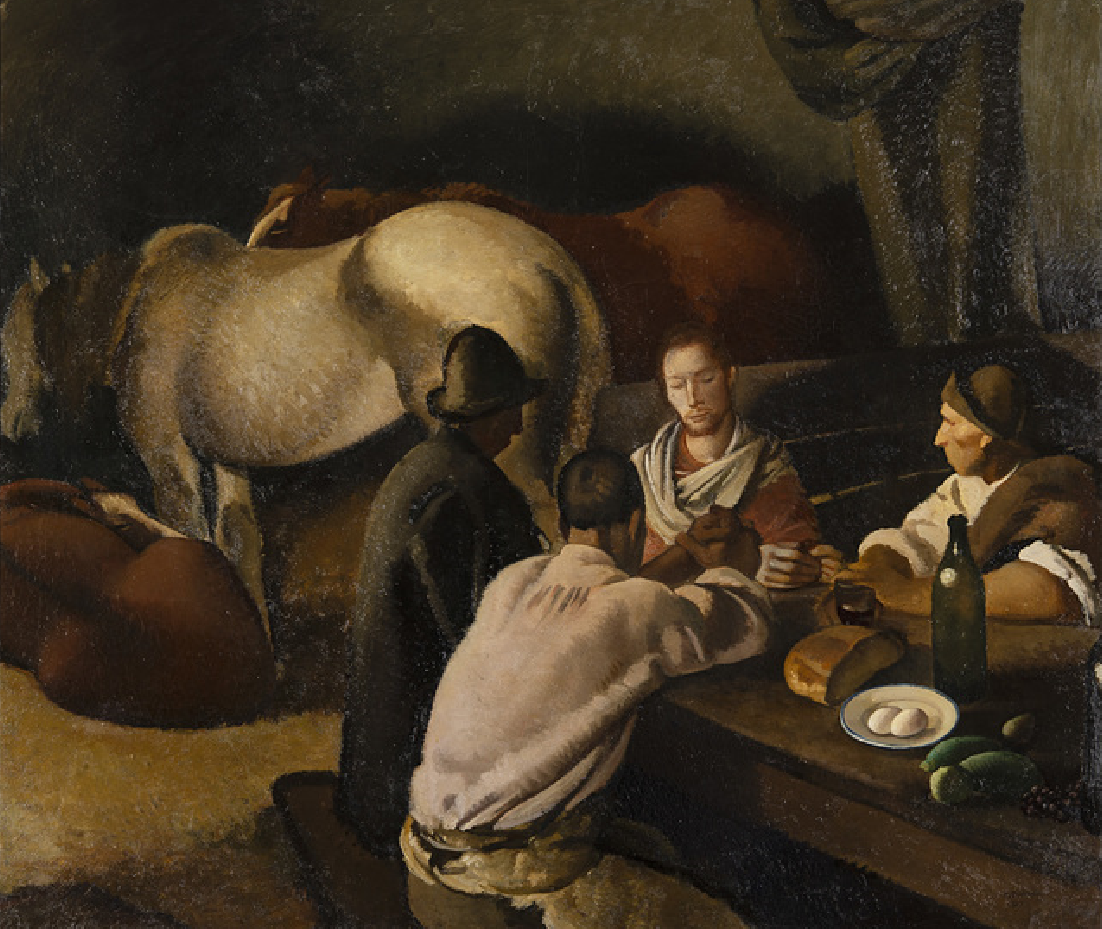
La cena di Emmaus is an oil painting by Italian artist Felice Carena, created in 1922. The work depicts the biblical narrative of Christ’s appearance to his disciples at Emmaus, a subject central to Christian iconography that Carena reimagined through an early twentieth-century artistic lens.
Carena developed this composition during a period of significant artistic evolution. Having moved to Rome in 1906, he was exposed to modernist influences, particularly the styles of Cézanne and Matisse, which began to shape his work between 1913 and 1915. The 1922 painting reflects this synthesis of classical subject matter with contemporary formal approaches. That same year, Carena founded an art school in Rome, positioning himself as both an active painter and an educator at a pivotal moment in Italian modernism.
About Felice Carena
Born in Cumiana in 1879, Carena studied at the Accademia Albertina in Turin before establishing himself in Rome. His career spanned modernism’s emergence in Italy; he exhibited at the Venice Biennale in 1912 and went on to teach at the Florence Academy from 1924 onwards. Carena remained a significant figure in twentieth-century Italian painting until his death in Venice in 1966.
Details
- Artist: Felice Carena (1879–1966)
- Date: 1922
- Subject: Biblical narrative, Supper at Emmaus
- Artistic context: Influenced by Cézanne and Matisse; active in Italian modernism
On video
Frequently asked questions
Who was Felice Carena?
Felice Carena was an Italian painter born in 1879 who studied at the Accademia Albertina in Turin and moved to Rome in 1906. He exhibited at the Venice Biennale in 1912 and founded an art school in Rome in 1922, later teaching at the Florence Academy.
What artistic influences shaped this work?
Between 1913 and 1915, Carena was influenced by the styles of Cézanne and Matisse, which informed his approach to form and colour in works created during the 1920s, including La cena di Emmaus.
What is the subject of the painting?
The painting depicts the biblical scene of the Supper at Emmaus, in which Christ appears to his disciples after the Resurrection, a traditional theme in Western religious art reinterpreted through modern artistic language.