
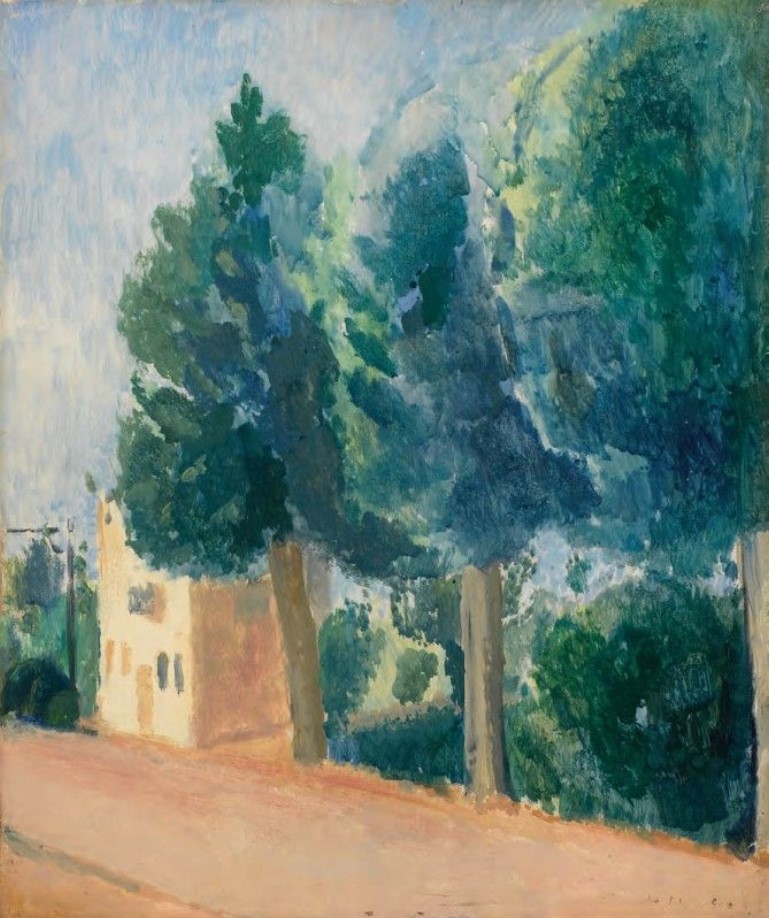
Paesaggio Veneto is a painting by Italian artist Virgilio Guidi, executed in 1927. The work exemplifies Guidi’s post-war approach to landscape, rooted in his deep study of Renaissance masters and his engagement with Venetian tonality.
Born in Rome in 1891, Guidi trained at the Scuola Libera di Pittura and the Accademia di Belle Arti, where he came under the influence of Armando Spadini. His early artistic formation was shaped by intensive study of Renaissance painters—Giotto, Piero della Francesca, and Correggio—supplemented by examination of Caravaggio and Cézanne. During the decade following the First World War, Guidi developed a distinctive approach: he painted modern subject matter using a tonality inspired by Venetian painting, while simplifying forms and emphasizing volumetric structure to lend his compositions a timeless quality.
About Virgilio Guidi
Guidi (1891–1984) was an Italian painter and writer who participated in the Rome Secession from 1915 onwards. His work from the 1920s onward demonstrated a synthesis of contemporary formal concerns with reverence for Italian artistic tradition. He exhibited regularly at major venues, including the Venice Biennale of 1922.
Details
- Artist: Virgilio Guidi (1891–1884)
- Year: 1927
- Medium: Painting
- Subject: Venetian landscape
- Movement: Post-war modern painting informed by Venetian tradition
On video
Frequently asked questions
Who was Virgilio Guidi?
Virgilio Guidi was a Rome-born painter and writer (1891–1984) who studied at the Accademia di Belle Arti under Armando Spadini. He developed a distinctive post-war style that combined modern subject matter with tonality inspired by Venetian masters and his study of Italian Renaissance painters.
What artistic traditions influenced this work?
Guidi’s approach was shaped by intensive study of Renaissance masters including Giotto, Piero della Francesca, and Correggio, as well as later masters such as Caravaggio. During the 1920s, he synthesized these influences with Venetian tonality to create paintings with simplified forms and emphasized volume.
When was this painting created?
The work dates to 1927, a period when Guidi was fully developing his mature post-war style of landscape and figurative painting.
Sources
- S1 — Pontiggia, Elena. Il Novecento Italiano. Abscondita, 2003. ISBN 978-88-8416-048-5.
- S2 — Ciucci, Giorgio. Gli architetti e il fascismo: architettura e città 1922-1944. Einaudi, 2002. ISBN 978-88-06-16310-5.
Spotted an error? Write to editorial@culturalheritageonline.com and we correct it the same day.


