
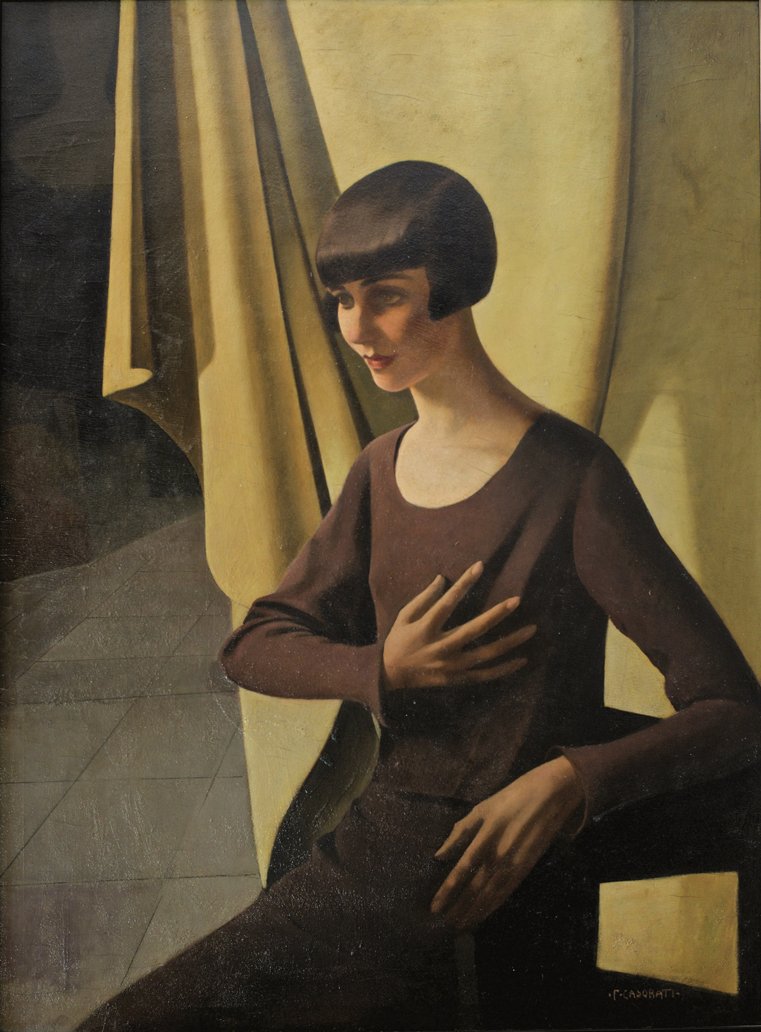
Cynthia Maughan is a portrait painting by Italian artist Felice Casorati, executed in 1924–25. The work belongs to Casorati’s mature period of figure composition and portraiture, disciplines for which he became widely recognized.
Casorati’s approach to portraiture was distinguished by unusual perspective effects and a visionary sensibility developed after 1910, when the influence of Symbolism and Gustav Klimt redirected his early naturalistic practice. By the 1920s, he had established himself as a leading figure painter working across multiple media, including painting, sculpture, and printmaking. His portraits of this era demonstrate a sophisticated treatment of form and psychological presence.
About Felice Casorati
Felice Casorati (1883–1963) was an Italian painter, sculptor, and printmaker born in Novara. After studying law at the University of Padua, he committed to art following his work’s acceptance at the 1907 Venice Biennale. He served in World War I and subsequently settled in Turin, where he developed the distinctive modernist idiom for which he is remembered.
Details
- Artist: Felice Casorati
- Year: 1924–25
- Medium: Painting
- Subject: Portrait
Frequently asked questions
Who painted this portrait?
Felice Casorati, an Italian painter known for figure compositions and portraits characterized by unusual perspective effects.
When was the work created?
The portrait was executed in 1924–25, during Casorati’s established period as a modernist portraitist.
What was Casorati’s artistic background?
Casorati initially worked in a naturalistic style but shifted toward a more visionary approach after 1910 under the influence of Symbolism and Gustav Klimt. He worked across painting, sculpture, and printmaking throughout his career.
Sources
- S1 — Pontiggia, Elena. Il Novecento Italiano. Abscondita, 2003. ISBN 978-88-8416-048-5.
- S2 — Ciucci, Giorgio. Gli architetti e il fascismo: architettura e città 1922-1944. Einaudi, 2002. ISBN 978-88-06-16310-5.
Spotted an error? Write to editorial@culturalheritageonline.com and we correct it the same day.


