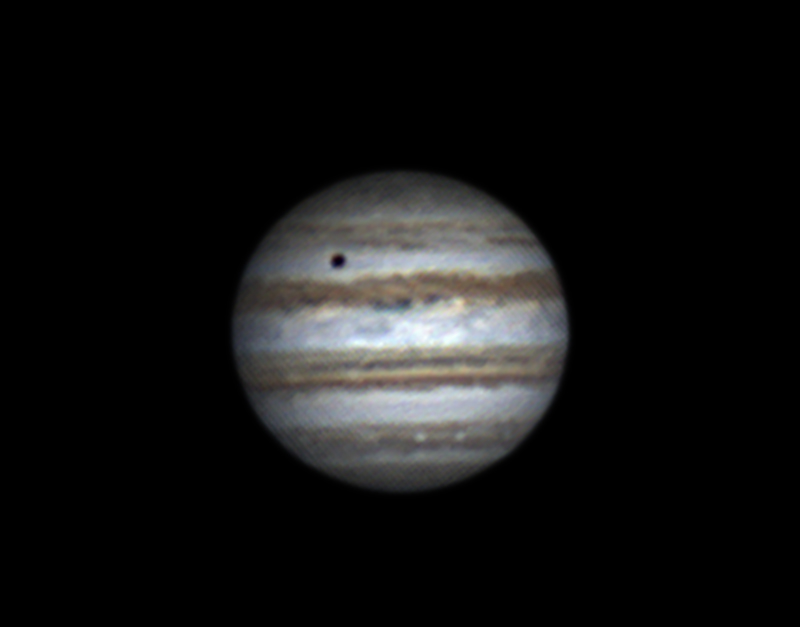
Presented in December 2019, this astrophotographic image documents Jupiter during a solar eclipse caused by one of its moons, Io, captured on April 5, 2016. The photograph was created using a direct-sensor planetary camera (ASI120MC color), processing video footage to produce the final result. Io appears in the upper left portion of the image during the eclipse event.
Capturing the Image
The photograph was taken with specialized planetary imaging equipment designed for detailed observation of solar system bodies. The ASI120MC camera, a direct-sensor device, enabled the capture of high-resolution footage that was subsequently processed into a single composite image. The technical setup allowed the photographer to record fine details of Jupiter’s atmosphere and the precise moment of Io’s solar eclipse.
Jupiter’s Moon Io
Io is one of Jupiter’s four largest moons, known as the Galilean moons. The eclipse documented here occurs when Io passes directly between Jupiter and the Sun from the observer’s perspective, casting a shadow on the planet’s cloud layers. Such events are regular occurrences in the Jovian system and provide opportunities for detailed observation of both the moon and the planet’s atmospheric features.
Frequently asked questions
What camera equipment was used for this photograph?
The image was created using an ASI120MC color planetary camera with a direct sensor, recording video footage that was processed into the final composite image.
When was this photograph taken?
The photograph was captured on April 5, 2016, and presented publicly in December 2019.
What is Io?
Io is one of Jupiter’s four largest Galilean moons, visible in the upper left of the image during the solar eclipse event.
Sources
- S1 — Burnham, Robert, Jr. Burnham's Celestial Handbook: An Observer's Guide to the Universe Beyond the Solar System. Dover Publications, 1978. ISBN 978-0-486-23568-4.
- S2 — Kitchin, C. R. Astrophysical Techniques. CRC Press, 2013. ISBN 978-1-4665-1115-6.
Spotted an error? Write to editorial@culturalheritageonline.com and we correct it the same day.