
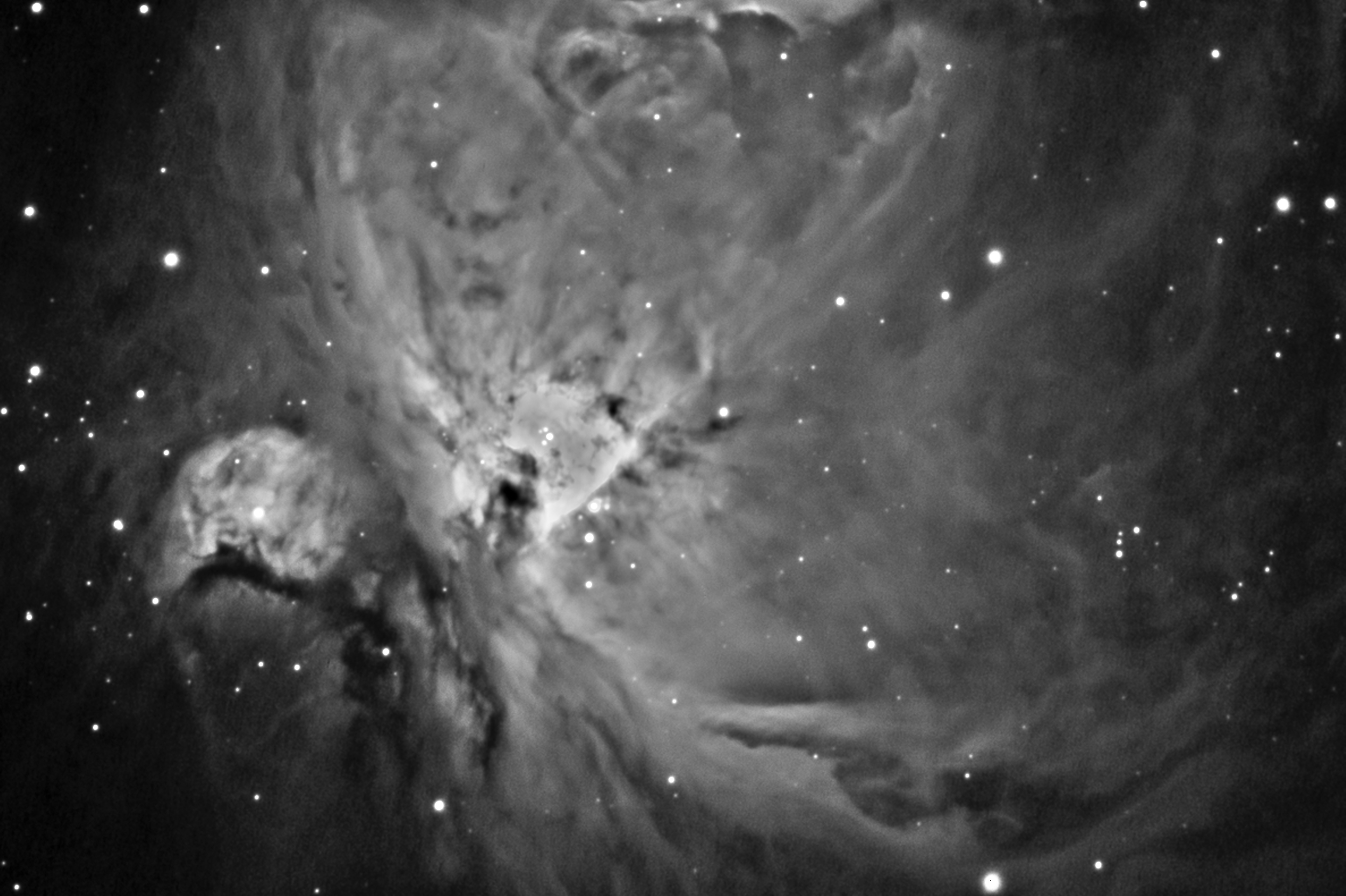
Published in October 2019, this photograph documents the Orion Nebula, also known as M42, one of the most notable nebulae visible during winter skies. The image isolates the nebula’s central region, the Trapezium, which comprises relatively young stars responsible for illuminating the surrounding nebula.
The Trapezium Region
The Trapezium forms the bright core of the Orion Nebula. The young stars concentrated in this region emit the light that causes the nebula itself to glow, making it one of the most visually distinctive features in the northern winter sky.
Technical Approach
The photograph was captured using a specialized H-alpha filter, a technique that isolates the hydrogen-alpha emission line to enhance contrast and reveal details in nebular structures. This method is widely used in astrophotography to bring out the structure and composition of emission nebulae.
Frequently asked questions
What does the designation M42 refer to?
M42 is the Messier catalog number for the Orion Nebula, a naming system that catalogues notable deep-sky objects observable from Earth.
What is the Trapezium in the Orion Nebula?
The Trapezium is the central region of the nebula composed of young stars whose light illuminates the surrounding gas cloud, making it the most luminous part of M42.
Why is an H-alpha filter used in this type of photography?
An H-alpha filter isolates specific wavelengths of light emitted by hydrogen, enhancing the visibility of nebular structures and improving contrast in astrophotographic images.
Sources
- S1 — Burnham, Robert, Jr. Burnham's Celestial Handbook: An Observer's Guide to the Universe Beyond the Solar System. Dover Publications, 1978. ISBN 978-0-486-23568-4.
- S2 — Kitchin, C. R. Astrophysical Techniques. CRC Press, 2013. ISBN 978-1-4665-1115-6.
Spotted an error? Write to editorial@culturalheritageonline.com and we correct it the same day.


